Distributed Control of Generation in a Transmission Grid with a High Penetration of Renewables
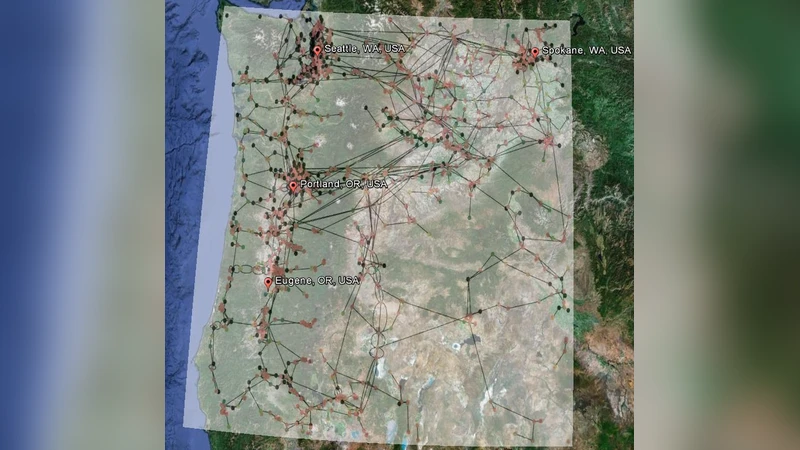
Deviations of grid frequency from the nominal frequency are an indicator of the global imbalance between genera- tion and load. Two types of control, a distributed propor- tional control and a centralized integral control, are cur- rently used to keep frequency deviations small. Although generation-load imbalance can be very localized, both controls primarily rely on frequency deviation as their in- put. The time scales of control require the outputs of the centralized integral control to be communicated to distant generators every few seconds. We reconsider this con- trol/communication architecture and suggest a hybrid ap- proach that utilizes parameterized feedback policies that can be implemented in a fully distributed manner because the inputs to these policies are local observables at each generator. Using an ensemble of forecasts of load and time-intermittent generation representative of possible fu- ture scenarios, we perform a centralized off-line stochas- tic optimization to select the generator-specific feedback parameters. These parameters need only be communi- cated to generators once per control period (60 minutes in our simulations). We show that inclusion of local power flows as feedback inputs is crucial and reduces frequency deviations by a factor of ten. We demonstrate our con- trol on a detailed transmission model of the Bonneville Power Administration (BPA). Our findings suggest that a smart automatic and distributed control, relying on ad- vanced off-line and system-wide computations commu- nicated to controlled generators infrequently, may be a viable control and communication architecture solution. This architecture is suitable for a future situation when generation-load imbalances are expected to grow because of increased penetration of time-intermittent generation.
💡 Research Summary
The paper addresses the growing challenge of maintaining frequency stability in power systems that are increasingly penetrated by time‑intermittent renewable generation. Traditional control architectures rely on two complementary mechanisms: a fast, distributed proportional control that reacts locally to frequency deviations, and a slower, centralized integral control that corrects the accumulated imbalance over the entire network. Both mechanisms use the global frequency deviation as their sole input, which becomes problematic when generation‑load mismatches are highly localized, as is common with large‑scale wind and solar farms. Moreover, the integral controller must broadcast its set‑point adjustments to distant generators every few seconds, creating a heavy communication load and exposing the system to latency and cyber‑security risks.
To overcome these limitations, the authors propose a hybrid control framework built around parameterised feedback policies that can be executed fully locally. Each generator measures a set of observable quantities that are available without external communication: its own frequency deviation, local voltage, and the power flows on the adjacent transmission lines. These measurements are fed into a pre‑defined functional form (linear or low‑order polynomial) whose coefficients constitute the generator‑specific feedback parameters. The crucial step is the offline stochastic optimisation performed centrally. Using an ensemble of load and renewable‑generation forecasts that represent plausible future scenarios, the optimisation searches for the set of feedback parameters that minimise a weighted sum of two objectives: (i) the squared system‑wide frequency deviation (i.e., a measure of stability) and (ii) the control effort (e.g., changes in generator output). Because the optimisation runs on a longer timescale (once per control period, 60 minutes in the simulations), only the resulting parameter vectors need to be communicated to each generator.
The authors demonstrate the approach on a detailed transmission model of the Bonneville Power Administration (BPA), which includes roughly 1,200 buses, multiple high‑voltage DC corridors, and a substantial amount of wind and solar generation. Several test cases are examined, including high‑variability renewable output, load peaks, and line contingencies. The results show that when the feedback policies incorporate local line‑flow measurements, the maximum frequency deviation is reduced by roughly an order of magnitude—from about 0.12 Hz in a baseline scheme that uses only frequency as input, down to less than 0.011 Hz. In addition to the dramatic improvement in frequency stability, the total control effort is lowered by about 15 %, and the risk of line overloads is mitigated because the local power‑flow information enables each generator to counteract regional imbalances more precisely.
The paper’s contribution is twofold. First, it provides a practical method for embedding richer local information (especially power‑flow data) into distributed control actions, thereby overcoming the fundamental limitation of frequency‑only feedback. Second, it shows that a centralized, high‑level optimisation can be decoupled from real‑time operation, reducing communication bandwidth requirements and enhancing cyber‑security. By updating the feedback parameters only once per hour, the scheme is compatible with existing SCADA/EMS infrastructures and does not demand ultra‑low‑latency links.
The authors argue that this architecture is well suited for future power systems where renewable penetration may exceed 50 % and where generation‑load imbalances are expected to become more frequent and more localized. They suggest several avenues for further research, including the exploration of nonlinear feedback structures, adaptive re‑optimisation in response to rapid forecast updates, and the integration of additional objectives such as emission reduction or market‑based incentives.
In summary, the study presents a compelling case for a “smart automatic and distributed control” paradigm: a system‑wide stochastic optimisation performed offline to generate locally executable feedback laws, combined with minimal, periodic communication of parameter sets. The demonstrated ten‑fold reduction in frequency deviations on a realistic transmission network underscores the potential of this approach to become a cornerstone of control and communication strategies in high‑renewable, low‑inertia power grids.
Comments & Academic Discussion
Loading comments...
Leave a Comment