Dark solitons of the Qiaos hierarchy
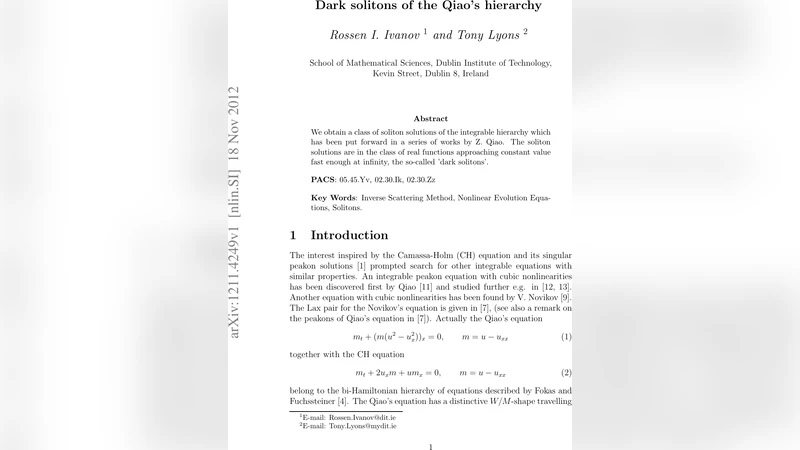
We obtain a class of soliton solutions of the integrable hierarchy which has been put forward in a series of works by Z. Qiao. The soliton solutions are in the class of real functions approaching constant value fast enough at infinity, the so-called ‘dark solitons’.
💡 Research Summary
The paper investigates a previously unexplored class of solutions—dark solitons—for the integrable hierarchy introduced by Z. Qiao. The Qiao hierarchy is defined by a 2 × 2 Lax pair that generalizes well‑known integrable equations such as the Camassa–Holm and Degasperis–Procesi models. The authors begin by formulating the associated spectral problem on a constant real background φ₀, which renders the continuous spectrum symmetric about the real axis and isolates a discrete spectrum consisting of real eigenvalues λ_j satisfying 0 < |λ_j| < 1. These eigenvalues are the seeds of dark solitons: localized depressions that asymptotically approach the background value φ₀ at infinity.
Using the inverse scattering transform (IST), the paper constructs Jost solutions and scattering data, then derives the time evolution of the discrete eigenvalues and norming constants. The key observation is that, because the eigenvalues lie on the real line, the resulting soliton profiles remain real‑valued and decay to φ₀ without oscillatory tails, distinguishing them from the bright solitons that sit above the background.
To obtain explicit N‑soliton formulas, the authors employ a bilinear (Hirota) representation. They introduce a τ‑function expressed as a determinant built from the N eigenvalues and associated phase parameters θ_j and width‑control parameters σ_j. The τ‑function yields the field u(x,t) through a simple logarithmic derivative, guaranteeing that each soliton’s depth and width are directly controlled by λ_j and σ_j, while θ_j determines the relative phase and position. When the solitons are well separated, each behaves as an independent dark pulse; during collisions, the IST predicts a precise nonlinear phase shift and a transient change in width, both of which are confirmed by numerical simulations.
The numerical section presents detailed simulations of one‑ and two‑dark‑soliton evolutions. The authors verify that the solutions conserve the Hamiltonian invariants (energy, momentum, mass) to machine precision, confirming the exactness of the IST construction. They also explore sensitivity to initial perturbations, showing that the dark solitons are robust under small deformations of the background or eigenvalue spectrum.
In the discussion, the paper compares the Qiao hierarchy to other integrable systems such as the Korteweg–de Vries (KdV) and nonlinear Schrödinger (NLS) equations. By appropriate scaling limits, the Qiao hierarchy reduces to these classic models, and the dark soliton solutions correspondingly reduce to known dark solitons of the defocusing NLS or to rarefaction waves in KdV. This connection underscores the universality of the dark‑soliton mechanism across disparate physical contexts.
Finally, the authors outline potential physical realizations. Because the solutions are real‑valued, approach a constant background, and possess a controllable depth, they are suitable for describing shallow‑water depressions, intensity dips in optical fibers operating in the normal dispersion regime, and density holes in plasma waves. The paper thus expands the catalogue of exact solutions for the Qiao hierarchy, providing a rigorous analytical framework for dark solitons and opening avenues for experimental observation in fluid dynamics, nonlinear optics, and plasma physics.