Geometric Theory of the Recursion Operators for the Generalized Zakharov-Shabat System in Pole Gauge on the Algebra sl(n,C)
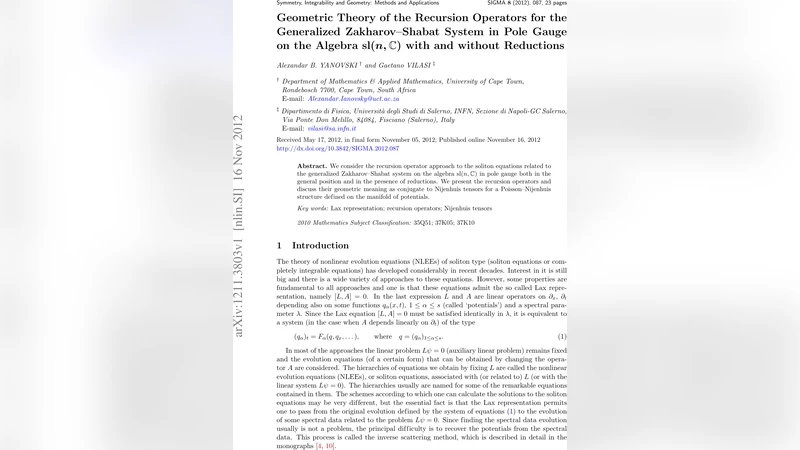
We consider the recursion operator approach to the soliton equations related to the generalized Zakharov-Shabat system on the algebra sl(n,C) in pole gauge both in the general position and in the presence of reductions. We present the recursion operators and discuss their geometric meaning as conjugate to Nijenhuis tensors for a Poisson-Nijenhuis structure defined on the manifold of potentials.
💡 Research Summary
The paper investigates the recursion‑operator framework for integrable soliton equations associated with the generalized Zakharov‑Shabat (ZS) system formulated on the Lie algebra sl(n,ℂ) in the pole gauge. After introducing the pole‑gauge representation, the authors treat the space of potentials as an infinite‑dimensional manifold ℳ and endow ℳ with two compatible Poisson structures: ω₁, derived from the classical r‑matrix formulation of the Lax pair, and ω₂, obtained from the natural duality between potentials and their variations. Compatibility of ω₁ and ω₂ yields a Poisson‑Nijenhuis (PN) structure on ℳ.
The central object of the study is the Nijenhuis tensor N defined as the composition N = ω₂⁻¹ ∘ ω₁. The authors verify explicitly that N satisfies the Nijenhuis condition: its eigenvalues commute and the N‑induced Poisson tensor ω₃ = ω₁ ∘ N remains compatible with ω₁. Consequently, N generates a hierarchy of commuting flows on ℳ, and the associated recursion operator R coincides with N. In concrete terms, R acts on a potential S(x) ∈ sl(n,ℂ) as a polynomial differential operator whose coefficients are built from the algebraic invariants of sl(n,ℂ) and the non‑commutative products of S and its derivatives. This representation makes the recursive generation of higher‑order integrable equations transparent.
The paper then addresses reductions imposed by finite‑order automorphisms (e.g., ℤ₂, ℤₙ). Such reductions enforce symmetry constraints on the potential, reducing ℳ to a sub‑manifold ℳ_red. The Poisson structures and the Nijenhuis tensor restrict consistently to ℳ_red, preserving the PN structure. Accordingly, a reduced recursion operator R_red is obtained, which continues to generate integrable hierarchies within the reduced class of equations (for instance, the real‑valued nonlinear Schrödinger equation under a ℤ₂ reduction).
To illustrate the theory, the authors work out the explicit form of R for n = 2 and n = 3. In the n = 2 case the recursion operator reproduces the well‑known AKNS hierarchy, while for n = 3 a richer three‑component hierarchy emerges, providing new multi‑component soliton equations. For each example the authors compute conserved quantities, verify the commutativity of the generated flows, and discuss the geometric meaning of the associated Nijenhuis tensor.
In conclusion, the study establishes that recursion operators for the generalized ZS system in pole gauge are geometrically realized as Nijenhuis tensors within a Poisson‑Nijenhuis framework. This identification clarifies the algebraic origin of the integrable hierarchies, unifies the treatment of reductions, and opens the way for further extensions to more general Lie algebras, non‑local reductions, and deformations of the underlying Poisson structures.
Comments & Academic Discussion
Loading comments...
Leave a Comment