Optimal Hitting Sets for Combinatorial Shapes
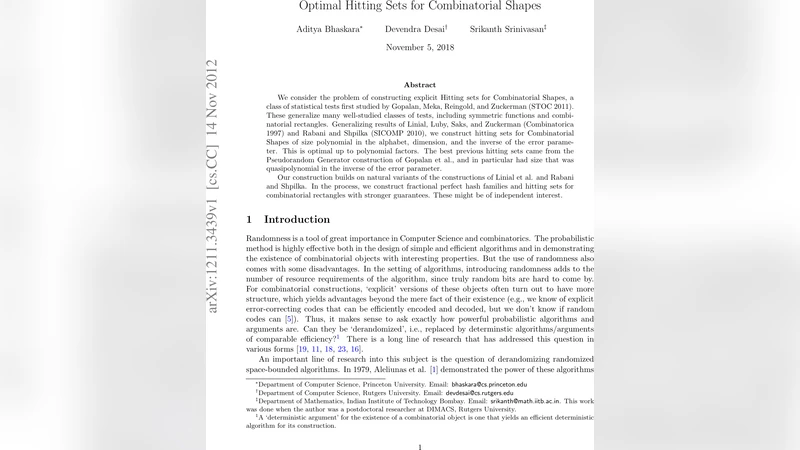
We consider the problem of constructing explicit Hitting sets for Combinatorial Shapes, a class of statistical tests first studied by Gopalan, Meka, Reingold, and Zuckerman (STOC 2011). These generalize many well-studied classes of tests, including symmetric functions and combinatorial rectangles. Generalizing results of Linial, Luby, Saks, and Zuckerman (Combinatorica 1997) and Rabani and Shpilka (SICOMP 2010), we construct hitting sets for Combinatorial Shapes of size polynomial in the alphabet, dimension, and the inverse of the error parameter. This is optimal up to polynomial factors. The best previous hitting sets came from the Pseudorandom Generator construction of Gopalan et al., and in particular had size that was quasipolynomial in the inverse of the error parameter. Our construction builds on natural variants of the constructions of Linial et al. and Rabani and Shpilka. In the process, we construct fractional perfect hash families and hitting sets for combinatorial rectangles with stronger guarantees. These might be of independent interest.
💡 Research Summary
The paper addresses the long‑standing problem of constructing explicit hitting sets for the class of combinatorial shapes, a broad family of statistical tests introduced by Gopalan, Meka, Reingold, and Zuckerman (STOC 2011). A combinatorial shape is defined by a collection of coordinate‑wise alphabet subsets (A_1,\dots,A_n\subseteq \Sigma); an input (x\in\Sigma^n) is accepted (output 1) iff (x_i\in A_i) for every coordinate. This model subsumes many well‑studied test families, including symmetric Boolean functions, combinatorial rectangles, and various product‑type predicates. A hitting set (H\subseteq \Sigma^n) must intersect every shape that accepts at least one input, and the goal is to make (|H|) as small as possible while keeping the construction explicit (polynomial‑time computable).
Prior work. The original Gopalan‑Meka‑Reingold‑Zuckerman (GMRZ) construction yields a pseudorandom generator (PRG) for combinatorial shapes. By enumerating the PRG’s seed space one obtains a hitting set, but its size is quasi‑polynomial in the error parameter (\varepsilon) (roughly (\exp(\tilde O(\log 1/\varepsilon)))). This is far from optimal when (\varepsilon) is tiny. Earlier results by Linial‑Luby‑Saks (1997) and Rabani‑Shpilka (2010) gave polynomial‑size hitting sets for the special cases of symmetric functions and combinatorial rectangles, respectively, but they were limited to the binary alphabet and did not extend to arbitrary (|\Sigma|) or to the full shape class.
Our contributions. The authors present a construction that achieves a hitting set of size \
Comments & Academic Discussion
Loading comments...
Leave a Comment