New observations in transient hydrodynamic perturbations. Frequency jumps, intermediate term and spot formation
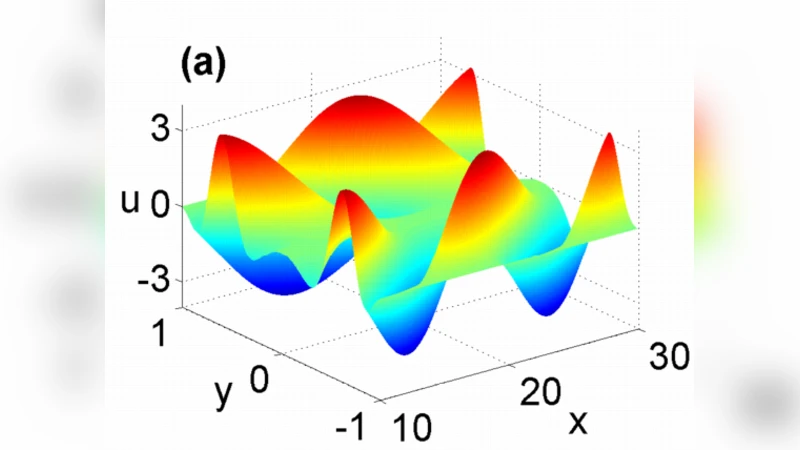
Sheared incompressible flows are usually considered non-dispersive media. As a consequence, the frequency evolution in transients has received much less attention than the wave energy density or growth factor. By carrying out a large number of long term transient simulations for longitudinal, oblique and orthogonal perturbations in the plane channel and wake flows, we could observe a complex time evolution of the frequency. The complexity is mainly associated to jumps which appear quite far along within the transients. We interpret these jumps as the transition between the early transient and the beginning of an intermediate term that reveals itself for times large enough for the influence of the fine details of the initial condition to disappear. The intermediate term leads to the asymptotic exponential state and has a duration one order of magnitude longer than the early term, which indicates the existence of an intermediate asymptotics. Since after the intermediate term perturbations die out or blowup, the mid-term can be considered as the most probable state in the perturbation life. Long structured transients can be related to the spot patterns commonly observed in subcritical transitional wall flows. By considering a large group of 3D waves in a narrow range of wavenumbers, we superposed them in a finite temporal window with oblique and longitudinal waves randomly delayed with respect to an orthogonal wave which is supposed to sustain the spot formation with its intense transient growth. We show that in this way it is possible to recover the linear initial evolution of the pattern characterized by the presence of longitudinal streaks. We also determined the asymptotic frequency and phase speed wavenumber spectra for the channel and wake flows. The mild dispersion observed can in part explain the different propagation speeds of the backward and forward fronts of the spot.
💡 Research Summary
The paper investigates the temporal evolution of the frequency of three‑dimensional perturbations in two canonical shear flows: the plane Poiseuille (channel) flow and the plane bluff‑body wake. While incompressible shear flows are traditionally treated as non‑dispersive, the authors focus on the largely neglected frequency dynamics during transients. They formulate an initial‑value problem (IVP) that allows arbitrary initial disturbances—specified only by their symmetry (symmetric or antisymmetric) and wall‑normal distribution—without resorting to eigenfunction expansions. The governing linearized Navier‑Stokes equations are expressed in terms of vorticity and velocity, and solved using a Fourier–Fourier transform for the channel (homogeneous in streamwise and spanwise directions) and a Laplace–Fourier transform for the wake (homogeneous in spanwise direction, weakly inhomogeneous in streamwise direction).
Key diagnostic quantities are the kinetic‑energy density e(t;α,γ), its amplification factor G(t)=e(t)/e(0), the instantaneous growth rate r(t)=½ log e(t)/t, and the frequency ω(t)=dθ/dt, where θ is the unwrapped phase of the wall‑normal velocity component. By tracking ω(t) at a fixed wall‑normal location, the authors reveal a three‑stage evolution of each perturbation:
- Early transient – dominated by the fine details of the initial condition. Energy grows algebraically, and the frequency fluctuates irregularly.
- Intermediate transient – a newly identified stage lasting roughly an order of magnitude longer than the early stage. During this period the influence of the initial condition wanes, the perturbation reorganises under the base shear, and a striking “frequency jump” occurs: the instantaneous frequency abruptly shifts to a new value before settling. This jump is typically preceded and followed by small oscillations. The intermediate stage bridges the early algebraic growth and the final exponential behaviour.
- Asymptotic exponential stage – the frequency stabilises at a constant value, and the perturbation either grows or decays exponentially according to the dominant eigenmode.
A particularly important finding concerns orthogonal perturbations (wave‑vector perpendicular to the base flow, φ = 90°). These disturbances exhibit exceptionally long intermediate transients and very strong transient amplification (or, at low Reynolds numbers, a very slow monotonic decay). The authors argue that such orthogonal waves act as the “seed” for turbulent spots observed in subcritical wall‑bounded shear flows.
To connect the linear analysis with the experimentally observed spot phenomenon, the authors construct a synthetic spot by linearly superposing a large ensemble of three‑dimensional waves whose streamwise and spanwise wavenumbers lie in a narrow band (k≈0.5–2). The ensemble includes an orthogonal wave (the seed) and many oblique waves with random time delays within a finite temporal window (≈10 flow‑time units). The resulting field reproduces the early linear development of a spot: longitudinal streaks appear first, followed by a spreading pattern reminiscent of observed turbulent spots. This demonstrates that the long intermediate transient of orthogonal waves, combined with the presence of nearby oblique modes, can generate the characteristic spot structure without invoking nonlinear interactions.
The authors also examine the dispersion characteristics of the asymptotic waves. By computing the frequency ω(k, φ) and phase speed c = ω/k for a range of Reynolds numbers (Re = 500 and 10 000 for the channel; Re = 50 and 100 for the wake), they find a mild dispersion: for long‑wavelength oblique and longitudinal waves the frequency varies only slightly with k, but enough to produce different phase speeds for forward‑ and backward‑propagating components of a spot. This weak dispersion offers a plausible linear explanation for the experimentally reported asymmetry between the spot’s leading and trailing edges (the rear moves slower than the front).
In summary, the paper makes three major contributions:
- Identification of a frequency‑jump phenomenon that marks the transition from early algebraic growth to the intermediate regime, establishing the existence of a distinct intermediate asymptotic stage in linear shear‑flow transients.
- Demonstration that orthogonal perturbations possess unusually long intermediate transients and strong transient growth, positioning them as key players in the formation of turbulent spots.
- Construction of a linear superposition model that reproduces the early evolution of spot patterns, linking the linear transient dynamics to observable flow structures, and providing evidence that mild dispersion can account for the differing propagation speeds of spot fronts and backs.
These results broaden the understanding of transient dynamics in shear flows, challenge the conventional view of incompressible flows as strictly non‑dispersive, and suggest new pathways for interpreting and predicting spot formation in both wall‑bounded and free shear flows.
Comments & Academic Discussion
Loading comments...
Leave a Comment