On Sensor Network Localization Using SDP Relaxation
A Semidefinite Programming (SDP) relaxation is an effective computational method to solve a Sensor Network Localization problem, which attempts to determine the locations of a group of sensors given t
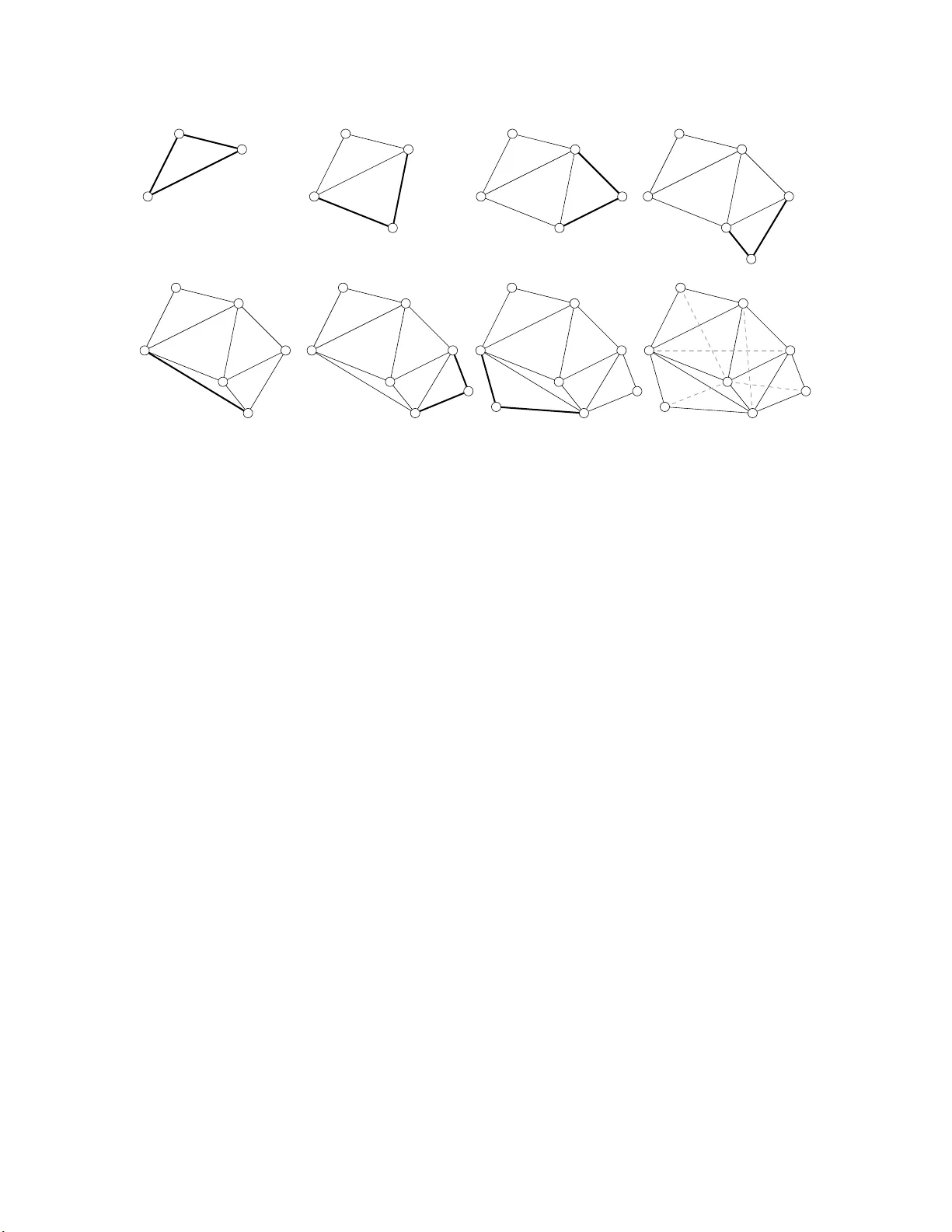
A Semidefinite Programming (SDP) relaxation is an effective computational method to solve a Sensor Network Localization problem, which attempts to determine the locations of a group of sensors given the distances between some of them [11]. In this paper, we analyze and determine new sufficient conditions and formulations that guarantee that the SDP relaxation is exact, i.e., gives the correct solution. These conditions can be useful for designing sensor networks and managing connectivities in practice. Our main contribution is twofold: We present the first non-asymptotic bound on the connectivity or radio range requirement of the sensors in order to ensure the network is uniquely localizable. Determining this range is a key component in the design of sensor networks, and we provide a result that leads to a correct localization of each sensor, for any number of sensors. Second, we introduce a new class of graphs that can always be correctly localized by an SDP relaxation. Specifically, we show that adding a simple objective function to the SDP relaxation model will ensure that the solution is correct when applied to a triangulation graph. Since triangulation graphs are very sparse, this is informationally efficient, requiring an almost minimal amount of distance information. We also analyze a number objective functions for the SDP relaxation to solve the localization problem for a general graph.
💡 Research Summary
This paper investigates the exactness of Semidefinite Programming (SDP) relaxations for the Sensor Network Localization (SNL) problem, where the goal is to recover the positions of a set of sensors from a subset of pairwise distance measurements. While SDP relaxations are known to be powerful in practice, prior theoretical guarantees have largely relied on asymptotic, probabilistic arguments that assume large, randomly placed networks with high average degree. The authors address this gap by providing two concrete, non‑asymptotic contributions that are directly applicable to network design.
First, they derive an explicit bound on the radio range (or connectivity radius) required for a network of any size to be uniquely localizable. Using tools from random geometric graph theory, they prove that if each sensor’s transmission radius r satisfies
\
📜 Original Paper Content
🚀 Synchronizing high-quality layout from 1TB storage...