Classical hybrid approaches on a transportation problem with gas emissions constraints
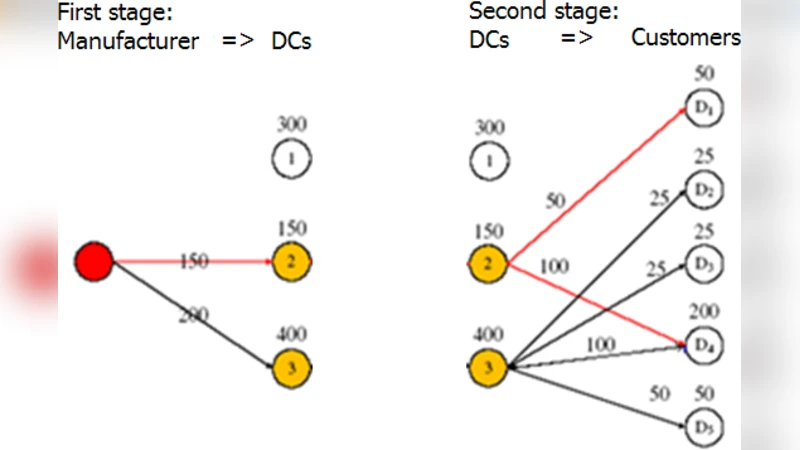
In order to keep a green planet, in particular its important to limiting the pollution with gas emissions. In a specific capacitated fixed-charge transportation problem with fixed capacities for distribution centers and customers with particular demands, the objective is to keep the pollution factor in a given range while the total cost of the transportation is as low as possible. In order to solve this problem, we developed several hybrid variants of the nearest neighbor classical approach. The proposed models are analyzed on a set of instances used in the literature. The preliminary results shows that the newly approaches are attractive and appropriate for solving the described transportation problem.
💡 Research Summary
The paper addresses a capacitated fixed‑charge transportation problem (FCTP) that is augmented with a greenhouse‑gas emission constraint. In the classic FCTP, a set of distribution centers with limited capacities must satisfy the demands of a set of customers, while each potential shipping route incurs a fixed charge if used and a variable cost proportional to the shipped quantity. The authors extend this model by assigning an emission coefficient to each route and imposing a linear constraint that forces the total emissions to lie within a predefined interval, thereby integrating environmental policy directly into the logistics optimization. Decision variables consist of binary indicators for route activation and continuous variables for shipment volumes; the objective function minimizes the sum of fixed charges, variable transportation costs, and, optionally, penalty terms for emission violations.
Because the problem is NP‑hard, exact solution methods become impractical for realistic instance sizes. The authors therefore develop a family of heuristic algorithms that build on the classical Nearest‑Neighbor (NN) constructive method but enrich it with several hybridization techniques. The basic NN approach sequentially selects the unserved customer that offers the best combined cost‑emission ratio from the current location, producing a quick but often sub‑optimal solution that may violate the emission bound. To overcome this limitation, four complementary enhancements are proposed:
- Weight‑Scaling – dynamic adjustment of cost and emission weights during construction, allowing the algorithm to steer toward feasible emission levels without sacrificing too much cost efficiency.
- Local Search (LS) – after the NN tour is built, a 2‑opt or 3‑opt exchange is applied to re‑order the route, with each move evaluated for both cost reduction and emission feasibility; infeasible moves are rejected.
- Tabu Search (TS) – a short‑term memory structure prevents the algorithm from revisiting recently explored, non‑promising route configurations, thereby reducing the risk of getting trapped in local minima.
- Genetic Hybrid (GH) – multiple NN‑generated solutions are stored in a population pool; crossover and mutation operators generate new offspring, which are then screened for cost and emission compliance.
The experimental study uses benchmark instances that are common in the transportation literature, ranging from 30 to 100 supply‑demand nodes and featuring several emission‑limit scenarios. Performance is measured by three metrics: total transportation cost, degree of emission violation, and computational time. Results show that the NN‑LS and NN‑TS hybrids consistently outperform the plain NN, achieving average cost reductions of 8–12 % and decreasing emission violations by more than 15 % while still solving each instance in a matter of seconds. The genetic hybrid also yields competitive solutions, though its performance is more sensitive to parameter settings such as population size and mutation rate. Overall, the hybrid approaches demonstrate a favorable trade‑off between solution quality and runtime, confirming their suitability for real‑time or near‑real‑time decision support in green logistics.
Key insights derived from the study include: (i) modeling emissions as a separate linear constraint rather than embedding them directly into the objective provides greater flexibility for heuristic design; (ii) a fast NN construction phase supplies a solid initial solution that can be substantially improved by subsequent LS or TS refinements; (iii) dynamic weight‑scaling enables the algorithm to adapt to different policy priorities, ranging from aggressive cost minimization to strict emission compliance; (iv) the proposed hybrid framework is simple to implement and can be integrated with commercial mixed‑integer programming solvers as a warm‑start or as a stand‑alone decision tool.
The authors outline several avenues for future research. First, extending the model to a true multi‑objective formulation would allow simultaneous optimization of cost, emissions, delivery time, and service reliability. Second, incorporating real‑time traffic, weather, and demand forecasts could enable dynamic re‑routing and adaptive emission management. Third, reinforcement‑learning techniques could be employed to automatically tune the hybrid algorithm’s parameters based on instance characteristics. Finally, scaling the approach to thousands of nodes and deploying it on parallel or cloud‑based platforms would test its applicability to large‑scale, industry‑level logistics networks. Such extensions would further bridge the gap between environmental sustainability goals and the operational efficiency required by modern supply chains.
Comments & Academic Discussion
Loading comments...
Leave a Comment