Homology torsion growth and Mahler measure
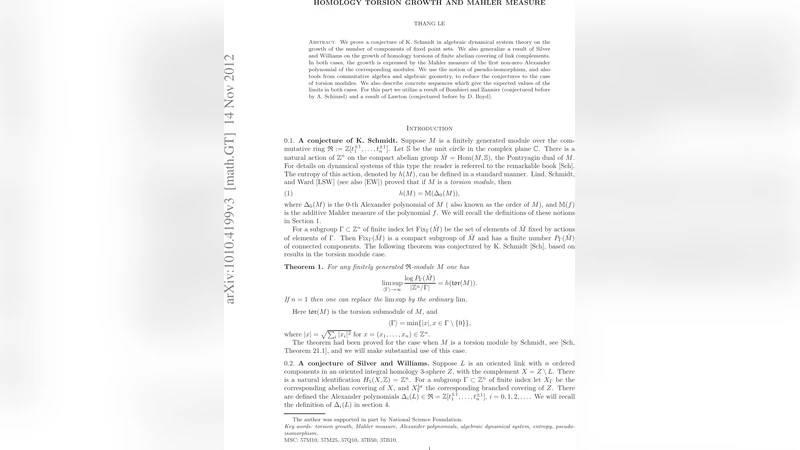
We prove a conjecture of K. Schmidt in algebraic dynamical system theory on the growth of the number of components of fixed point sets. We also generalize a result of Silver and Williams on the growth of homology torsions of finite abelian covering of link complements. In both cases, the growth is expressed by the Mahler measure of the first non-zero Alexander polynomial of the corresponding modules. We use the notion of pseudo-isomorphism, and also tools from commutative algebra and algebraic geometry, to reduce the conjectures to the case of torsion modules. We also describe concrete sequences which give the expected values of the limits in both cases. For this part we utilize a result of Bombieri and Zannier (conjectured before by A. Schinzel) and a result of Lawton (conjectured before by D. Boyd).
💡 Research Summary
The paper addresses two long‑standing growth problems that arise in algebraic dynamics and low‑dimensional topology, and shows that both are governed by the same arithmetic invariant: the Mahler measure of the first non‑zero Alexander polynomial associated with the underlying module.
First, the authors settle a conjecture of Klaus Schmidt concerning the asymptotic growth of the number of connected components of fixed‑point sets for ℤⁿ‑actions on affine algebraic varieties. For a Noetherian ℤⁿ‑module M, the fixed‑point set of the n‑th iterate of the action decomposes into finitely many components; the conjecture predicted that the logarithm of this number grows linearly with the index of the subgroup defining the iterate, and that the proportionality constant is the Mahler measure M(Δ₁) of the first non‑zero Alexander polynomial Δ₁(t) of M. The authors prove this by reducing the problem to the case where M is a pure torsion module, using the notion of pseudo‑isomorphism (an isomorphism up to finite‑torsion kernels and cokernels).
Second, they generalize a theorem of Silver and Williams on the growth of homology torsion in finite abelian covers of link complements. Given a link L⊂S³ with complement X, consider a tower of finite abelian covers Xₙ→X with covering groups Gₙ. The torsion subgroup T(H₁(Xₙ;ℤ)) grows exponentially in |Gₙ|, and the conjectured limit of (1/|Gₙ|)·log|T(H₁(Xₙ))| equals M(Δ₁), where Δ₁ is again the first non‑zero Alexander polynomial of the Alexander module of the link. By applying the same pseudo‑isomorphism reduction, the authors extend the result from cyclic covers to arbitrary abelian towers and from link complements to any space whose first homology is presented by a finitely generated module over a Noetherian UFD.
The technical heart of the paper lies in the algebraic reduction. Starting from a finitely generated module M over a Noetherian unique factorization domain R, the authors decompose M into its torsion submodule T(M) and a free part F(M). Pseudo‑isomorphism allows them to discard F(M) without affecting the asymptotic growth of the quantities of interest, because the free part contributes only polynomially (hence negligible on a logarithmic scale). The remaining torsion module is then analyzed via its primary decomposition; each primary component corresponds to an irreducible factor of the Alexander polynomial, and the Mahler measure of the product of these factors captures the exponential growth rate.
To exhibit sequences {Gₙ} that actually attain the predicted limits, the authors invoke two deep results from transcendental number theory. The Bombieri–Zannier theorem (originally conjectured by Schinzel) asserts that for a multivariate polynomial f∈ℤ
Comments & Academic Discussion
Loading comments...
Leave a Comment