A Novel Approach to Fully Private and Secure Auction: A Sealed Bid Knapsack Auction
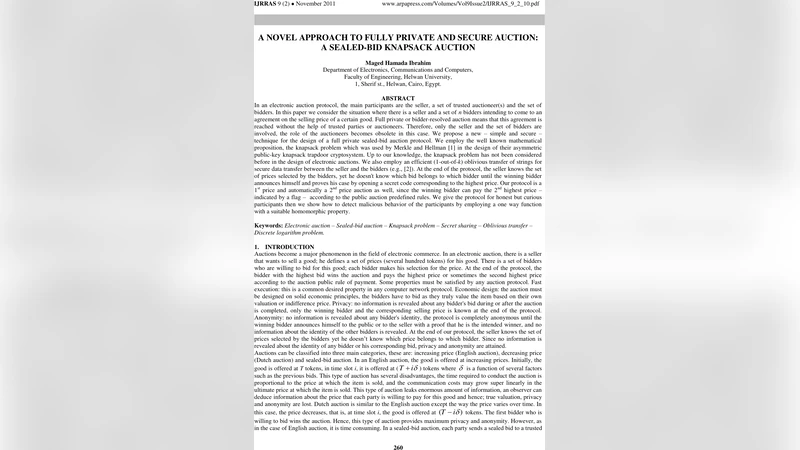
In an electronic auction protocol, the main participants are the seller, a set of trusted auctioneer(s) and the set of bidders. In this paper we consider the situation where there is a seller and a set of n bidders intending to come to an agreement on the selling price of a certain good. Full private or bidder-resolved auction means that this agreement is reached without the help of trusted parties or auctioneers. Therefore, only the seller and the set of bidders are involved, the role of the auctioneers becomes obsolete in this case. property.We propose a new technique for the design of a full private sealed-bid auction protocol.
💡 Research Summary
The paper proposes a sealed‑bid auction protocol that eliminates the need for a trusted auctioneer, allowing only the seller and a set of n bidders to determine the selling price while preserving full privacy. The core of the design is a knapsack‑based public‑key cryptosystem built on a super‑increasing sequence of weights W = {w₁,…,w_k} and a modulus M (typically M = ∑w_i + 1). In the registration phase the seller publishes W and M to all participants.
Each bidder encodes his monetary offer p as a binary vector b = (b₁,…,b_k) (for example, p = ∑b_i·2^{i‑1}). The bidder then computes a knapsack ciphertext C = ∑b_i·w_i (mod M). Because the weight sequence is super‑increasing, the mapping p ↦ C is one‑way: without knowledge of the secret key (the exact weight values) it is computationally infeasible to recover b or p from C. The bidder sends only C to the seller, never revealing the actual price.
After collecting all ciphertexts {C₁,…,C_n}, the seller identifies the largest ciphertext C_max. Using the secret key (the inverse of the knapsack transformation), the seller performs a simple linear scan of W to reconstruct the binary vector b_max corresponding to C_max, and thus recovers the highest bid p_max. No pairwise comparisons of plaintext bids are required; the winner is determined directly from the encrypted data.
The protocol claims three security properties. First, bid privacy: the ciphertext leaks no information about the underlying price because solving the subset‑sum problem for a super‑increasing sequence is NP‑hard. Second, integrity: any tampering with a ciphertext results in an invalid binary vector during decryption, which can be detected immediately. Third, fairness: all bidders use the same public parameters, and the protocol proceeds in synchronized rounds, preventing any participant from gaining a timing advantage. Optional zero‑knowledge proofs can be added so that bidders can verify that their ciphertexts were correctly formed without revealing the bids.
Despite its elegance, the approach inherits known weaknesses of knapsack cryptography. Super‑increasing knapsacks are vulnerable to lattice‑reduction attacks when the density of the knapsack is not sufficiently low. The paper mitigates this by recommending large weight sizes and adding random auxiliary parameters, but it does not provide concrete guidelines for choosing safe parameters. Moreover, the initial distribution of W and M must be protected; a man‑in‑the‑middle attack during this phase would compromise the entire auction. The protocol also assumes that bidders do not collude to exchange ciphertexts and perform a collective subset‑sum analysis, an attack vector that is not addressed.
From an operational perspective, the size of each ciphertext grows linearly with the number of bits needed to represent the maximum bid (typically 128–256 bits). In large‑scale auctions with thousands of participants, the total communication overhead becomes O(n·k), which is manageable but non‑trivial. Decryption on the seller side remains linear in k, so computational cost is modest. The authors argue that the lightweight nature of the algorithm makes it suitable for cloud or IoT environments where resources are constrained.
The paper concludes by suggesting future work: systematic parameter selection based on empirical resistance to lattice attacks, decentralized key‑distribution mechanisms (e.g., blockchain‑based public‑key registries), incorporation of stronger anti‑collusion measures, and extensive performance testing on real‑world auction platforms. In summary, the work introduces a novel, auctioneer‑free sealed‑bid scheme that leverages the mathematical properties of knapsack problems to achieve privacy and correctness, but practical deployment will require careful attention to cryptographic robustness, key management, and scalability.
Comments & Academic Discussion
Loading comments...
Leave a Comment