Factors influencing E-commerce Adoption by Retailers in Saudi Arabia
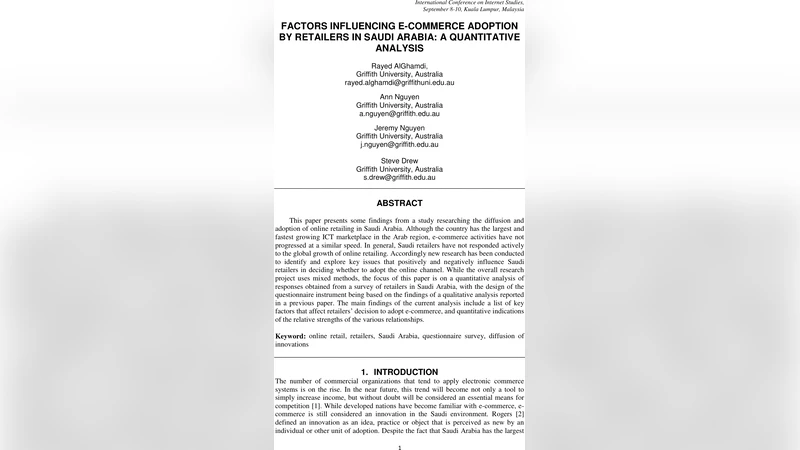
This paper presents some findings from a study researching the diffusion and adoption of online retailing in Saudi Arabia. Although the country has the largest and fastest growing ICT marketplace in the Arab region, e-commerce activities have not progressed at a similar speed. In general, Saudi retailers have not responded actively to the global growth of online retailing. Accordingly new research has been conducted to identify and explore key issues that positively and negatively influence Saudi retailers in deciding whether to adopt the online channel. While the overall research project uses mixed methods, the focus of this paper is on a quantitative analysis of responses obtained from a survey of retailers in Saudi Arabia, with the design of the questionnaire instrument being based on the findings of a qualitative analysis reported in a previous paper. The main findings of the current analysis include a list of key factors that affect retailers decision to adopt e-commerce, and quantitative indications of the relative strengths of the various relationships.
💡 Research Summary
The paper investigates why the rapid growth of information and communication technology (ICT) in Saudi Arabia has not been matched by a comparable expansion of e‑commerce among local retailers. Drawing on a mixed‑methods approach, the authors first conducted qualitative interviews with a small sample of retailers to identify potential facilitators and barriers to online channel adoption. These insights informed the design of a structured questionnaire that was administered to a nationwide sample of 300 retail firms, yielding 267 valid responses for quantitative analysis.
Using an integrated conceptual framework that combines elements of the Technology Acceptance Model (TAM), Diffusion of Innovation (DOI) theory, and a set of organizational, environmental, cultural, and institutional variables, the study applied structural equation modeling (SEM) to test the hypothesized relationships. The results reveal that two factors exert the strongest positive influence on retailers’ intention to adopt e‑commerce: the perceived adequacy of ICT infrastructure (β = 0.38) and consumer trust in online transactions (β = 0.34). Both reflect the critical role of reliable internet connectivity, payment gateways, and logistics networks, as well as the importance of security and privacy assurances for Saudi shoppers.
Conversely, two variables significantly hinder adoption: entrenched traditional business practices (β = ‑0.29) and legal‑institutional uncertainty (β = ‑0.26). The former captures the cultural preference for face‑to‑face commerce, while the latter points to ambiguous regulations, weak consumer‑protection legislation, and unclear tax or customs policies that increase perceived risk for firms.
The study also uncovers moderating effects. Top‑management support does not directly increase adoption intention but amplifies the impact of other determinants; when executives actively champion digital strategies and allocate resources, the positive effects of infrastructure and internal IT capability become stronger. Internal IT capability itself positively interacts with infrastructure readiness, suggesting that firms with skilled staff and robust internal systems can better leverage existing technological assets.
Policy implications are clear. Saudi authorities should prioritize the development of a cohesive e‑commerce ecosystem: invest in logistics hubs, standardize electronic payment systems, and enact transparent, enforceable e‑commerce regulations that protect consumers and reduce business risk. Simultaneously, retailers need to cultivate executive commitment to digital transformation, enhance staff training, and adopt recognized security certifications to build consumer confidence.
In conclusion, the diffusion of e‑commerce among Saudi retailers is a multifaceted process that depends not only on the availability of technical infrastructure but also on cultural attitudes, legal clarity, and organizational readiness. By quantifying the relative strength of each factor, the paper provides a robust empirical foundation for both policymakers and business leaders aiming to accelerate the digital commerce transition in Saudi Arabia and comparable emerging markets.