Impact of a Liquid Drop on a Granular Medium: inertia, viscosity and surface tension effects on the drop deformation
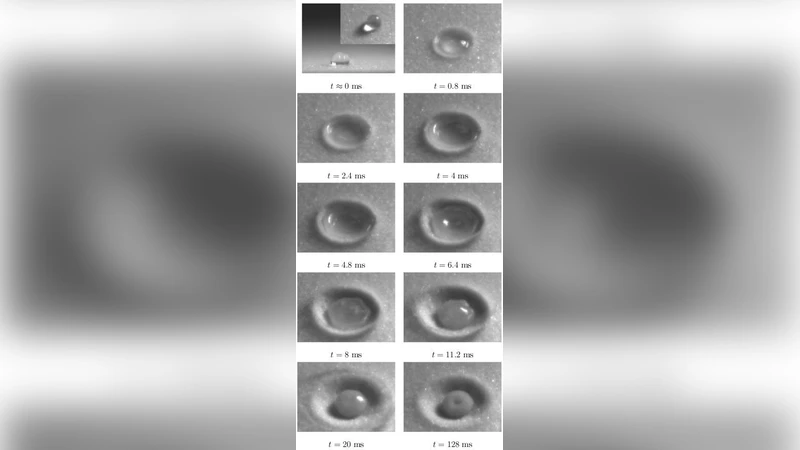
An experimental study of liquid drop impacts on a granular medium is proposed. Four fluids were used to vary physical properties: pure distilled water, water with glycerol at 2 concentrations 1:1 and 1:2 v/v and water with Tween 20 at the concentration of 0.1g/l. The drop free fall height was varied to obtain a Weber number (We) between 10 and 2000. Results showed that obtained crater morphologies highly depend on the impacting drop kinetic energy E_{K}. Different behaviours during the drop spreading, receding and absorption are highlighted as function of the fluids viscosity and surface tension. Experimental absorption times are also commented and compared with a simplified theoretical model. Drops maximal extensions and craters diameters were found to scale as $We^{1/5}$ and $E_K^{1/5}$ respectively. In both cases, found dependencies are smaller than those reported in literature: $We^{1/4}$ for drop impacts on solid or granular surfaces and $E_K^{1/4}$ for spherical solid impacts on granular media.
💡 Research Summary
This paper presents a systematic experimental investigation of liquid‑drop impacts on a granular substrate, focusing on how inertia, viscosity, and surface tension govern drop deformation, spreading, receding, and eventual absorption. Four test fluids were employed: pure distilled water, two water‑glycerol mixtures (1:1 and 1:2 by volume), and water containing Tween 20 at 0.1 g L⁻¹. By varying the drop release height, the authors achieved Weber numbers (We) ranging from 10 to 2000, thereby spanning a wide spectrum of the ratio between inertial and capillary forces. The impact kinetic energy (E_K) was correspondingly tuned, allowing the authors to explore scaling relationships over more than two orders of magnitude.
High‑speed imaging captured the full temporal evolution of each impact, from initial contact through maximum spread, subsequent recoil, and final absorption into the granular bed. The granular medium consisted of uniformly sized glass beads (diameter ≈ 300 µm) loosely packed to a bulk density of ~1.5 g cm⁻³, providing a reproducible yet intrinsically heterogeneous target.
Key findings are as follows:
-
Crater morphology is energy‑controlled. At low E_K the resulting crater is shallow and roughly circular; as E_K increases the crater deepens and widens, adopting a conical shape. The crater diameter D_c scales with impact energy as D_c ∝ E_K^{1/5}. This exponent is significantly lower than the D_c ∝ E_K^{1/4} law reported for solid spheres impacting granular beds, indicating that a substantial fraction of the kinetic energy is dissipated in grain rearrangement and inter‑particle friction rather than being transferred to bulk displacement.
-
Drop spread follows a reduced Weber scaling. The maximum radial extension of the liquid sheet, R_max, obeys R_max ∝ We^{1/5}. Classical studies of drops impacting solid or liquid surfaces typically report R_max ∝ We^{1/4}. The deviation again reflects the additional energy sink provided by the porous substrate, which absorbs part of the inertial impulse through capillary infiltration and grain motion.
-
Viscosity and surface tension modulate the three dynamical phases. High‑viscosity glycerol‑rich drops exhibit markedly suppressed spreading, negligible recoil, and prolonged absorption times (up to several seconds). Low‑viscosity water spreads rapidly, recoils strongly, and is absorbed within a few hundred milliseconds. Adding Tween 20 reduces surface tension, which accelerates spreading but does not significantly alter absorption time because the viscous resistance remains dominant.
-
Absorption time can be captured by a simple balance model. The authors propose a scaling t_abs ∝ μ^{α} σ^{β} E_K^{γ}, where μ is dynamic viscosity and σ is surface tension. Fitting experimental data yields exponents α ≈ 0.8, β ≈ ‑0.2, and γ ≈ 0.2, leading to predictions within 20 % of measured values. This model treats absorption as a competition between viscous drainage into the pore network and capillary suction, with inertial contribution entering through E_K.
-
Qualitative observations of splashing and asymmetric crater formation. Low‑viscosity drops generate fine splashing jets upon impact, whereas high‑viscosity drops do not. Local variations in bead packing produce asymmetries in crater walls, suggesting that microscale heterogeneity can influence macroscopic scaling, especially at the lower end of the energy range.
The paper concludes that liquid‑drop impacts on granular media obey distinct scaling laws compared with impacts on rigid or smooth liquid surfaces. The reduced exponents (1/5 instead of 1/4) underscore the importance of energy dissipation mechanisms unique to porous, deformable substrates. These insights have practical relevance for agricultural spray applications, erosion modeling, planetary science (e.g., meteoroid‑soil interactions), and the design of industrial processes involving liquid injection into powders.
Future work is suggested to explore the role of particle size distribution, bed compaction, and fluid rheology beyond Newtonian behavior, as well as to employ higher‑resolution imaging and three‑dimensional reconstruction techniques to refine the theoretical description of drop‑granular coupling.
Comments & Academic Discussion
Loading comments...
Leave a Comment