Random Sequences from Primitive Pythagorean Triples
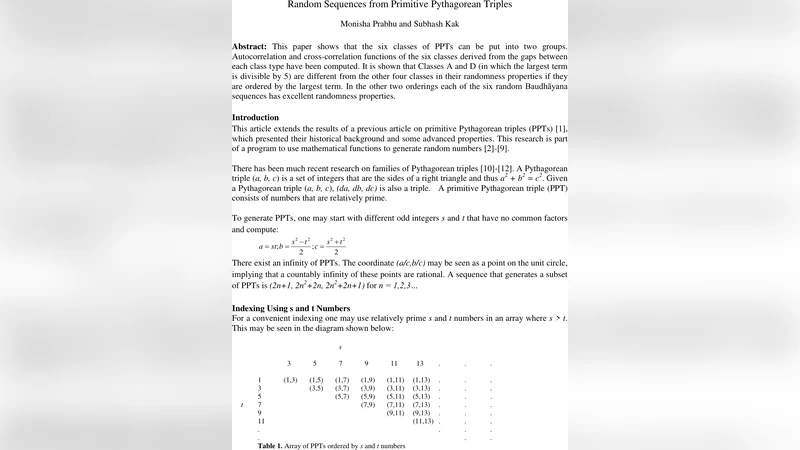
This paper shows that the six classes of PPTs can be put into two groups. Autocorrelation and cross-correlation functions of the six classes derived from the gaps between each class type have been computed. It is shown that Classes A and D (in which the largest term is divisible by 5) are different from the other four classes in their randomness properties if they are ordered by the largest term. In the other two orderings each of the six random Baudhayana sequences has excellent randomness properties.
💡 Research Summary
The paper investigates the generation of binary‑like random sequences from primitive Pythagorean triples (PPTs) and evaluates their statistical randomness. A PPT is an integer triple (a, b, c) with a² + b² = c², a < b < c, and gcd(a,b,c)=1. Using the classical parametrisation (m² − n², 2mn, m² + n²) with coprime m > n of opposite parity, the authors recall the six well‑known equivalence classes (A–F) originally identified by Baudhāyana and later formalised in modern number‑theoretic literature. The classification depends on which of the three sides is divisible by the small primes 3, 4, or 5; for example, class A consists of triples whose hypotenuse c is a multiple of 5, while class D contains triples where the smallest side a is a multiple of 5.
The central methodological step is to impose an ordering on the infinite set of PPTs and to study the gaps between consecutive triples in that order. Three distinct orderings are examined: (i) by increasing hypotenuse c, (ii) by increasing smallest side a, and (iii) by increasing middle side b. For each ordering the authors compute the difference sequence Δ_i = x_{i+1} − x_i where x_i denotes the chosen side (c, a, or b). These positive integer gaps are then mapped to a binary (or multi‑level) alphabet, producing what the authors call “Baudhayana sequences”. The mapping used in the main experiments is a simple parity conversion (Δ_i mod 2 → {0,1}), but the analysis is deliberately kept agnostic to the exact coding, focusing instead on the statistical structure of the gap series.
To assess randomness the paper calculates both autocorrelation R_{xx}(τ) = E
Comments & Academic Discussion
Loading comments...
Leave a Comment