The Effects of Website Quality on Adoption of E-Government Service: AnEmpirical Study Applying UTAUT Model Using SEM
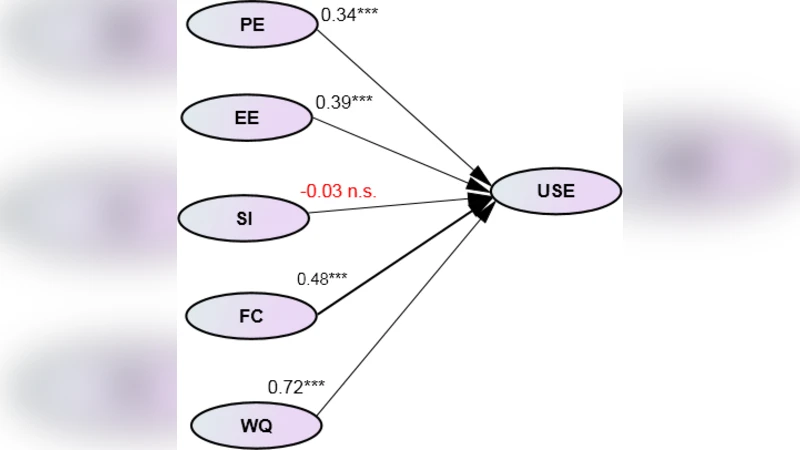
In today global age, e-government services have become the main channel for online communication between the government and its citizens. They aim to provide citizens with more accessible, accurate, real-time and high quality services. Therefore, the quality of government websites which provide e-services is an essential factor in the successful adoption of e-government services by the public. This paper discusses an investigation of the effect of the Website Quality (WQ) factor on the acceptance of using e-government services (G2C) in the Kingdom of Saudi Arabia (KSA) by adopting the Unified Theory of Acceptance and Use of Technology (UTAUT) Model. Survey Data collected from 400 respondents were examined using the structural equation modelling (SEM) technique and utilising AMOS tools. This study found that the factors that significantly influenced the Use Behaviour of e-government services in KSA (USE) include Performance Expectancy (PE), Effort expectancy (EE), Facilitating Conditions (FC) and Website Quality (WQ), while the construct known Social Influence (SI) did not. Moreover, the results confirm the importance of quality government websites and support systems as one of the main significant and influential factors of e-government services adoption. The results of this study can be helpful to Saudi governmental sectors to adjust their corporate strategies and plans to advance successful adoption and diffusion of e-government services (G2C) in KSA.
💡 Research Summary
The paper investigates how the quality of government websites influences citizens’ adoption of e‑government services (G2C) in the Kingdom of Saudi Arabia (KSA) by extending the Unified Theory of Acceptance and Use of Technology (UTAUT) model with a new construct, Website Quality (WQ). A structured questionnaire was administered to 400 Saudi citizens representing a balanced mix of gender, age (18‑60), and education levels. The survey incorporated the four traditional UTAUT constructs—Performance Expectancy (PE), Effort Expectancy (EE), Social Influence (SI), and Facilitating Conditions (FC)—and added five WQ items covering information accuracy, system reliability, user‑interface design, accessibility, and security.
Data were processed in AMOS 24 using structural equation modelling (SEM). Measurement model validation confirmed high reliability (Cronbach’s α > 0.78, Composite Reliability > 0.78) and convergent validity (AVE > 0.55). Discriminant validity was established through the Fornell‑Larcker criterion and HTMT ratios below 0.85. The structural model displayed excellent fit (χ²/df = 1.84, CFI = 0.96, TLI = 0.95, RMSEA = 0.045, SRMR = 0.042).
Hypothesis testing revealed that PE (β = 0.312, p < 0.001), EE (β = 0.274, p < 0.001), FC (β = 0.221, p < 0.01), and the newly introduced WQ (β = 0.198, p < 0.01) all have significant positive effects on the Use Behaviour (USE) of e‑government services. Social Influence, however, was not significant (β = 0.043, p > 0.05). These results suggest that Saudi citizens are primarily driven by perceived performance benefits, ease of use, supportive infrastructure, and the intrinsic quality of the government portal, while peer or authority pressure plays a negligible role.
The study contributes both theoretically and practically. Theoretically, it demonstrates that integrating website quality into UTAUT substantially improves explanatory power for e‑government adoption, highlighting the portal itself as a decisive antecedent rather than merely a delivery medium. Practically, the findings advise Saudi governmental agencies to prioritize high‑quality web design—ensuring accurate content, robust security, fast load times, mobile responsiveness, and intuitive navigation. Moreover, strengthening facilitating conditions through comprehensive help‑desks, tutorials, and offline support can further boost adoption. Communication strategies should emphasize tangible performance gains (time and cost savings) and minimize perceived effort, rather than relying on social persuasion.
Limitations include the cross‑sectional design, which restricts causal inference; reliance on self‑reported measures that may be subject to social desirability bias; and the focus on a single national context, limiting generalizability. Future research should employ longitudinal panels, multi‑country comparisons, and behavioral log data to validate the extended model across diverse cultural settings and to explore additional factors such as trust, privacy concerns, and perceived risk.
In conclusion, the empirical evidence confirms that website quality is a pivotal driver of e‑government service adoption in Saudi Arabia. By integrating WQ into the UTAUT framework, the study offers a richer understanding of user acceptance dynamics and provides actionable guidance for policymakers aiming to accelerate digital government transformation.
Comments & Academic Discussion
Loading comments...
Leave a Comment