Rank-1 Games With Exponentially Many Nash Equilibria
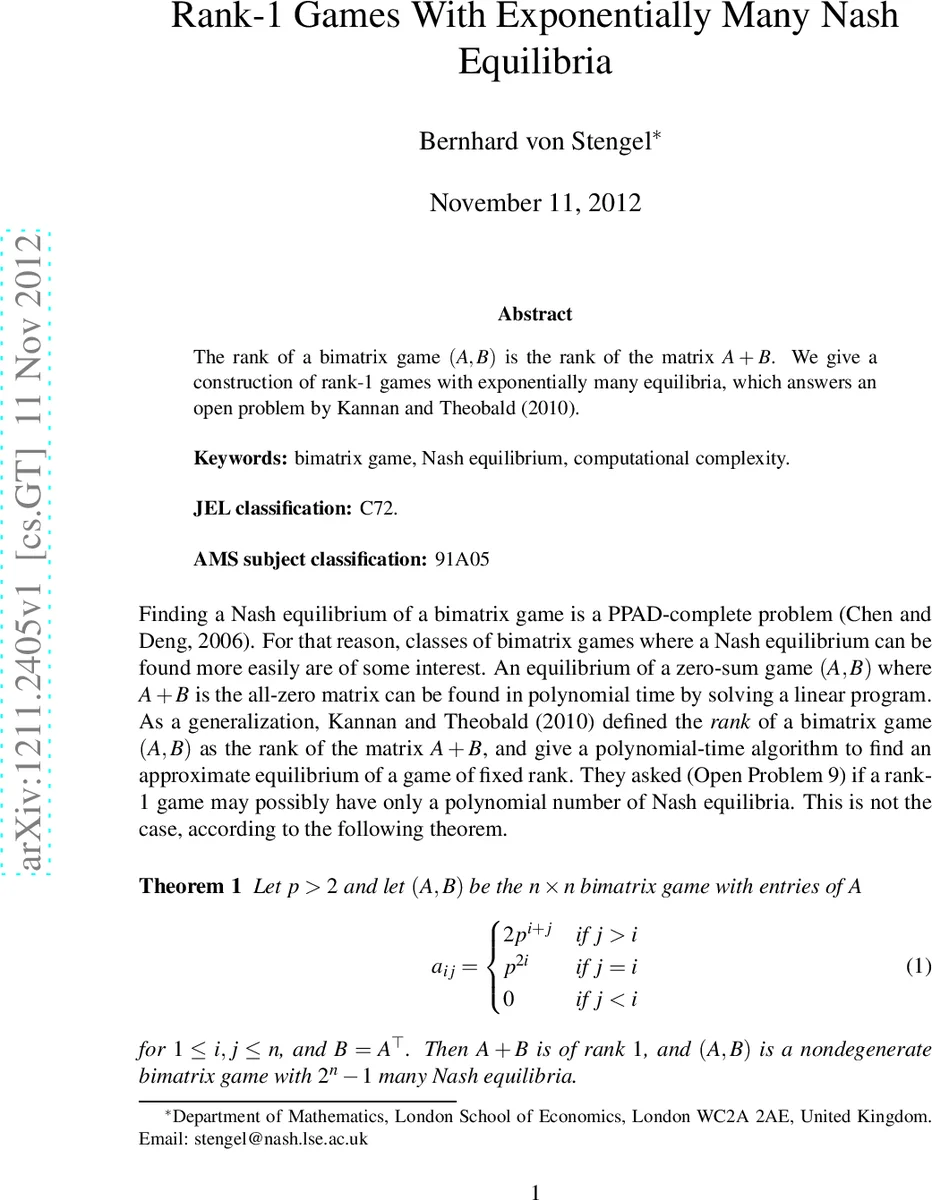
The rank of a bimatrix game (A,B) is the rank of the matrix A+B. We give a construction of rank-1 games with exponentially many equilibria, which answers an open problem by Kannan and Theobald (2010).
💡 Research Summary
The paper addresses an open question posed by Kannan and Theobald (2010) concerning the number of Nash equilibria that can arise in bimatrix games of rank 1, i.e., games where the matrix sum A + B has rank one. While zero‑sum games (rank 0) admit polynomial‑time equilibrium computation, Kannan and Theobald showed that for any fixed rank a polynomial‑time algorithm can compute an approximate equilibrium, and they asked whether rank‑1 games might be limited to only a polynomial number of exact equilibria.
The author constructs a family of n × n rank‑1 games that disproves this conjecture. Define a matrix A with entries
aᵢⱼ = 2 p^{i+j} if j > i,
aᵢⱼ = p^{2i} if j = i,
aᵢⱼ = 0 if j < i,
where p > 2 is an integer (e.g., p = 3 or 4). Let B = Aᵀ. Then A + B = αβᵀ with αᵢ = p^{i} and βⱼ = 2 p^{j}, so the sum has rank one.
The proof proceeds in three steps. First, the game is shown to be non‑degenerate: for any mixed strategy y of the column player, let S be its support. For any row i ∉ S, the expected payoff (Ay)ᵢ is strictly less than the payoff of some row t ∈ S, because the upper‑triangular structure and the exponential growth of the entries guarantee aᵢⱼ < a_{t j} for all j > i. By symmetry the same holds for the column player, implying that no strategy has more pure best‑responses than the size of its support.
Second, non‑degeneracy forces any Nash equilibrium (x, y) to have identical supports. For any non‑empty support set S ⊆ {1,…,n} the author constructs a mixed strategy y with support S that satisfies (Ay)ᵢ = u for all i ∈ S, where u > 0 is an arbitrary constant (e.g., u = 1). Starting from the largest index s ∈ S, y_s is fixed by u = a_{ss} y_s. Then, moving downwards, each y_i is uniquely determined by the equation (Ay)ᵢ = u, because the contributions from higher‑indexed support elements are already known and strictly smaller than u. After all y_i (i ∈ S) are obtained, the vector is normalized to a probability distribution. This yields a Nash equilibrium (y, y).
Since there are exactly 2ⁿ − 1 non‑empty subsets S, the game possesses 2ⁿ − 1 distinct Nash equilibria. Thus a rank‑1 game can have exponentially many equilibria, answering Kannan‑Theobald’s open problem in the negative.
The paper also connects this construction to the algorithm of Adsul, Garg, Mehta, and Sohoni (2011), which solves rank‑1 games by reducing them to a parameterized linear program (LP) in a scalar λ and performing a binary search on λ. In the present game, the path traced by the LP solutions as λ varies intersects the hyperplane xᵀα = λ exactly 2ⁿ − 1 times, implying that the LP path contains exponentially many linear segments. This phenomenon mirrors the classic example of Murty (1980), who exhibited a parameterized LP with an exponential‑length solution path.
Finally, the author situates the result within the broader literature on the maximal number of Nash equilibria. While the coordination game (A = I) achieves 2ⁿ − 1 equilibria and Quint‑Shubik (2002) proved this to be optimal for symmetric games (A, A), the present construction shows that even when A + B has minimal rank, the same exponential bound is attainable. Moreover, by a standard symmetrization technique, a game with more than 2ⁿ equilibria can be embedded into a 2n × 2n symmetric game with more than (2ⁿ)² equilibria, leaving open the question whether a non‑degenerate n × n rank‑1 game can exceed the 2ⁿ − 1 bound. The paper thus settles the original open problem and opens new avenues for exploring equilibrium complexity in low‑rank bimatrix games.
Comments & Academic Discussion
Loading comments...
Leave a Comment