Approximating the partition function of the ferromagnetic Potts model
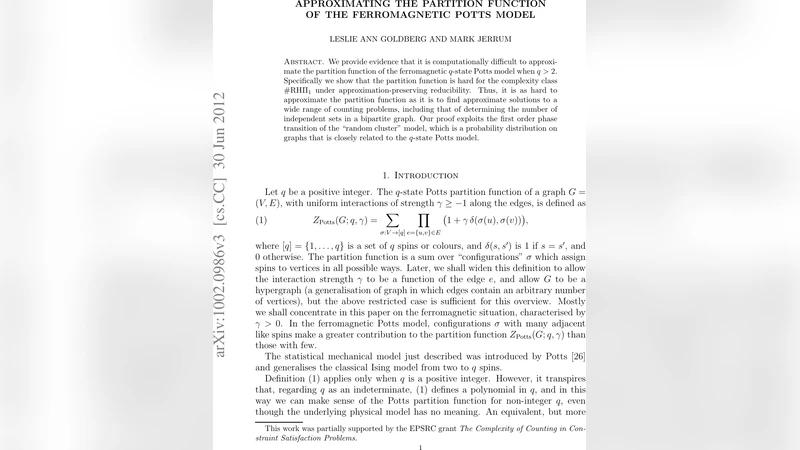
We provide evidence that it is computationally difficult to approximate the partition function of the ferromagnetic q-state Potts model when q>2. Specifically we show that the partition function is hard for the complexity class #RHPi_1 under approximation-preserving reducibility. Thus, it is as hard to approximate the partition function as it is to find approximate solutions to a wide range of counting problems, including that of determining the number of independent sets in a bipartite graph. Our proof exploits the first order phase transition of the “random cluster” model, which is a probability distribution on graphs that is closely related to the q-state Potts model.
💡 Research Summary
The paper investigates the computational difficulty of approximating the partition function of the ferromagnetic q‑state Potts model when the number of spin states q exceeds two. The authors establish that this approximation problem is as hard as any problem in the counting complexity class #RHPi₁ under approximation‑preserving (AP) reducibility. Their main result shows that, for q > 2, computing an approximate value of the Potts partition function is #RHPi₁‑hard, meaning that it is at least as difficult as the well‑studied #BIS problem (counting independent sets in bipartite graphs), which is believed to be intractable for fully polynomial‑time randomized approximation schemes (FPRAS).
The technical approach hinges on the random‑cluster model (RCM), a graphical representation that is mathematically equivalent to the Potts model. In the RCM, each edge of a graph is either “open” with probability p or “closed,” and each resulting connected component (cluster) receives a weight q. When q is an integer greater than two, the model exhibits a first‑order phase transition at a critical edge‑activation probability p_c. Near this critical point the distribution of cluster sizes becomes bimodal: one mode corresponds to configurations dominated by many small clusters, the other to configurations containing a giant cluster. This sharp structural change is exploited to construct a reduction from #BIS to the Potts partition‑function approximation problem.
Specifically, given an arbitrary bipartite graph H for which we wish to count independent sets, the authors build two derived graphs G₁ and G₂. Both graphs encode the adjacency structure of H but are equipped with edge‑activation probabilities p₁ = p_c − ε and p₂ = p_c + ε, where ε is a small positive constant. Because of the phase transition, the partition functions Z(G₁) and Z(G₂) differ in a way that is directly proportional to the number of independent sets in H. By approximating the ratio Z(G₁)/Z(G₂) within a prescribed multiplicative error, one can recover an approximation of the #BIS count. The transformation from H to (G₁,G₂) can be performed in polynomial time, and the approximation error can be controlled so that the reduction is AP‑preserving.
Having established an AP‑reduction from #BIS to the Potts approximation problem, the authors conclude that the latter is #RHPi₁‑hard. Since #BIS is itself complete for the class of problems that are AP‑hard but not known to be NP‑hard, this places the ferromagnetic Potts approximation problem in a similarly elusive complexity tier. Notably, the result contrasts sharply with the case q = 2 (the Ising model), for which a fully polynomial‑time randomized approximation scheme (FPRAS) exists thanks to the absence of a first‑order transition.
The paper also discusses the practical implications of this hardness result. In many applications—such as image segmentation, statistical inference in graphical models, and Monte‑Carlo simulations of magnetic materials—exact computation of the partition function is infeasible, and one typically relies on approximation methods. The authors argue that, for general graphs and q > 2, no FPRAS can exist unless a major collapse occurs in the counting hierarchy (e.g., #RHPi₁ ⊆ FP). Consequently, algorithm designers must either restrict attention to special graph families (planar lattices, bounded‑treewidth graphs) where alternative techniques may succeed, or resort to heuristic methods (simulated annealing, variational approximations) that lack provable guarantees.
In summary, the work provides a rigorous complexity‑theoretic barrier for approximating the ferromagnetic Potts partition function with more than two spin states. By linking the problem to the first‑order phase transition of the random‑cluster model and to the canonical #BIS counting problem, the authors demonstrate that any efficient approximation algorithm would resolve a long‑standing open problem in counting complexity. This deepens our understanding of the interplay between statistical‑physics phase transitions and computational hardness, and it delineates clear limits for future algorithmic research in this domain.
Comments & Academic Discussion
Loading comments...
Leave a Comment