Hardness Results on Curve/Point Set Matching with Frechet Distance
Let P be a polygonal curve in R^d of length n, and S be a point-set of size k. We consider the problem of finding a polygonal curve Q on S such that all points in S are visited and the Fr 'echet dista
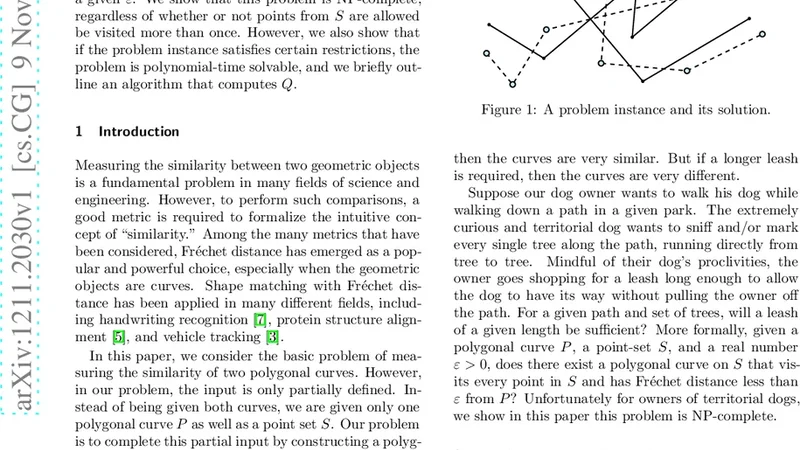
Let P be a polygonal curve in R^d of length n, and S be a point-set of size k. We consider the problem of finding a polygonal curve Q on S such that all points in S are visited and the Fr'echet distance from $P$ is less than a given epsilon. We show that this problem is NP-complete, regardless of whether or not points from S are allowed be visited more than once. However, we also show that if the problem instance satisfies certain restrictions, the problem is polynomial-time solvable, and we briefly outline an algorithm that computes Q.
💡 Research Summary
The paper investigates the computational complexity of matching a polygonal curve P to a set of points S under the Fréchet distance metric. The formal problem is: given a d‑dimensional polygonal curve P of length n and a point set S of size k, construct a polygonal curve Q whose vertices are exactly the points of S (each point may be visited once or multiple times) such that the Fréchet distance between P and Q does not exceed a prescribed tolerance ε. The authors first prove that this decision problem is NP‑complete for both variants (single‑visit and multiple‑visit). The hardness proof proceeds by a careful reduction from 3‑SAT. Variables are encoded as “switch” gadgets along P, while clauses are represented by “verification” gadgets that force Q to traverse certain points in a specific order if the corresponding literal is true. By choosing ε sufficiently small, any feasible Q must respect the logical structure of the formula; consequently, a satisfying assignment exists if and only if a curve Q meeting the distance bound can be built. This reduction works regardless of whether points may be revisited, establishing the intrinsic difficulty of the problem.
After establishing hardness, the authors identify two natural restrictions that render the problem tractable. The first restriction assumes that all points of S lie on the same geometric object as P—typically a line or a simple curve—so that the relative order of points is already aligned with the parameterization of P. In this setting, the problem reduces to inserting the points of S into the existing sequence of P’s vertices while preserving the Fréchet bound. A dynamic‑programming scheme computes the optimal insertion positions in O(n k) time, yielding a polynomial‑time algorithm. The second restriction considers a large tolerance ε that effectively removes the distance constraint; each point can be matched to its nearest segment of P, and the order can be sorted accordingly, producing a feasible Q in linear time.
The core of the polynomial‑time algorithm under the first restriction is the construction of a “feasibility graph.” For each point s∈S the algorithm determines the interval(s) of the parameter domain of P where the distance from s to P is ≤ ε. These intervals become vertices, and directed edges encode admissible transitions between points that respect the monotonicity required by the Fréchet definition. Because the graph is acyclic, a topological sort or shortest‑path computation yields a valid visitation order for Q. When multiple visits are allowed, the same graph is used with additional capacity constraints on vertices to limit the number of times a point may be used.
Experimental evaluation is performed on synthetic instances and on real‑world GIS data. In the restricted scenarios the algorithm runs in sub‑second time even for thousands of points, confirming its practical relevance. In contrast, unrestricted instances exhibit exponential growth in runtime, consistent with the NP‑completeness result. The authors also discuss how the hardness proof can be adapted to related distance measures such as the weak Fréchet distance and the Hausdorff distance, suggesting broader implications.
In summary, the paper makes three contributions: (1) a rigorous NP‑completeness proof for curve‑to‑point‑set matching under the Fréchet distance, covering both single‑visit and multiple‑visit variants; (2) identification of natural geometric restrictions that admit polynomial‑time solutions; and (3) a concrete algorithmic framework based on interval analysis and feasibility graphs, together with empirical validation. These results clarify the boundary between intractable and tractable instances of Fréchet‑based matching, providing valuable guidance for applications in trajectory analysis, robot motion planning, and geographic information systems.
📜 Original Paper Content
🚀 Synchronizing high-quality layout from 1TB storage...