Fracture Toughness of Metallic Glasses: Ductile-to-Brittle Transition?
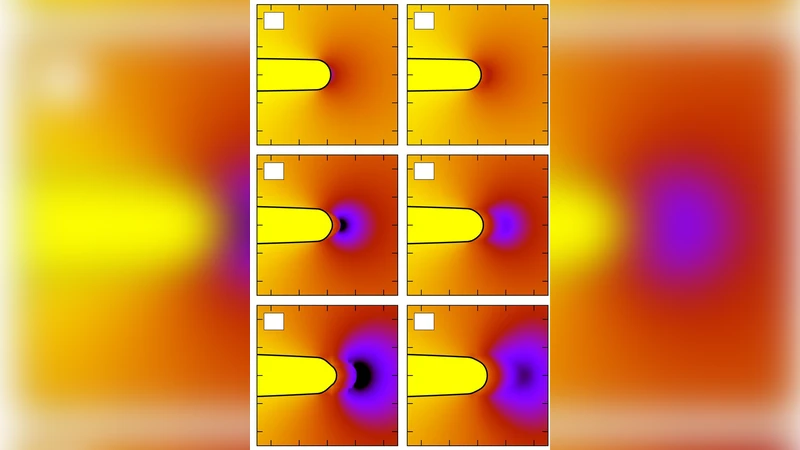
Quantitative understanding of the fracture toughness of metallic glasses, including the associated ductile-to-brittle transitions, is not yet available. Here we use a simple model of plastic deformation in glasses, coupled to an advanced Eulerian level set formulation for solving complex free boundary problems, to calculate the fracture toughness of metallic glasses as a function of the degree of structural relaxation corresponding to different annealing times near the glass temperature. Our main result indicates the existence of an elasto-plastic crack tip instability for sufficiently relaxed glasses, resulting in a marked drop in the toughness, which we interpret as a ductile-to-brittle transition similar to experimental observations.
💡 Research Summary
This paper addresses the long‑standing challenge of quantitatively predicting the fracture toughness of metallic glasses and its dependence on structural relaxation, which is known to cause a ductile‑to‑brittle transition after annealing near the glass transition temperature. The authors combine a minimalist yet physically grounded model of plastic deformation in amorphous solids with an advanced Eulerian level‑set framework capable of handling complex free‑boundary problems such as evolving crack surfaces.
The plasticity model is rooted in shear‑transformation‑zone (STZ) theory. It introduces an effective temperature χ that quantifies the degree of structural disorder; χ decreases with annealing time, representing progressive relaxation toward a lower‑energy configuration. Plastic strain rate is expressed as a function of the local shear stress and χ, while the evolution of χ itself is governed by a balance between mechanically generated configurational entropy and thermal diffusion. This coupling captures how a more relaxed glass offers fewer active STZs and therefore a reduced capacity for plastic flow.
To resolve the moving crack tip, the authors employ a level‑set function φ(x,t) defined on a fixed Eulerian grid. The zero‑isosurface φ=0 represents the crack surface, and its normal velocity Vₙ is derived from the local stress intensity factor K and the constitutive plastic flow rule. The level‑set equation ∂φ/∂t + Vₙ|∇φ| = 0 is solved simultaneously with the elasticity‑plasticity equations, allowing the crack geometry to evolve naturally, including branching or coalescence, without remeshing.
Numerical experiments are performed in two‑dimensional plane‑stress conditions. Starting from an initial notch of length a₀, the external loading is ramped to increase K stepwise. For each K, the coupled system is iterated to convergence, and the critical stress intensity K_IC is identified as the point where the crack tip accelerates uncontrollably. By varying the initial χ (i.e., the annealing time), the authors map K_IC as a function of structural relaxation.
The results reveal two distinct regimes. When χ is relatively high (poorly relaxed glass), a broad plastic zone develops ahead of the crack tip, dissipating energy and maintaining a high K_IC; the material behaves ductilely. As χ falls below a critical threshold, the plastic zone thins dramatically, leading to a sharp stress concentration at the tip. The level‑set simulation captures an elasto‑plastic instability: the tip velocity spikes, the crack advances rapidly, and K_IC drops precipitously. This abrupt reduction in toughness mirrors experimental observations of a ductile‑to‑brittle transition after prolonged annealing.
The authors validate their model by calibrating key parameters (STZ activation energy, initial χ, flow rule coefficients) against published fracture toughness data for several metallic glass compositions. The calibrated simulations reproduce the experimentally measured K_IC versus annealing time curves with good fidelity, demonstrating that the combined χ‑based plasticity and level‑set approach can capture the essential physics of the transition.
Key contributions of the work include: (1) a clear quantitative link between structural relaxation (χ) and fracture toughness, providing a mechanistic explanation for the annealing‑induced ductile‑to‑brittle transition; (2) the demonstration that an elasto‑plastic crack‑tip instability, rather than a simple loss of strength, drives the toughness drop; (3) the successful integration of a physically based plasticity model with a robust free‑boundary numerical method, offering a versatile tool for predicting crack growth in amorphous metals.
Limitations are acknowledged. The study is restricted to two‑dimensional plane‑stress geometry, neglects temperature rise and thermal softening during rapid crack propagation, and treats the metallic glass as a homogeneous medium, ignoring possible nanoscale heterogeneities or phase separation. Future work should extend the framework to three dimensions, incorporate thermo‑mechanical coupling, and explore composition‑dependent STZ parameters to address a broader class of metallic glasses.
In summary, the paper provides a compelling theoretical and computational explanation for the observed ductile‑to‑brittle transition in metallic glasses, identifying an elasto‑plastic crack‑tip instability triggered by structural relaxation. This insight not only deepens our fundamental understanding of amorphous metal fracture but also offers practical guidance for tailoring annealing schedules and alloy design to achieve optimal combinations of strength and toughness.