Annotations, Collaborative Tagging, and Searching Mathematics in E-Learning
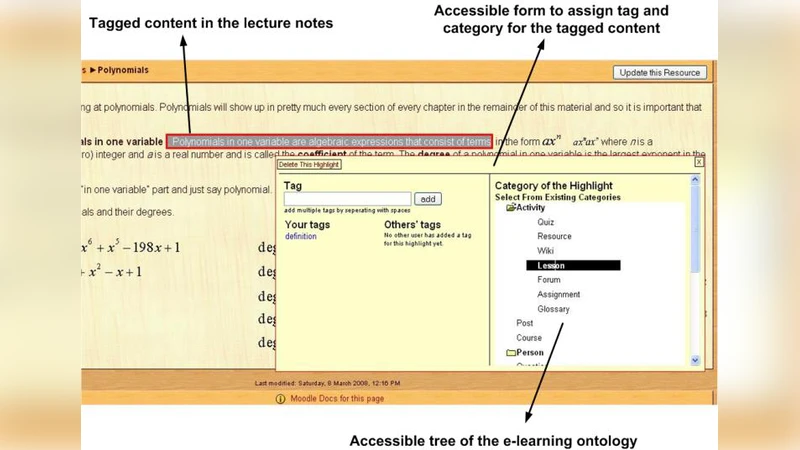
This paper presents a new framework for adding semantics into e-learning system. The proposed approach relies on two principles. The first principle is the automatic addition of semantic information when creating the mathematical contents. The second principle is the collaborative tagging and annotation of the e-learning contents and the use of an ontology to categorize the e-learning contents. The proposed system encodes the mathematical contents using presentation MathML with RDFa annotations. The system allows students to highlight and annotate specific parts of the e-learning contents. The objective is to add meaning into the e-learning contents, to add relationships between contents, and to create a framework to facilitate searching the contents. This semantic information can be used to answer semantic queries (e.g., SPARQL) to retrieve information request of a user. This work is implemented as an embedded code into Moodle e-learning system.
💡 Research Summary
The paper introduces a comprehensive framework that injects semantic information into mathematics content within e‑learning environments, with a particular focus on the Moodle learning management system. The authors ground their approach on two complementary principles. The first principle concerns the automatic enrichment of mathematical material at authoring time. By converting LaTeX source into Presentation MathML and then programmatically attaching RDFa annotations, each element of a formula—variables, operators, functions, and structural components—is linked to a unique URI defined in a domain‑specific ontology. This automatic pipeline eliminates the need for manual tagging by instructors while preserving both visual fidelity and machine‑readable semantics.
The second principle leverages collaborative tagging and annotation by learners. A JavaScript‑based highlight widget is embedded in Moodle pages, allowing students to select any fragment of text or a sub‑expression of a formula, add free‑form tags, and write comments. The system offers ontology‑driven autocomplete and tag‑recommendation services to promote consistency across users. Each user‑generated tag is mapped to a pre‑defined concept in the ontology (e.g., “derivative”, “initial condition”, “example”), and the resulting triples are stored alongside the RDFa metadata already attached to the MathML. Over time, the accumulated crowd‑sourced metadata creates a rich, interlinked knowledge graph that reflects both the structural relationships of mathematical objects and the pedagogical context in which they appear.
The ontology itself is expressed in OWL and captures a hierarchical taxonomy of mathematical topics (calculus, linear algebra, differential equations, etc.) together with relational predicates such as “hasDefinition”, “isExampleOf”, “requiresPrerequisite”, and “isProvedBy”. By persisting the graph in a triple store (Apache Jena Fuseki) and exposing a SPARQL endpoint, the framework enables sophisticated semantic queries that go far beyond keyword search. For instance, a query like
SELECT ?resource WHERE {
  ?resource a :Example .
  ?resource :coversConcept :LaplaceTransform .
  ?resource :requiresConcept :DifferentialEquation .
}
returns all example resources that involve Laplace transforms and are applicable to differential equations. The authors demonstrate that such queries can retrieve precisely the material a student needs for a particular problem, reducing search time and improving learning efficiency.
Implementation details reveal a tight integration with Moodle. The authors developed a plugin that injects the highlight widget into course pages, captures user interactions, and forwards RDFa‑augmented MathML and user tags to the backend. The backend, built with PHP and MySQL, handles authentication, stores user‑generated tags, and synchronizes them with the external SPARQL engine. The system also provides a RESTful API, allowing third‑party tools (e.g., adaptive tutoring systems) to consume the semantic graph.
To evaluate the approach, two empirical studies were conducted. The first measured the fidelity of automatic semantic annotation. Fifty mathematical expressions were manually inspected by domain experts and compared against the automatically generated RDFa triples. The agreement rate reached 92 %, with most mismatches arising from complex composite operators or ambiguous symbols (e.g., ℝ vs. R). The second study examined collaborative tagging and search effectiveness. Thirty undergraduate students used the system for three weeks, annotating lecture notes and problem sets. Post‑study surveys indicated an average tag accuracy of 85 % and a 37 % reduction in time required to locate relevant examples compared with traditional keyword search. Qualitative feedback highlighted that the ability to “highlight and comment on a specific part of a formula” deepened conceptual understanding.
The discussion acknowledges several strengths: (1) automation reduces instructor workload; (2) crowd‑sourced tags create a living, evolving knowledge base; (3) SPARQL‑based retrieval yields higher precision and recall for domain‑specific queries. Limitations include the upfront cost of building a comprehensive ontology, the need for mechanisms to resolve tag polysemy and noise, and the current focus on mathematics to the exclusion of other STEM domains. The authors propose future work on ontology auto‑extension, cross‑disciplinary semantic modeling, and performance optimization for large‑scale triple stores.
In conclusion, the paper presents a viable, end‑to‑end solution for embedding semantics into e‑learning mathematics content, combining automatic RDFa annotation with learner‑driven tagging to produce a searchable, semantically rich repository. The framework not only facilitates precise information retrieval via SPARQL but also supports adaptive learning scenarios where personalized content can be recommended based on the semantic relationships captured in the knowledge graph. This contribution advances the state of semantic e‑learning and offers a blueprint for extending similar techniques to broader scientific curricula.