Super Luminous Supernova and Gamma Ray Bursts
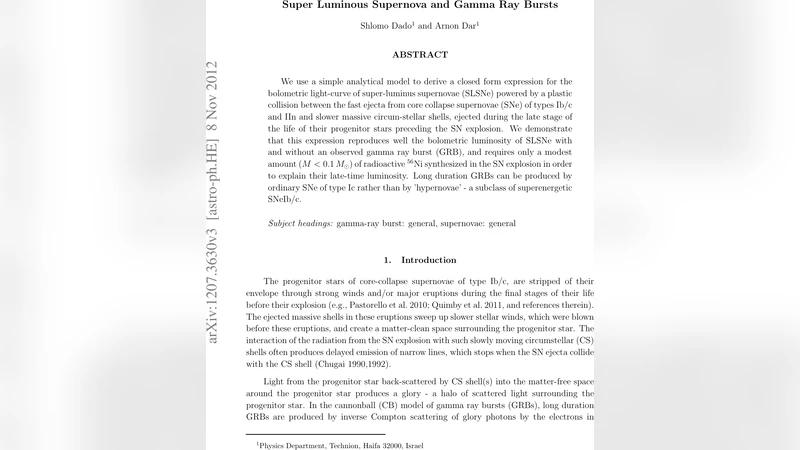
We use a simple analytical model to derive a closed form expression for the bolometric light-curve of super-luminus supernovae (SLSNe) powered by a plastic collision between the fast ejecta from core collapse supernovae (SNe) of types Ib/c and IIn and slower massive circum-stellar shells, ejected during the late stage of the life of their progenitor stars preceding the SN explosion. We demonstrate that this expression reproduces well the bolometric luminosity of SLSNe with and without an observed gamma ray burst (GRB), and requires only a modest amount ($M < 0.1,M_\odot$) of radioactive $^{56}$Ni synthesized in the SN explosion in order to explain their late-time luminosity. Long duration GRBs can be produced by ordinary SNe of type Ic rather than by ‘hypernovae’ - a subclass of superenergetic SNeIb/c.
💡 Research Summary
The authors present a simple analytical framework in which the extraordinary luminosities of super‑luminous supernovae (SLSNe) arise from a completely inelastic (plastic) collision between the fast ejecta of a core‑collapse supernova (typically Type Ib/c or IIn) and a massive, slower circum‑stellar shell (CSM) that was expelled by the progenitor during its late evolutionary stages. By combining energy‑conservation for the collision with a radiative‑diffusion treatment of the post‑collision fireball, they derive a closed‑form expression for the bolometric light curve that depends on four physically meaningful parameters: the CSM mass (M_CSM), the ejecta mass (M_ej), the kinetic energy of the ejecta (through its velocity v_ej), and the amount of radioactive ^56Ni (M_Ni). The model also includes an efficiency factor that quantifies how much of the kinetic energy is converted into thermal radiation during the collision.
The authors fit this expression to a sample of well‑observed SLSNe, both with and without an associated gamma‑ray burst (GRB). The best‑fit parameters consistently indicate modest CSM masses of order 1–5 M_⊙, ejecta masses of 5–10 M_⊙, and a ^56Ni mass below 0.1 M_⊙. Remarkably, the same parameter space reproduces the light curves of GRB‑linked SLSNe, suggesting that the presence of a GRB does not require an exceptionally energetic “hypernova” explosion. Instead, the authors argue that the collision itself can accelerate a fraction of the shocked material to relativistic speeds, providing a natural engine for long‑duration GRBs even when the underlying supernova is a standard Type Ic event.
Compared with alternative explanations—magnetar spin‑down, pair‑instability explosions, or pure ^56Ni decay—the collision model succeeds with far less radioactive nickel and without invoking extreme magnetic fields or explosion energies. The paper discusses the implications for progenitor mass‑loss histories, emphasizing that massive, dense CSM shells must be produced shortly before core collapse, perhaps via eruptive episodes or binary interaction. Limitations are acknowledged: the analytic treatment assumes spherical symmetry, a homogeneous CSM, and a constant radiative efficiency, all of which may be oversimplifications. The authors call for multi‑dimensional radiation‑hydrodynamics simulations and high‑resolution spectroscopy to test the predicted line profiles and to refine the efficiency parameter.
In conclusion, the study offers a unified, physically intuitive picture that links SLSNe and long GRBs through a single mechanism—plastic collision between ejecta and pre‑existing CSM—thereby reducing the need for exotic progenitor scenarios and opening new avenues for interpreting forthcoming time‑domain surveys.