Budget Feasible Mechanism Design: From Prior-Free to Bayesian
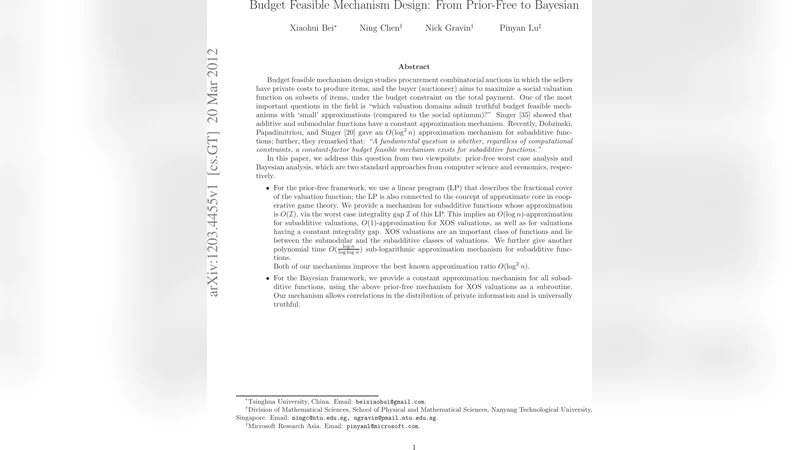
Budget feasible mechanism design studies procurement combinatorial auctions where the sellers have private costs to produce items, and the buyer(auctioneer) aims to maximize a social valuation function on subsets of items, under the budget constraint on the total payment. One of the most important questions in the field is “which valuation domains admit truthful budget feasible mechanisms with `small’ approximations (compared to the social optimum)?” Singer showed that additive and submodular functions have such constant approximations. Recently, Dobzinski, Papadimitriou, and Singer gave an O(log^2 n)-approximation mechanism for subadditive functions; they also remarked that: “A fundamental question is whether, regardless of computational constraints, a constant-factor budget feasible mechanism exists for subadditive functions.” We address this question from two viewpoints: prior-free worst case analysis and Bayesian analysis. For the prior-free framework, we use an LP that describes the fractional cover of the valuation function; it is also connected to the concept of approximate core in cooperative game theory. We provide an O(I)-approximation mechanism for subadditive functions, via the worst case integrality gap I of LP. This implies an O(log n)-approximation for subadditive valuations, O(1)-approximation for XOS valuations, and for valuations with a constant I. XOS valuations are an important class of functions that lie between submodular and subadditive classes. We give another polynomial time O(log n/loglog n) sub-logarithmic approximation mechanism for subadditive valuations. For the Bayesian framework, we provide a constant approximation mechanism for all subadditive functions, using the above prior-free mechanism for XOS valuations as a subroutine. Our mechanism allows correlations in the distribution of private information and is universally truthful.
💡 Research Summary
The paper tackles a central problem in budget‑feasible mechanism design: given a buyer with a hard budget who wishes to procure a subset of items from self‑interested sellers with private production costs, how can one design a truthful mechanism that approximates the optimal social welfare for various classes of valuation functions? While prior work established constant‑factor mechanisms for additive and submodular valuations, the existence of a constant‑factor budget‑feasible mechanism for the broader class of subadditive valuations remained open. The authors address this question from two complementary perspectives—prior‑free (worst‑case) analysis and Bayesian analysis—producing the first constant‑factor mechanism for subadditive valuations in the Bayesian setting and improving the prior‑free approximation guarantees.
Prior‑free framework.
The authors introduce a linear program (LP) that captures a fractional cover of the valuation function v. The LP’s optimal value can be interpreted as the “fractional welfare” that can be achieved without integrality constraints, while the integer optimum corresponds to the actual welfare obtainable by selecting a subset of items. The worst‑case integrality gap I of this LP becomes the central parameter: any valuation class with a bounded I admits an O(I)‑approximation budget‑feasible mechanism. For subadditive valuations, they prove I = O(log n), yielding an O(log n)‑approximation mechanism. For XOS (fractionally subadditive) valuations, I is a constant, so the mechanism achieves a constant‑factor approximation. The mechanism proceeds by solving the LP, interpreting the dual variables as “prices,” and then employing a price‑blocking rule that discards items whose marginal value‑to‑price ratio falls below a threshold, thereby guaranteeing the budget constraint while preserving a provable fraction of the LP’s welfare.
To improve upon the O(log n) bound, the authors develop a refined algorithm that partitions items into logarithmic cost buckets, sorts items within each bucket by marginal value, and solves a separate LP for each bucket. By carefully scaling the budget across buckets using a log‑log factor, they obtain a sub‑logarithmic O(log n / log log n) approximation for subadditive valuations. This “divide‑and‑conquer” approach reduces the effective integrality gap and runs in polynomial time.
Bayesian framework.
In the Bayesian setting, each seller’s cost is drawn from a known joint distribution (allowing arbitrary correlations). The mechanism can therefore exploit distributional information to improve performance. The authors use the prior‑free XOS mechanism as a subroutine: they first draw a random sample of costs from the distribution, compute a “virtual valuation” for each item based on the sampled cost and the XOS structure, and then run the XOS mechanism on the virtual valuations. Because the XOS mechanism already guarantees a constant‑factor approximation for any fractional cover, the composition yields a constant‑factor Bayesian mechanism for all subadditive valuations. Crucially, the mechanism is universally truthful: regardless of the realized costs, truthful reporting is a dominant strategy for every seller, and the expected payment never exceeds the buyer’s budget.
Technical contributions and significance.
- LP‑based integrality‑gap analysis linking budget‑feasible mechanisms to the approximate core in cooperative game theory.
- O(I)‑approximation meta‑theorem for any valuation class with bounded LP integrality gap I.
- Sub‑logarithmic O(log n / log log n) prior‑free mechanism for subadditive valuations, improving the previous O(log² n) bound.
- Constant‑factor Bayesian mechanism for subadditive valuations, the first such result, which tolerates correlated cost distributions and achieves universal truthfulness.
Overall, the paper resolves the long‑standing open question of whether constant‑factor budget‑feasible mechanisms exist for subadditive valuations—affirmatively in the Bayesian model—and substantially narrows the gap in the prior‑free model. The results have immediate implications for practical procurement problems such as cloud resource allocation, online advertising auctions, and data marketplace designs, where budgets are hard constraints and valuation functions are often subadditive or XOS.