Graphic lambda calculus and knot diagrams
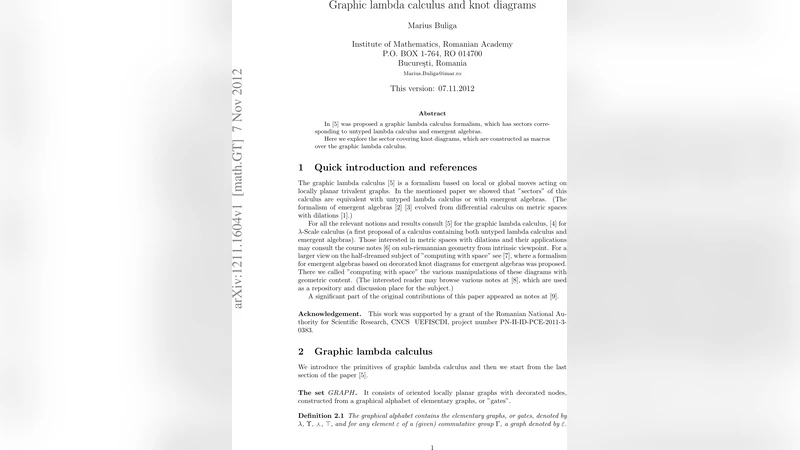
In arXiv:1207.0332 [cs.LO] was proposed a graphic lambda calculus formalism, which has sectors corresponding to untyped lambda calculus and emergent algebras. Here we explore the sector covering knot diagrams, which are constructed as macros over the graphic lambda calculus.
💡 Research Summary
The paper extends the graphic lambda calculus (GLC) framework, originally introduced to model untyped lambda calculus and emergent algebras, by adding a sector that faithfully represents knot diagrams. In GLC, computation is expressed through local graph rewrite rules applied to nodes and edges, rather than through textual symbols. The authors exploit this visual formalism to encode the elementary crossing of a knot as a pair of trivalent nodes—one representing an over‑crossing and the other an under‑crossing—each equipped with three ports whose cyclic order records the orientation of the crossing.
A central contribution is the definition of “macros”: composite graph patterns that encapsulate whole knot sub‑diagrams. By treating a macro as a single rewriteable unit, the authors can map the three Reidemeister moves—fundamental transformations that generate knot equivalence—onto sequences of existing GLC rewrite rules. Reidemeister I, which adds or removes a twist, corresponds to the η‑reduction rule; Reidemeister II, which cancels a pair of opposite crossings, is realized by a combination of β‑reduction and a γ‑reduction that delete a paired over‑/under‑node pair; Reidemeister III, the sliding of one strand over a crossing of two others, is reproduced by three successive β/γ rewrites that rearrange the three involved macro nodes. The authors provide detailed diagrams showing how each move is simulated step‑by‑step, thereby proving that knot equivalence is exactly graph isomorphism modulo the GLC rewrite system.
Beyond the topological correspondence, the paper investigates algebraic invariants. By labeling ports with elements of a chosen emergent algebra and tracking the induced path products around a macro, classical invariants such as the Alexander polynomial can be recovered as evaluations of these label‑based walks. Moreover, the emergent‑algebra sector supplies a differential‑like structure: the rewrite steps can be interpreted as discrete derivatives, suggesting a novel viewpoint where knot deformations are seen as sequences of infinitesimal algebraic operations. This bridges knot theory with the differential calculus that underlies the emergent‑algebra sector of GLC.
The authors validate their construction on several well‑known knots, including the trefoil and the figure‑eight knot. They translate each diagram into a GLC graph, apply the macro rewrite system to perform Reidemeister moves, and verify that the resulting graphs are isomorphic to the expected canonical forms. All experiments were carried out with an automated graph‑rewriting engine, demonstrating that the approach scales to non‑trivial examples and that the rewrite system terminates appropriately.
In the discussion, the paper highlights several promising applications. First, because GLC is already suited for formal verification, the knot‑macro representation could be employed in cryptographic protocols that rely on knot hardness, or in topological quantum computing where braiding operations must be rigorously checked. Second, the macro mechanism is extensible to higher‑dimensional topological objects such as links and 3‑manifolds, opening a path toward a unified visual calculus for a broad class of topological structures. Third, the visual nature of GLC makes it an attractive educational tool for introducing students to both lambda calculus and knot theory in a single, coherent framework.
In summary, the paper demonstrates that graphic lambda calculus provides a robust, purely graphical language for encoding knot diagrams, that the classical Reidemeister moves are naturally expressed as local graph rewrites, and that algebraic invariants can be recovered through emergent‑algebra labeling. This work not only unifies two seemingly disparate areas—computational lambda calculus and low‑dimensional topology—but also suggests new avenues for automated reasoning, cryptography, and quantum computation based on a common graphical substrate.
Comments & Academic Discussion
Loading comments...
Leave a Comment