Study of Supernova nu-Nucleus Coherent Scattering Interactions
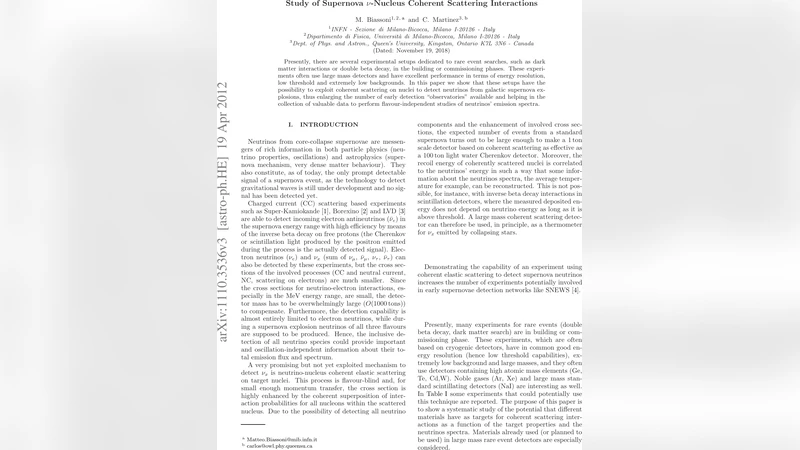
Presently, there are several experimental setups dedicated to rare event searches, such as dark matter interactions or double beta decay, in the building or commissioning phases. These experiments often use large mass detectors and have excellent performance in terms of energy resolution, low threshold and extremely low backgrounds. In this paper we show that these setups have the possibility to exploit coherent scattering on nuclei to detect neutrinos from galactic supernova explosions, thus enlarging the number of early detection “observatories” available and helping in the collection of valuable data to perform flavour-independent studies of neutrinos’ emission spectra.
💡 Research Summary
The paper investigates the feasibility of using existing large‑mass, low‑threshold, ultra‑low‑background detectors—originally built for rare‑event searches such as dark‑matter direct detection and neutrinoless double‑beta decay—to observe neutrinos from a Galactic core‑collapse supernova via coherent elastic neutrino‑nucleus scattering (CENNS). The authors begin by reviewing the astrophysical context: a type‑II supernova releases roughly 3 × 10⁵³ erg of energy, almost entirely in the form of neutrinos of all flavors (νₑ, \barνₑ, νₓ where νₓ denotes the μ and τ families). The dominant production mechanisms are electron‑positron pair annihilation and nucleon‑bremsstrahlung, which generate a flavor‑blind flux.
A simplified model assumes that each flavor follows a Boltzmann spectrum with characteristic temperatures Tₑ ≈ 3.5 MeV, T_{\bar e} ≈ 5 MeV, and Tₓ ≈ 8 MeV, and that the total emitted neutrino numbers are N_{νₑ}=3 × 10⁵⁶, N_{\barνₑ}=2.1 × 10⁵⁶, N_{νₓ}=5.2 × 10⁵⁷. The flux at Earth scales as 1/(4πd²) with a typical distance d ≈ 8.5 kpc (the Galactic centre).
The core of the analysis is the CENNS cross‑section, a neutral‑current process whose amplitude adds coherently over all nucleons. For low momentum transfer (Q ≲ 50 MeV/c) the differential cross‑section is
dσ/dΩ = (G_F²/4π²) E_ν² (1+cosθ) Q_w² F²(Q²),
where Q_w ≈ N (the neutron number) because sin²θ_W ≈ 0.231 suppresses the proton contribution. The nuclear form factor F(Q²) is taken from the Helm model, with radius R₀ ≈ 1.2 A^{1/3} fm and skin thickness s ≈ 0.5 fm. This form factor reduces the cross‑section at higher Q, i.e., for heavier nuclei or higher recoil energies.
The authors compile a list of existing experiments (GERDA, SuperCDMS, CUORE, XENON100, ARGO, DAMA/LIBRA, etc.) and extract the target material, total mass, and isotopic composition. Using Avogadro’s number and stoichiometric ratios, they compute the number of target nuclei per tonne for each constituent element. For each detector they numerically integrate the product of the differential cross‑section, the total neutrino flux (sum over flavors), and a delta function linking recoil energy T to the scattering angle, thereby obtaining the expected recoil spectrum Y(T) = dN/dT.
Results show that a 1‑ton detector made of germanium, for example, would register several tens of events above a 1 keV threshold, while a xenon‑based detector would see a few hundred events despite a stronger form‑factor suppression because of its large neutron number. Materials with high atomic mass (W, Xe) benefit from the N² enhancement, but the loss of coherence at higher Q limits the usable recoil range. The authors stress that detectors with sub‑keV thresholds (cryogenic Ge/Si/Te bolometers) are especially powerful: they can capture the low‑energy tail of the recoil spectrum, which directly encodes the average neutrino energy and thus the temperature of the νₓ component.
A key implication is that CENNS provides a flavor‑independent measurement of the total neutrino fluence, complementing existing charged‑current detectors that are primarily sensitive to νₑ. By reconstructing the recoil energy distribution, one can infer the average νₓ temperature (≈8 MeV) and test supernova models without relying on oscillation assumptions, because the neutral‑current process is blind to flavor mixing.
The paper also discusses experimental challenges: background suppression (radiogenic gammas, neutrons), precise energy calibration of nuclear recoils, and uncertainties in the nuclear form factor. However, the authors argue that many of these issues are already addressed in current dark‑matter experiments, which routinely achieve background rates below 10⁻³ events/(kg·keV·day) and sub‑keV thresholds. Consequently, the existing global network of rare‑event detectors could be incorporated into the SuperNova Early Warning System (SNEWS) without additional hardware, providing a real‑time, multi‑flavor neutrino alert for a Galactic supernova.
In conclusion, the study demonstrates that coherent elastic neutrino‑nucleus scattering in large, low‑threshold detectors offers a viable, flavor‑blind channel for supernova neutrino detection. By leveraging the N² enhancement of the cross‑section and the excellent energy resolution of current rare‑event experiments, it is possible to obtain both a prompt supernova alert and valuable spectral information on the otherwise inaccessible νₓ flux. This opens the path toward a more complete, multi‑messenger view of core‑collapse supernovae using already‑operating experimental infrastructures.
Comments & Academic Discussion
Loading comments...
Leave a Comment