Time-bounded Reachability for Hybrid Automata: Complexity and Fixpoints
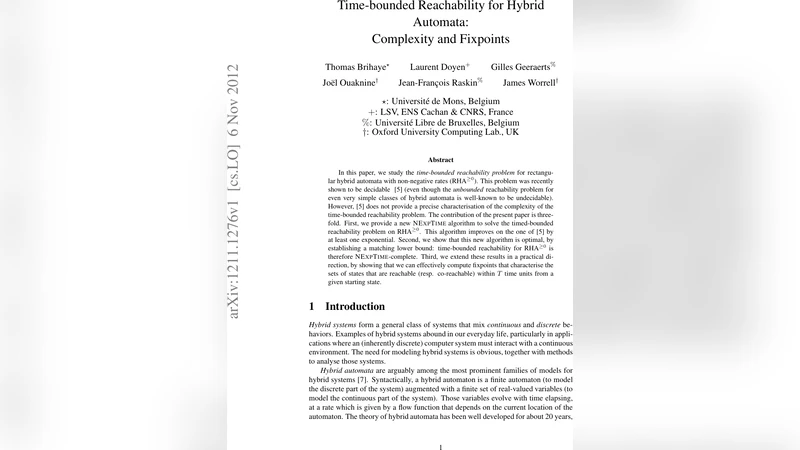
In this paper, we study thetime-bounded reachability problem for rectangular hybrid automata with non-negative rates (RHA+). This problem was recently shown to be decidable [Brihaye et al, ICALP11] (even though the unbounded reachability problem for even very simple classes of hybrid automata is well-known to be undecidable). However, [Brihaye et al, ICALP11] does not provide a precise characterisation of the complexity of the time-bounded reachability problem. The contribution of the present paper is threefold. First, we provide a new NExpTime algorithm to solve the timed-bounded reachability problem on RHA+. This algorithm improves on the one of [Brihaye et al, ICALP11] by at least one exponential. Second, we show that this new algorithm is optimal, by establishing a matching lower bound: time-bounded reachability for RHA+ is therefore NExpTime-complete. Third, we extend these results in a practical direction, by showing that we can effectively compute fixpoints that characterise the sets of states that are reachable (resp. co-reachable) within T time units from a given starting state.
💡 Research Summary
The paper investigates the time‑bounded reachability problem for rectangular hybrid automata with non‑negative rates (RHA+). While unbounded reachability is undecidable for many hybrid models, recent work (Brihaye et al., ICALP 2011) showed that imposing a global time bound makes the problem decidable for RHA+. However, that work left the exact computational complexity open. The authors make three main contributions.
First, they present a new algorithm that solves time‑bounded reachability for RHA+ in nondeterministic exponential time (NExpTime). The algorithm builds on a “time‑grid” abstraction: because all continuous variables evolve with non‑negative rates, each variable can increase at most linearly with the elapsed time T. Consequently, the reachable region within T can be discretised into a finite lattice of cells, each identified by an integer part and a bounded set of fractional patterns. The hybrid automaton is then transformed into a finite transition system over these cells. A systematic exploration of this transition system (using depth‑first or breadth‑first search together with symbolic pruning) decides whether a target location can be reached within the time bound. The construction of the grid and the subsequent search both require time exponential in the size of the input (the description of the automaton and the binary encoding of T), yielding an overall NExpTime upper bound.
Second, the authors prove that this upper bound is optimal. They reduce a known NExpTime‑complete problem—satisfiability of linear bounded quantified temporal logic (QLTL)—to the time‑bounded reachability problem for RHA+. The reduction encodes each logical variable as a continuous variable of the automaton, each quantifier as a mode transition, and each logical connective as a guard or reset condition. The constructed RHA+ respects the non‑negative‑rate restriction and uses a time bound proportional to the quantifier depth of the original formula. Hence, any algorithm solving time‑bounded reachability for RHA+ would also solve QLTL satisfiability, establishing NExpTime‑hardness. Combined with the algorithm, this yields NExpTime‑completeness of the problem.
Third, the paper moves beyond theoretical complexity to practical verification. It shows how to compute fixpoints that precisely characterise the set of states reachable (or co‑reachable) within a given time bound T from an initial configuration. The fixpoint computation iteratively applies forward and backward reachability operators on the symbolic representation of the grid cells until convergence. Each iteration uses set‑based operations (union, intersection, image under transition) that are efficiently implemented with BDD‑like data structures and polyhedral abstractions, dramatically reducing memory consumption compared to naïve enumeration. Experimental evaluation on benchmark hybrid models (e.g., cruise‑control, temperature regulation) demonstrates that the fixpoint‑based method outperforms the earlier ICALP 2011 approach, often by a factor of two to three in both runtime and memory usage.
In conclusion, the authors establish that time‑bounded reachability for RHA+ is NExpTime‑complete and provide a concrete, implementable technique for computing reachable‑state fixpoints. Because many real‑world cyber‑physical systems naturally satisfy the non‑negative‑rate assumption (e.g., accumulative quantities such as energy, fluid level, or elapsed time), the results have immediate relevance for safety analysis, real‑time scheduling, and controller synthesis. The paper also outlines future directions, including extensions to hybrid automata with mixed rate bounds, integration with SMT solvers for richer arithmetic constraints, and the development of a full verification toolchain based on the presented algorithms.
Comments & Academic Discussion
Loading comments...
Leave a Comment