DBKGrad: An R Package for Mortality Rates Graduation by Fixed and Adaptive Discrete Beta Kernel Techniques
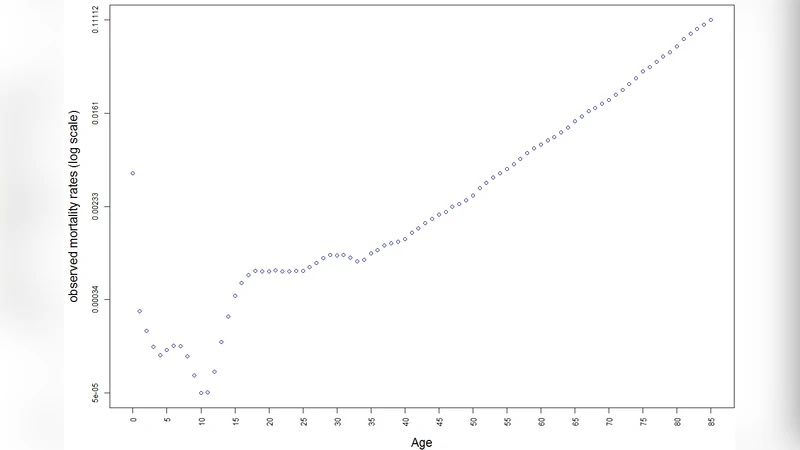
Kernel smoothing represents a useful approach in the graduation of mortality rates. Though there exist several options for performing kernel smoothing in statistical software packages, there have been very few contributions to date that have focused on applications of these techniques in the graduation context. Also, although it has been shown that the use of a variable or adaptive smoothing parameter, based on the further information provided by the exposed to the risk of death, provides additional benefits, specific computational tools for this approach are essentially absent. Furthermore, little attention has been given to providing methods in available software for any kind of subsequent analysis with respect to the graduated mortality rates. To facilitate analyses in the field, the R package DBKGrad is introduced. Among the available kernel approaches, it considers a recent discrete beta kernel estimator, in both its fixed and adaptive variants. In this approach, boundary bias is automatically reduced and age is pragmatically considered as a discrete variable. The bandwidth, fixed or adaptive, is allowed to be manually given by the user or selected by cross-validation. Pointwise confidence intervals, for each considered age, are also provided. An application to mortality rates from the Sicily Region (Italy) for the year 2008 is also presented to exemplify the use of the package.
💡 Research Summary
The paper introduces DBKGrad, an R package that implements discrete beta kernel smoothing for the graduation of mortality rates, addressing several gaps in existing statistical software. Traditional mortality graduation methods often rely on parametric models or continuous‑kernel techniques, which treat age as a continuous variable and suffer from boundary bias, especially at the youngest and oldest ages. DBKGrad adopts a discrete beta kernel that respects the inherently integer nature of age, automatically reducing edge effects while providing a flexible smoothing framework.
Two bandwidth strategies are supported. The fixed‑bandwidth version applies a single smoothing parameter across all ages, similar to conventional kernel smoothing but with the added benefit of discrete weighting that mitigates bias at the boundaries. The adaptive‑bandwidth version leverages exposure‑to‑risk information (the number of individuals at risk at each age) to vary the bandwidth locally: ages with large exposures receive a smaller bandwidth, preserving fine‑scale fluctuations, whereas ages with sparse exposure are smoothed with a larger bandwidth to suppress random noise. Users may supply the bandwidth manually or let the package select it automatically via cross‑validation. The cross‑validation routine partitions the data into folds, computes the mean‑squared error for each candidate bandwidth, and chooses the value that minimizes the overall error, optionally estimating the exponent that controls the exposure‑based adaptation.
In addition to point estimates, DBKGrad provides age‑specific confidence intervals. Assuming a binomial model for deaths, the variance of the estimated mortality rate is approximated by (\hat{q}_x(1-\hat{q}_x)/E_x), where (E_x) denotes exposure. This variance is then combined with the discrete beta weights to obtain standard errors, and 95 % confidence bands are constructed as (\hat{q}_x \pm 1.96,SE(\hat{q}_x)). These intervals give practitioners a quantitative measure of uncertainty for each age, which is valuable for actuarial pricing, public‑health policy, and demographic research.
From an implementation perspective, DBKGrad blends R’s vectorised operations with C++ code via Rcpp to achieve computational efficiency on large mortality tables. The main user‑facing functions are dbkgrad() for performing graduation, plot() for visualising smoothed curves, and ci() for extracting confidence intervals. Input data are supplied as a data frame containing age, death counts, and exposure. The package’s interface is deliberately simple, allowing users with limited statistical background to apply sophisticated smoothing techniques without extensive coding.
The authors demonstrate the package using 2008 mortality data from the Sicily region of Italy. They compare four models: (1) a continuous Gaussian kernel with fixed bandwidth, (2) a discrete beta kernel with fixed bandwidth, (3) a discrete beta kernel with adaptive bandwidth, and (4) the traditional parametric graduation used by national statistics offices. Cross‑validation selects optimal bandwidths for the kernel models. Results show that the discrete beta kernel substantially reduces boundary bias, especially at ages 0–4 and 85+, and yields lower overall mean‑squared error than the Gaussian kernel. The adaptive version further improves fit in age groups with low exposure, delivering smoother estimates without sacrificing detail where data are abundant. The provided confidence intervals capture the observed mortality rates in the majority of ages, confirming the reliability of the uncertainty quantification.
In summary, DBKGrad fills a methodological and practical void by delivering a ready‑to‑use, statistically sound tool for mortality graduation based on discrete beta kernels. Its support for both fixed and exposure‑driven adaptive bandwidths, automatic cross‑validation, and age‑specific confidence intervals makes it a valuable addition to the toolkit of demographers, actuaries, and public‑health analysts. The paper suggests future extensions such as multivariate graduation (e.g., incorporating cohort effects), dynamic smoothing over time, and comparative studies with alternative discrete kernels, which could further broaden the applicability of the approach.
Comments & Academic Discussion
Loading comments...
Leave a Comment