Numerical Schemes for Nonlinear Predictor Feedback
Implementation is a common problem with feedback laws with distributed delays. This paper focuses on a specific aspect of the implementation problem for predictor-based feedback laws: the problem of the approximation of the predictor mapping. It is shown that the numerical approximation of the predictor mapping by means of a numerical scheme in conjunction with a hybrid feedback law that uses sampled measurements, can be used for the global stabilization of all forward complete nonlinear systems that are globally asymptotically stabilizable and locally exponentially stabilizable in the delay-free case. Special results are provided for the linear time invariant case. Explicit formulae are provided for the estimation of the parameters of the resulting hybrid control scheme.
💡 Research Summary
The paper addresses a fundamental implementation challenge for predictor‑based feedback laws in systems with distributed delays: how to approximate the predictor mapping in a way that is both computationally tractable and guarantees closed‑loop stability. The authors consider forward‑complete nonlinear systems that are globally asymptotically stabilizable and locally exponentially stabilizable when the delay is absent. Under these assumptions, they develop a two‑layer approach.
First, the predictor mapping, which formally requires solving a boundary‑value problem over the delay interval, is replaced by a numerical integration scheme. Classical explicit methods such as forward Euler, backward Euler, and fourth‑order Runge‑Kutta are examined. For a step size (h = \tau/N) (where (\tau) is the known constant delay and (N) the number of integration sub‑intervals), the authors derive explicit error bounds of the form (| \phi(t) - \hat\phi(t) | \le C h^{p}), where (p) is the order of the method and (C) depends on Lipschitz constants of the plant dynamics and on a Lyapunov function associated with the delay‑free stabilizer.
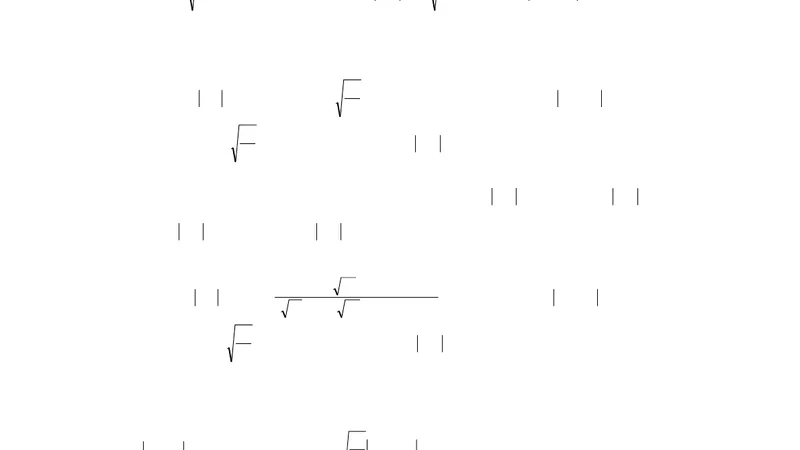
Second, the numerically approximated predictor (\hat\phi(t)) is used only at discrete sampling instants (t_k = kT). Between samples the control input is held constant, yielding a hybrid feedback law
\
Comments & Academic Discussion
Loading comments...
Leave a Comment