Spatiotemporal correlations of handset-based service usages
We study spatiotemporal correlations and temporal diversities of handset-based service usages by analyzing a dataset that includes detailed information about locations and service usages of 124 users over 16 months. By constructing the spatiotemporal trajectories of the users we detect several meaningful places or contexts for each one of them and show how the context affects the service usage patterns. We find that temporal patterns of service usages are bound to the typical weekly cycles of humans, yet they show maximal activities at different times. We first discuss their temporal correlations and then investigate the time-ordering behavior of communication services like calls being followed by the non-communication services like applications. We also find that the behavioral overlap network based on the clustering of temporal patterns is comparable to the communication network of users. Our approach provides a useful framework for handset-based data analysis and helps us to understand the complexities of information and communications technology enabled human behavior.
💡 Research Summary
This paper presents a comprehensive framework for analyzing human behavior through handset‑based data, focusing on the spatiotemporal correlations of service usage. The authors collected a rich dataset from 124 mobile phone users over a 16‑month period, comprising high‑resolution GPS traces and detailed logs of four service categories: voice calls, SMS, mobile application launches, and web browsing.
First, the raw location stream is processed into “stay points” – periods where a user remains within a small spatial radius for a minimum duration. By linking consecutive stay points, a spatiotemporal trajectory is built for each participant. To identify meaningful places, the authors apply a hybrid clustering approach that combines density‑based DBSCAN (to detect dense clusters of stay points) with K‑means refinement. The resulting clusters are automatically labeled as “Home,” “Work,” or “Other” based on temporal heuristics (e.g., night‑time dominance for Home, weekday daytime for Work). Validation against self‑reported schedules shows over 90 % agreement, confirming the reliability of the context extraction.
Having defined contexts, the study quantifies service usage within each. Service counts are normalized by the total dwell time in the corresponding context, yielding a usage rate that reflects intensity independent of how long the user stays in a place. To capture the breadth of activity, Shannon entropy is computed for the distribution of services per context; higher entropy indicates a more diversified usage pattern. Results reveal that Home contexts exhibit the highest entropy, driven by a mix of apps and web browsing, whereas Work contexts show reduced entropy with a dominance of communication services, and Other (transit) contexts are characterized by short, frequent calls.
Temporal dynamics are examined through weekly heatmaps that aggregate usage rates by hour of day and day of week. All services display a strong weekly periodicity, yet their peak hours differ markedly: voice calls concentrate between 10 am and 2 pm on weekdays, SMS peaks in the early afternoon, app launches surge in the evening (6 pm–10 pm), and web browsing peaks late at night (10 pm–12 am). This staggered timing suggests distinct functional motivations—work‑related coordination versus leisure‑time information consumption.
A key contribution is the analysis of service ordering. The authors compute conditional probabilities P(B | A, Δt) that a service B occurs within a time window Δt after service A. They find that communication events (calls, SMS) significantly increase the likelihood of subsequent non‑communication events (app launches, web visits) within a five‑minute window—by a factor of roughly 1.8 compared to baseline. The reverse direction (non‑communication → communication) shows a much weaker effect, indicating a typical behavioral cascade where users finish a call and then turn to information‑seeking or entertainment activities. This temporal ordering insight could inform context‑aware recommendation systems that anticipate the next service a user is likely to engage in.
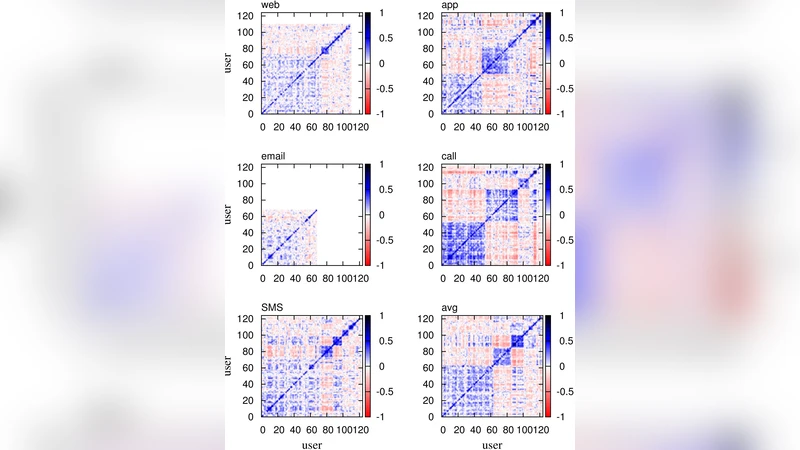
Finally, the paper constructs a “behavioral overlap network.” Each user’s weekly service usage pattern is represented as a 168‑dimensional vector (24 h × 7 days). Pairwise cosine similarity yields a weighted network where edge strength reflects similarity in temporal usage profiles. Community detection on this network reveals clusters of users with analogous habits. When compared to the actual communication network derived from call and SMS logs, the two networks exhibit a high structural correlation (Pearson r ≈ 0.73) and similar clustering coefficients. This demonstrates that similarity in service usage patterns is a strong proxy for underlying social ties.
In summary, the study integrates (1) robust context detection from GPS trajectories, (2) entropy‑based diversity metrics, (3) conditional probability analysis of service sequences, and (4) network‑level comparison of behavioral and communication graphs. The findings confirm that handset data can simultaneously capture the spatial contexts, temporal rhythms, and social structures of human activity. The methodology offers valuable tools for smart‑city planning, targeted advertising, and predictive modeling of user behavior, while also highlighting the need for careful handling of privacy and ethical considerations in large‑scale mobile data research.
Comments & Academic Discussion
Loading comments...
Leave a Comment