The Decentralized Structure of Collective Attention on the Web
Background: The collective browsing behavior of users gives rise to a flow network transporting attention between websites. By analyzing the structure of this network we uncovered a nontrivial scaling regularity concerning the impact of websites. Methodology: We constructed three clickstreams networks, whose nodes were websites and edges were formed by the users switching between sites. We developed an indicator Ci as a measure of the impact of site i and investigated its correlation with the traffic of the site Ai both on the three networks and across the language communities within the networks. Conclusions: We found that the impact of websites increased slower than their traffic. Specifically, there existed a scaling relationship between Ci and Ai with an exponent gamma smaller than 1. We suggested that this scaling relationship characterized the decentralized structure of the clickstream circulation: the World Wide Web is a system that favors small sites in reassigning the collective attention of users.
💡 Research Summary
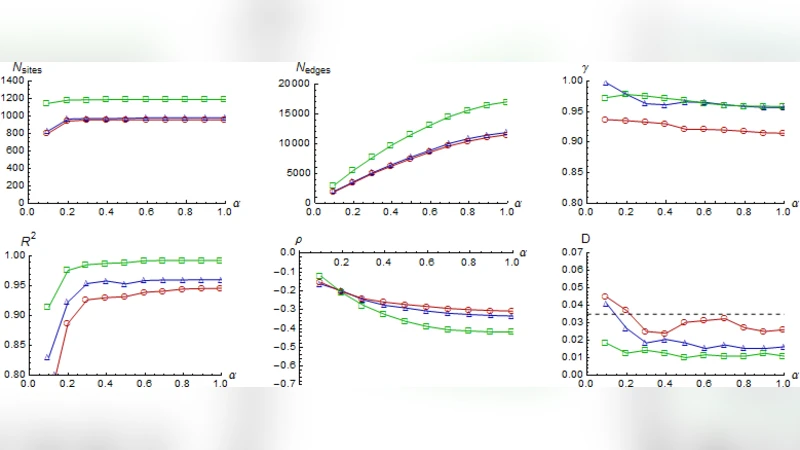
The paper investigates the collective browsing behavior of Internet users by constructing and analysing click‑stream networks, where nodes represent websites and directed weighted edges represent the proportion of global users who move from one site to another in a single browsing step. Three such networks (denoted w₁, w₂, and w₃) were built from data obtained from Google statistics and Alexa rankings at three different time points. Each network contains roughly 1,000–1,200 sites and 10,000–17,000 directed edges, capturing the “backbone” of the most significant click‑streams rather than the full set of possible transitions (Alexa supplies only the top ten inbound and outbound streams per site).
The authors introduce two key quantities for each site i:
- Traffic Aᵢ – the total volume of click‑streams entering or leaving site i (i.e., the sum of the balanced flow f′ᵢₖ over all outgoing edges).
- Impact Cᵢ – a measure of how much of the overall click‑stream circulation is controlled by site i, taking into account both direct and indirect pathways through the network.
To compute Cᵢ, the network is first balanced by adding artificial “source” and “sink” nodes so that inflow equals outflow at every real node. The balanced flow matrix F′ is row‑normalised to obtain a stochastic transition matrix M, where mᵢⱼ is the probability that a random user visits j immediately after i. The matrix U = (I – M)⁻¹ = I + M + M² + … captures the expected number of visits from i to j over all possible path lengths. The impact is then defined as Cᵢ = Gᵢ·∑ₖ uᵢₖ, where Gᵢ aggregates the flow from the source to i, weighted by the entries of U. This formulation ensures that Cᵢ reflects not only the immediate traffic through i but also its role as a conduit for traffic that subsequently passes through other sites.
The central empirical finding is a scaling relationship between impact and traffic: \
Comments & Academic Discussion
Loading comments...
Leave a Comment