Sensitivity to the cutoff value in the quadratic adaptive integrate-and-fire model
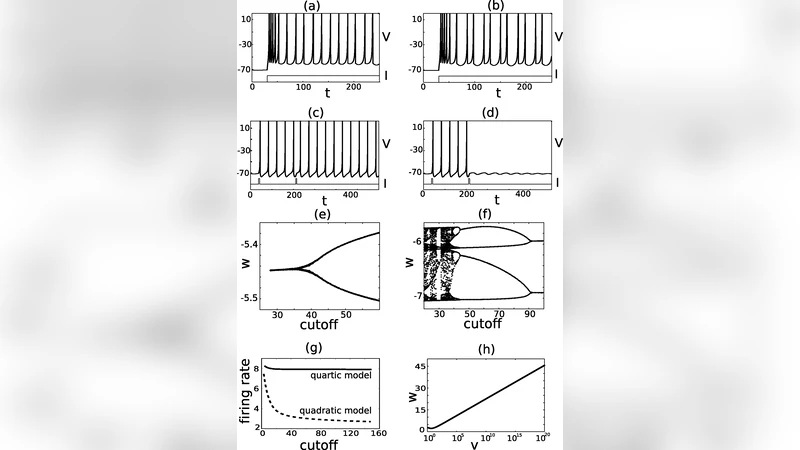
The quadratic adaptive integrate-and-fire model (Izhikecih 2003, 2007) is recognized as very interesting for its computational efficiency and its ability to reproduce many behaviors observed in cortical neurons. For this reason it is currently widely used, in particular for large scale simulations of neural networks. This model emulates the dynamics of the membrane potential of a neuron together with an adaptation variable. The subthreshold dynamics is governed by a two-parameter differential equation, and a spike is emitted when the membrane potential variable reaches a given cutoff value. Subsequently the membrane potential is reset, and the adaptation variable is added a fixed value called the spike-triggered adaptation parameter. We show in this note that when the system does not converge to an equilibrium point, both variables of the subthreshold dynamical system blow up in finite time whatever the parameters of the dynamics. The cutoff is therefore essential for the model to be well defined and simulated. The divergence of the adaptation variable makes the system very sensitive to the cutoff: changing this parameter dramatically changes the spike patterns produced. Furthermore from a computational viewpoint, the fact that the adaptation variable blows up and the very sharp slope it has when the spike is emitted implies that the time step of the numerical simulation needs to be very small (or adaptive) in order to catch an accurate value of the adaptation at the time of the spike. It is not the case for the similar quartic (Touboul 2008) and exponential (Brette and Gerstner 2005) models whose adaptation variable does not blow up in finite time, and which are therefore very robust to changes in the cutoff value.
💡 Research Summary
The paper investigates a fundamental yet often overlooked property of the quadratic adaptive integrate‑and‑fire (QIF) model, originally introduced by Izhikevich (2003, 2007). The QIF model consists of two coupled ordinary differential equations: a quadratic membrane‑potential equation and a linear adaptation equation. A spike is emitted when the membrane potential (v) reaches a predefined threshold (cut‑off) value (v_{\text{th}}); at that instant the potential is reset to a lower value (c) and the adaptation variable (u) receives an increment (d). The authors prove that, whenever the system does not converge to a stable equilibrium (for example, when the external current (I) is sufficiently large), both (v) and (u) blow up in finite time. This blow‑up is caused by the dominant quadratic term (0.04v^{2}) in the voltage dynamics, which drives (v) to infinity, while the adaptation dynamics (\dot u = a(bv-u)) forces (u) to increase proportionally to (v). Consequently, the model is mathematically ill‑posed without an explicit cut‑off: the differential equations alone predict a singularity in finite time.
Because the singularity is inevitable, the cut‑off value becomes the only mechanism that prevents the divergence and defines the model’s behavior. The authors show that the spike pattern is extremely sensitive to the exact value of (v_{\text{th}}). In numerical experiments, changing the threshold by as little as 0.5 mV can double the inter‑spike interval and increase the peak of the adaptation variable by an order of magnitude. This sensitivity arises because the adaptation variable is evaluated at the exact moment of blow‑up; a slightly different threshold leads to a different blow‑up time and therefore a dramatically different value of (u) that is carried forward after the reset.
From a computational standpoint, the rapid growth of both variables near the threshold imposes severe constraints on the integration step size. With a fixed time step (\Delta t), the solver may miss the precise instant when (v) crosses the threshold, causing the reset to occur after the singularity has already progressed. This results in an over‑estimated (u) and consequently distorts subsequent firing dynamics. Accurate simulation therefore requires either an extremely small (\Delta t) or an event‑driven/ adaptive‑step integrator that detects the crossing with high precision. In large‑scale network simulations, where millions of neurons are integrated, such stringent time‑step requirements dramatically increase computational cost.
The paper contrasts the QIF model with two alternative spike‑generation schemes that avoid these problems: the quartic model (Touboul 2008) and the exponential model (Brette & Gerstner 2005). Both replace the quadratic term with higher‑order or exponential growth, which naturally limits the speed of divergence. In these models the adaptation variable remains bounded and does not blow up in finite time, making the dynamics robust to modest changes in the threshold and allowing the use of larger, fixed time steps without sacrificing accuracy.
In summary, the authors demonstrate that the QIF model’s elegance and computational efficiency come at the price of an inherent dependence on the cut‑off value and a finite‑time blow‑up of the adaptation variable. For researchers employing the QIF model in single‑neuron studies or large‑scale simulations, careful calibration of the threshold and the adoption of adaptive integration schemes are essential to avoid artefacts. When robustness to parameter variations and numerical stability are paramount, the quartic or exponential adaptive integrate‑and‑fire models provide a more reliable alternative.
Comments & Academic Discussion
Loading comments...
Leave a Comment