Electoral Susceptibility
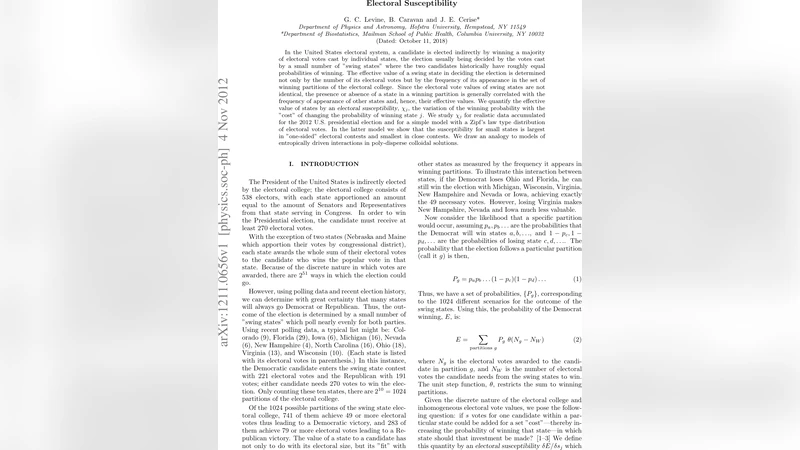
In the United States electoral system, a candidate is elected indirectly by winning a majority of electoral votes cast by individual states, the election usually being decided by the votes cast by a small number of “swing states” where the two candidates historically have roughly equal probabilities of winning. The effective value of a swing state in deciding the election is determined not only by the number of its electoral votes but by the frequency of its appearance in the set of winning partitions of the electoral college. Since the electoral vote values of swing states are not identical, the presence or absence of a state in a winning partition is generally correlated with the frequency of appearance of other states and, hence, their effective values. We quantify the effective value of states by an {\sl electoral susceptibility}, $\chi_j$, the variation of the winning probability with the “cost” of changing the probability of winning state $j$. We study $\chi_j$ for realistic data accumulated for the 2012 U.S. presidential election and for a simple model with a Zipf’s law type distribution of electoral votes. In the latter model we show that the susceptibility for small states is largest in “one-sided” electoral contests and smallest in close contests. We draw an analogy to models of entropically driven interactions in poly-disperse colloidal solutions.
💡 Research Summary
The paper introduces a novel quantitative measure called “electoral susceptibility” (χ j) to assess the real impact of swing states in the United States presidential election. In the Electoral College system a candidate wins by securing a majority of the 538 electoral votes, but the outcome is usually decided by a handful of swing states whose individual probabilities of voting for either candidate are roughly equal. Traditional analyses treat a state’s influence as proportional to its electoral‑vote count, ignoring the fact that the same number of votes can have very different effects depending on which other states are also won. χ j captures this nuance by measuring how the overall winning probability P changes when the probability pj of winning a particular state j is perturbed: χ j = ∂P/∂pj. The “cost” associated with changing pj can be interpreted as campaign resources such as advertising spend, ground operations, or voter‑mobilization efforts.
The authors first apply the concept to real data from the 2012 presidential election. Using pre‑election polling and historical voting patterns they estimate pj for each swing state and enumerate every possible winning partition of the Electoral College (all 2S combinations, where S is the number of swing states). Each partition’s probability is computed under the assumption of independent Bernoulli outcomes, and those that exceed the 270‑vote threshold are identified as winning partitions. By aggregating the contributions of each partition they obtain the total winning probability P and then evaluate χ j for every state. The analysis reveals strong correlations among states: when large‑vote states such as Florida (29 votes) and Pennsylvania (20 votes) are both in a winning partition, the marginal contribution of small‑vote states like Nevada (6 votes) or Connecticut (7 votes) diminishes. Consequently, χ j is highest for the biggest swing states and lowest for the smallest, but the ranking is not a simple monotonic function of electoral‑vote count.
To explore the underlying mechanisms, the paper constructs a stylized model in which electoral votes follow a Zipf distribution: the i‑th largest state receives N / i votes (N being the total number of votes). This captures the empirical observation that a few states hold the bulk of electoral power while many hold only a few votes. Within this framework the authors examine two regimes. In a “one‑sided” contest, where one candidate already controls more than half of the votes, the susceptibility of small states becomes relatively large because any additional votes from a small state can push the total over the majority threshold, producing a steep increase in P. In a “close” contest, where both candidates are near the 270‑vote mark, the susceptibility of large states dominates; adding a few votes from a big state dramatically changes the outcome, while the effect of a small state is muted.
The authors draw an analogy to entropically driven interactions in polydisperse colloidal solutions. In such physical systems large particles exclude or trap small particles, thereby influencing the system’s free energy more than the small particles do when the large particles already dominate the structure. Similarly, in the Electoral College the “size” of a state (its vote count) and its position within a winning partition jointly determine its effective influence, as captured by χ j.
Practically, the study suggests that campaign resources should be allocated according to electoral susceptibility rather than raw electoral‑vote counts. In a one‑sided scenario, even low‑vote swing states merit attention because their χ j is comparatively high; in a tight race, focusing on the high‑χ j large states yields the greatest marginal gain in overall winning probability. χ j therefore provides a scientifically grounded tool for optimizing campaign strategy, complementing traditional swing‑state lists.
In conclusion, by defining and empirically validating electoral susceptibility, the paper offers a deeper understanding of how swing states interact within the combinatorial structure of the Electoral College. It bridges political science with statistical physics, opening new avenues for analyzing complex, interdependent decision‑making systems.
Comments & Academic Discussion
Loading comments...
Leave a Comment