Diffeomorphism groups of non-compact manifolds endowed with the Whitney C^infty-topology
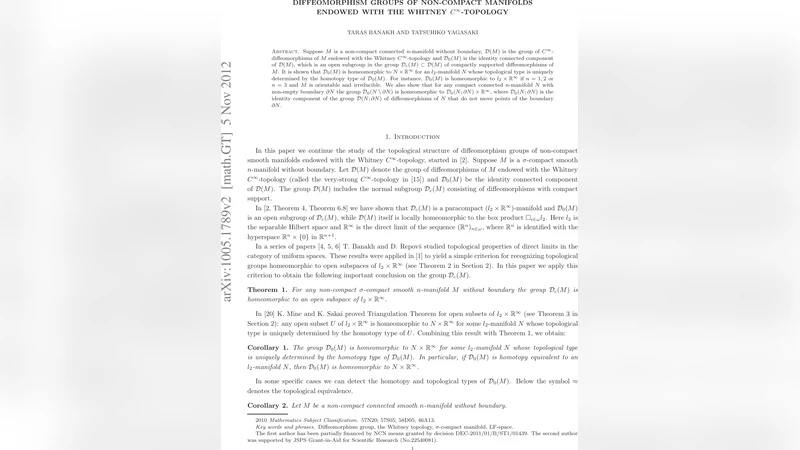
Suppose M is a non-compact connected n-manifold without boundary, DD(M) is the group of C^\infty-diffeomorphisms of M endowed with the Whitney C^\infty-topology and DD_0(M) is the identity connected component of DD(M), which is an open subgroup in the group DD_c(M) \subset DD(M) of compactly supported diffeomorphisms of M. It is shown that DD_0(M) is homeomorphic to N \times IR^\infty for an l_2-manifold N whose topological type is uniquely determined by the homotopy type of DD_0(M). For instance, DD_0(M) is homeomorphic to l_2 \times IR^\infty if n = 1, 2 or n = 3 and M is orientable and irreducible. We also show that for any compact connected n-manifold N with non-empty boundary \partial N the group DD_0(N - \partial N) is homeomorphic to DD_0(N; \partial N) \times IR^\infty, where DD_0(N;\partial N) is the identity component of the group DD(N;\partial N) of diffeomorphisms of N that do not move points of the boundary \partial N.
💡 Research Summary
The paper investigates the diffeomorphism group Diff (M) of a non‑compact, connected n‑manifold M without boundary, equipped with the Whitney C^∞‑topology, and its identity component Diff₀ (M). The authors first isolate the subgroup Diff_c (M) consisting of compactly supported diffeomorphisms and show that Diff₀ (M) is an open subgroup of Diff_c (M). By expressing M as an increasing union of compact submanifolds K₁⊂K₂⊂… and considering the direct limit of the restriction maps Diff(K_i)→Diff(K_{i+1}), they obtain a concrete description of the topology on Diff_c (M). The Whitney C^∞‑topology, being Fréchet‑type, guarantees that each stage of this limit inherits a product structure of a separable Hilbert space l₂ and an infinite‑dimensional Euclidean factor ℝ^∞.
The central theorem asserts that Diff₀ (M) is homeomorphic to N × ℝ^∞, where N is an l₂‑manifold whose topological type is uniquely determined by the homotopy type of Diff₀ (M). In particular, when n = 1, 2, or 3 and M is orientable and irreducible, N itself is homeomorphic to l₂, so Diff₀ (M) ≅ l₂ × ℝ^∞. The proof for low dimensions relies on classical classification results: for n = 1 the diffeomorphism group of the line or circle is known to be an l₂‑manifold; for n = 2 the mapping class group of a surface is discrete, and the identity component is contractible, leading to an l₂‑structure; for n = 3 the irreducibility hypothesis together with the Smale conjecture (proved by Hatcher) yields a contractible identity component, again forcing N ≅ l₂.
The paper also treats manifolds with boundary. Let N be a compact connected n‑manifold with non‑empty boundary ∂N. The authors prove that the identity component of the diffeomorphism group of the interior, Diff₀(N \ ∂N), splits as a product Diff₀(N;∂N) × ℝ^∞, where Diff₀(N;∂N) consists of diffeomorphisms fixing the boundary pointwise. The argument uses extension and restriction maps that are continuous in the Whitney topology, together with a careful analysis of the “end” structure of N \ ∂N. The boundary‑fixing condition guarantees that the extension of a compactly supported diffeomorphism from the interior to the whole manifold does not create new topological complexity, allowing the ℝ^∞ factor to be isolated.
Overall, the work extends the well‑known description of diffeomorphism groups for compact manifolds (where Diff₀ is often an l₂‑manifold) to the non‑compact setting, revealing a universal product decomposition Diff₀ (M) ≅ N × ℝ^∞. This decomposition shows that the infinite‑dimensional topology of Diff₀ (M) is governed by two independent pieces: an l₂‑manifold encoding the homotopy‑type information, and a Hilbert‑cube‑like factor ℝ^∞ accounting for the “support‑moving” degrees of freedom. The results provide a new framework for classifying infinite‑dimensional diffeomorphism groups, suggest avenues for studying their homotopy and homology, and illustrate how boundary conditions influence the product structure. The paper thus bridges gaps between infinite‑dimensional topology, geometric topology of manifolds, and the theory of transformation groups.
Comments & Academic Discussion
Loading comments...
Leave a Comment