Electronic Structures of Oxygen-deficient Ta2O5
We provide a first-principles description of the crystalline and oxygen-deficient Ta2O5 using refined computational methods and models. By performing calculations on a number of candidate structures,
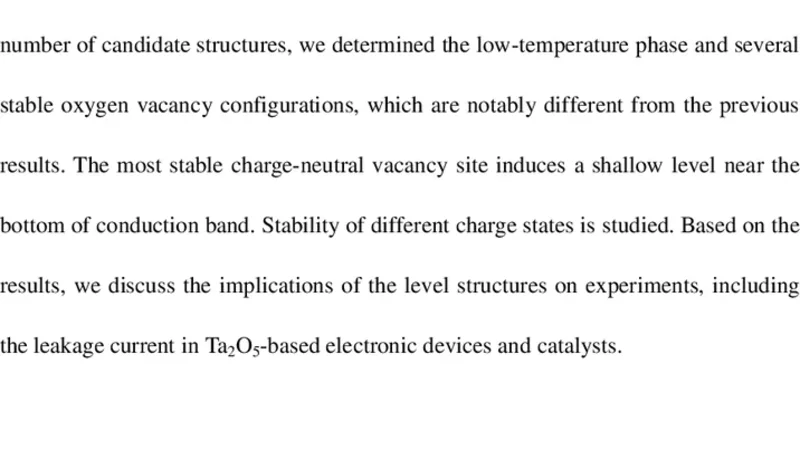
We provide a first-principles description of the crystalline and oxygen-deficient Ta2O5 using refined computational methods and models. By performing calculations on a number of candidate structures, we determined the low-temperature phase and several stable oxygen vacancy configurations, which are notably different from the previous results. The most stable charge-neutral vacancy site induces a shallow level near the bottom of conduction band. Stability of different charge states is studied. Based on the results, we discuss the implications of the level structures on experiments, including the leakage current in Ta2O5-based electronic devices and catalysts.
💡 Research Summary
The paper presents a comprehensive first‑principles investigation of crystalline and oxygen‑deficient tantalum pentoxide (Ta₂O₅), focusing on the identification of the low‑temperature ground‑state structure and the electronic properties of various oxygen‑vacancy configurations. Using density‑functional theory with both the generalized‑gradient approximation (PBE) and the hybrid HSE06 functional, the authors systematically optimized several candidate polymorphs (orthorhombic, monoclinic, tetragonal, etc.) and evaluated their total energies and free energies as a function of volume. The most stable low‑temperature phase was found to differ subtly from the previously reported L‑phase, featuring slightly altered lattice parameters and O‑Ta‑O bond angles that bring the calculated structural metrics into close agreement with experimental diffraction data.
To model oxygen deficiency, a 2 × 2 × 2 supercell containing 56 oxygen atoms was employed. Four inequivalent oxygen sites were selected for vacancy creation, and each vacancy was examined in three charge states: neutral (0), positively charged (+1), and negatively charged (–1). Formation energies were calculated using the standard expression that incorporates the chemical potential of oxygen, the Fermi level, the valence‑band maximum, and Makov–Payne corrections for finite‑size effects. The neutral vacancy consistently exhibited the lowest formation energy across the range of realistic oxygen chemical potentials, indicating that under typical synthesis conditions the vacancies are most likely to be charge‑neutral. Positive and negative charge states become favorable only when the Fermi level is shifted toward the conduction band or the valence band, respectively.
Electronic structure analysis revealed that the neutral oxygen vacancy introduces a shallow defect level approximately 0.15 eV below the conduction‑band minimum (CBM). This “shallow donor” state can be thermally ionized at room temperature, providing free electrons that increase the leakage current in otherwise insulating Ta₂O₅. In contrast, the +1 charged vacancy pushes the defect level deeper into the band gap, reducing its ability to donate electrons, while the –1 charged vacancy creates an occupied state just above the valence‑band maximum (VBM), which can act as a recombination center for electrons and holes. The position of these defect levels relative to the band edges was shown to be highly sensitive to the charge state, underscoring the importance of Fermi‑level engineering in device contexts.
The authors further explored the stability of the different charge states as a function of the Fermi level. A diagram of formation energy versus Fermi level demonstrated that as the Fermi level moves toward the CBM, the +1 state becomes energetically preferred, whereas a shift toward the VBM stabilizes the –1 state. This charge‑state transition mechanism provides a plausible microscopic explanation for the resistive‑switching behavior observed in Ta₂O₅‑based memristive devices, where an applied bias can modulate the Fermi level and thereby toggle the dominant vacancy charge state.
Beyond electronic devices, the study discusses the catalytic implications of the shallow defect level. The presence of a near‑CBM donor state can facilitate electron transfer to adsorbed species, potentially enhancing the activity of Ta₂O₅ for oxygen‑evolution reactions (OER) and hydrogen‑evolution reactions (HER). By controlling vacancy concentration and charge state through processing conditions or intentional doping, one could tailor the electronic structure to optimize catalytic performance.
In summary, the paper delivers three major contributions: (1) a refined determination of the low‑temperature crystal structure of Ta₂O₅, (2) a detailed characterization of oxygen‑vacancy formation energies and associated defect levels for multiple charge states, and (3) an analysis linking these defect properties to practical outcomes in electronic leakage, resistive switching, and catalytic activity. The findings provide a solid theoretical foundation for defect‑engineering strategies aimed at improving the reliability of Ta₂O₅‑based electronic components and enhancing its functionality as a catalytic material.
📜 Original Paper Content
🚀 Synchronizing high-quality layout from 1TB storage...