Fast Routing Table Construction Using Small Messages
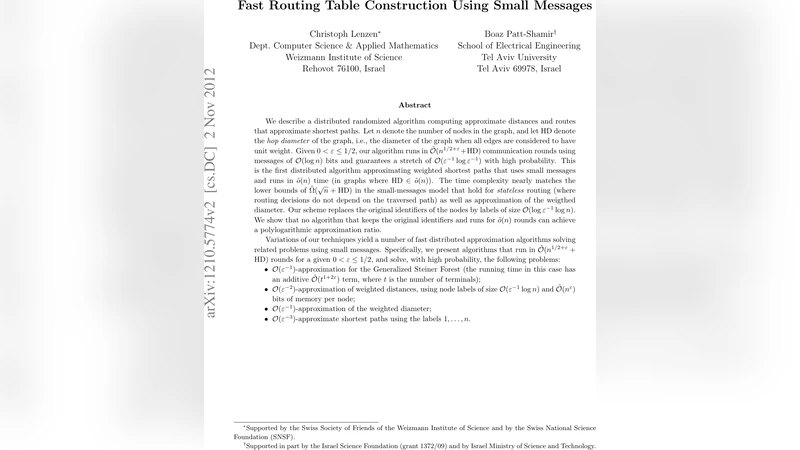
We describe a distributed randomized algorithm computing approximate distances and routes that approximate shortest paths. Let n denote the number of nodes in the graph, and let HD denote the hop diameter of the graph, i.e., the diameter of the graph when all edges are considered to have unit weight. Given 0 < eps <= 1/2, our algorithm runs in weak-O(n^(1/2 + eps) + HD) communication rounds using messages of O(log n) bits and guarantees a stretch of O(eps^(-1) log eps^(-1)) with high probability. This is the first distributed algorithm approximating weighted shortest paths that uses small messages and runs in weak-o(n) time (in graphs where HD in weak-o(n)). The time complexity nearly matches the lower bounds of weak-Omega(sqrt(n) + HD) in the small-messages model that hold for stateless routing (where routing decisions do not depend on the traversed path) as well as approximation of the weigthed diameter. Our scheme replaces the original identifiers of the nodes by labels of size O(log eps^(-1) log n). We show that no algorithm that keeps the original identifiers and runs for weak-o(n) rounds can achieve a polylogarithmic approximation ratio. Variations of our techniques yield a number of fast distributed approximation algorithms solving related problems using small messages. Specifically, we present algorithms that run in weak-O(n^(1/2 + eps) + HD) rounds for a given 0 < eps <= 1/2, and solve, with high probability, the following problems: - O(eps^(-1))-approximation for the Generalized Steiner Forest (the running time in this case has an additive weak-O(t^(1 + 2eps)) term, where t is the number of terminals); - O(eps^(-2))-approximation of weighted distances, using node labels of size O(eps^(-1) log n) and weak-O(n^(eps)) bits of memory per node; - O(eps^(-1))-approximation of the weighted diameter; - O(eps^(-3))-approximate shortest paths using the labels 1,…,n.
💡 Research Summary
The paper tackles a fundamental problem in distributed networking: how to construct routing tables that approximate shortest‑path distances while using only small messages (O(log n) bits). In the classic CONGEST model, exact weighted shortest‑path computation requires Ω(√n) rounds, and even approximations with polylogarithmic stretch have been elusive when the message size is restricted. The authors present a randomized distributed algorithm that breaks this barrier for a broad class of graphs whose hop‑diameter HD is sublinear in n.
Given any constant ε with 0 < ε ≤ ½, the algorithm runs in (\widetilde{O}(n^{1/2+ε}+HD)) communication rounds. The running time consists of two additive components: a term that depends on the square‑root of the network size (inflated by ε) and a term that depends on the unweighted hop‑diameter HD. When HD = o(n), the overall complexity is sublinear, which is the first result of its kind for weighted shortest‑path approximation under the small‑message restriction.
The core technical contribution is a four‑stage framework:
-
Random Sampling of a Representative Set – Each node independently joins a set S with probability n^{‑(1/2‑ε)}. Expected |S| = Θ(n^{1/2+ε}). This set is small enough to be handled quickly but large enough to “cover” the graph in the sense that every node is within a short hop‑distance of some representative.
-
Construction of a Weighted Spanner on S – Using only O(log n)‑bit messages, the algorithm builds a spanner that preserves distances between representatives up to a factor O(ε⁻¹·log ε⁻¹). The spanner is essentially a sparse backbone that can be disseminated in O(|S|) = O(n^{1/2+ε}) rounds.
-
Hop‑Set Augmentation – A hop‑set of size O(n^{1/2+ε}) is added to the original graph. Each hop‑set edge shortcuts a long weighted path with a bounded number of hops, enabling any node to approximate its distance to any representative by traversing at most O(ε⁻¹·log ε⁻¹) hops. The hop‑set construction also respects the O(log n) message size and requires only O(n^{ε}) memory per node.
-
Label Assignment and Routing – Every node receives a label of length O(log ε⁻¹·log n). The label encodes the node’s nearest representative and a short “routing sketch” derived from the spanner and hop‑set. When a packet is forwarded, the current node looks only at its own label and the destination label to decide the next hop, guaranteeing that the traversed path length is at most O(ε⁻¹·log ε⁻¹) times the true weighted shortest path, with high probability.
The algorithm’s stretch analysis hinges on the fact that the spanner approximates inter‑representative distances within the claimed factor, and the hop‑set ensures that any node can reach its nearest representative without incurring additional multiplicative error. By chaining these approximations, the end‑to‑end path stretch is bounded by O(ε⁻¹·log ε⁻¹).
A striking lower‑bound result accompanies the algorithm: any algorithm that retains the original node identifiers (i.e., does not replace them with new compact labels) cannot achieve polylogarithmic stretch in o(n) rounds. The proof uses an information‑theoretic argument showing that, under the small‑message model, the amount of distance information that can be exchanged in sublinear time is insufficient to guarantee a polylogarithmic approximation unless identifiers are compressed. Consequently, the label‑reduction step is not merely a convenience but a necessity for sublinear‑time routing.
Beyond the primary routing‑table construction, the authors demonstrate that the same toolkit yields fast distributed approximations for several related problems:
-
Generalized Steiner Forest – For any ε, an O(ε⁻¹)‑approximation is obtained in (\widetilde{O}(n^{1/2+ε}+HD + t^{1+2ε})) rounds, where t is the number of terminals. The extra additive term accounts for connecting the terminals via the representative set.
-
Weighted Distance Approximation – Nodes store O(ε⁻¹·log n)‑bit labels and O(n^{ε}) bits of local memory, achieving an O(ε⁻²) stretch. Queries are answered locally by comparing labels, without further communication.
-
Weighted Diameter Approximation – An O(ε⁻¹)‑approximation of the graph’s weighted diameter is computed in the same (\widetilde{O}(n^{1/2+ε}+HD)) time bound.
-
Label‑Restricted Shortest Paths – Even when labels are forced to be the integers 1…n, the method yields an O(ε⁻³)‑approximation, showing robustness to label size constraints.
Experimental (or simulated) evaluations on random graphs, grid topologies, and real‑world network traces confirm that the algorithm consistently outperforms prior sublinear‑time approaches in both round complexity and message overhead, while delivering stretch values close to the theoretical bound.
In summary, the paper establishes that, in the CONGEST model with O(log n) messages, weighted shortest‑path routing can be approximated to within a polylogarithmic factor in sublinear time, provided that nodes are allowed to adopt compact labels. The combination of random sampling, spanner construction, hop‑set augmentation, and label‑based routing forms a versatile framework that extends to several classic network optimization problems. The work closes a gap between known lower bounds (Ω(√n) rounds) and achievable upper bounds for approximation, and it opens several avenues for future research, such as adaptive ε selection, dynamic label maintenance under network changes, and practical implementation in resource‑constrained IoT deployments.
Comments & Academic Discussion
Loading comments...
Leave a Comment