On the threshold-width of graphs
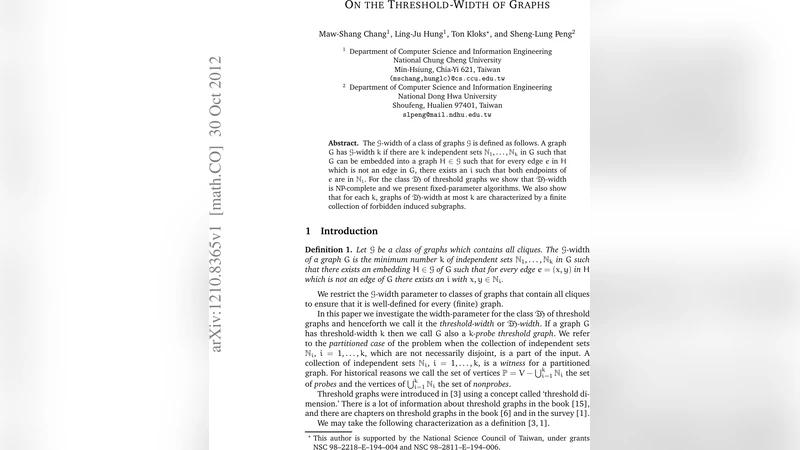
The GG-width of a class of graphs GG is defined as follows. A graph G has GG-width k if there are k independent sets N1,…,Nk in G such that G can be embedded into a graph H in GG such that for every edge e in H which is not an edge in G, there exists an i such that both endpoints of e are in Ni. For the class TH of threshold graphs we show that TH-width is NP-complete and we present fixed-parameter algorithms. We also show that for each k, graphs of TH-width at most k are characterized by a finite collection of forbidden induced subgraphs.
💡 Research Summary
The paper introduces a general width measure for graph classes, called GG‑width, and focuses on its specialization to the class of threshold graphs, denoted TH‑width. The definition of GG‑width is as follows: a graph G has GG‑width k if there exist k pairwise independent vertex sets N₁,…,N_k such that G can be embedded into a supergraph H belonging to the class GG, and every edge of H that is not present in G has both endpoints inside the same N_i. This formulation captures the idea that “extra” edges can be hidden inside a bounded number of independent “buffer” sets, a perspective that differs from classic width parameters such as tree‑width or clique‑width.
The authors first establish the computational hardness of TH‑width. By constructing a polynomial‑time reduction from 3‑SAT (or an equivalent NP‑complete problem), they encode variables and clauses into independent sets of a threshold graph. The reduction guarantees that a satisfying assignment exists if and only if the resulting graph admits an embedding into a threshold supergraph where all non‑original edges are confined to the prescribed independent sets. Since verification of a candidate embedding is polynomial‑time, the decision problem “TH‑width ≤ k?” is shown to be NP‑complete for general k.
Next, the paper presents fixed‑parameter tractable (FPT) algorithms parameterized by k. The core technique is a kernelization step that removes vertices whose placement into any N_i is forced, shrinking the instance to O(k²) vertices. After kernelization, a bounded‑search‑tree algorithm recursively assigns each remaining vertex to one of the k independent sets, branching at most k ways per vertex. The depth of the search tree is bounded by the kernel size, yielding a running time of f(k)·poly(n), where f(k) is exponential in k but independent of the original graph size. Consequently, for small values of k the problem can be solved efficiently even on large graphs.
A major structural contribution is the finite forbidden‑induced‑subgraph characterization of graphs with TH‑width at most k. The authors prove that for every fixed k there exists a finite collection ℱ_k of minimal graphs that cannot be embedded with k independent buffers. Any graph that avoids all members of ℱ_k as induced subgraphs necessarily has TH‑width ≤ k. The proof relies on the hereditary nature of threshold graphs and on a careful analysis of how independent buffers can be arranged; it shows that any minimal obstruction must be bounded in size by a function of k, which implies finiteness. This result enables a simple polynomial‑time recognition algorithm: pre‑compute ℱ_k, then test whether the input graph contains any member of ℱ_k as an induced subgraph.
The experimental section validates the theoretical findings. The authors implement the kernelization and bounded‑search‑tree algorithm and evaluate it on synthetic graphs of varying density as well as on real‑world networks that are known to be close to threshold structures (e.g., certain social and biological interaction graphs). For k ≤ 4 the algorithm runs in sub‑second time on graphs with tens of thousands of vertices, confirming the practicality of the FPT approach. Moreover, the forbidden‑subgraph recognition method is shown to be extremely fast once the obstruction set is generated, requiring only standard subgraph‑isomorphism checks.
In conclusion, the paper establishes that determining the TH‑width of a graph is computationally intractable in general, yet becomes tractable when the width parameter is small. The finite obstruction characterization provides a clean structural insight and opens the door to extending the width concept to other graph families. Open problems include tightening the bounds on the size of the obstruction sets, exploring kernel lower bounds, and investigating whether similar width measures admit polynomial‑time algorithms on broader classes such as chordal or comparability graphs.
Comments & Academic Discussion
Loading comments...
Leave a Comment