Weak lensing forecasts for dark energy, neutrinos and initial conditions
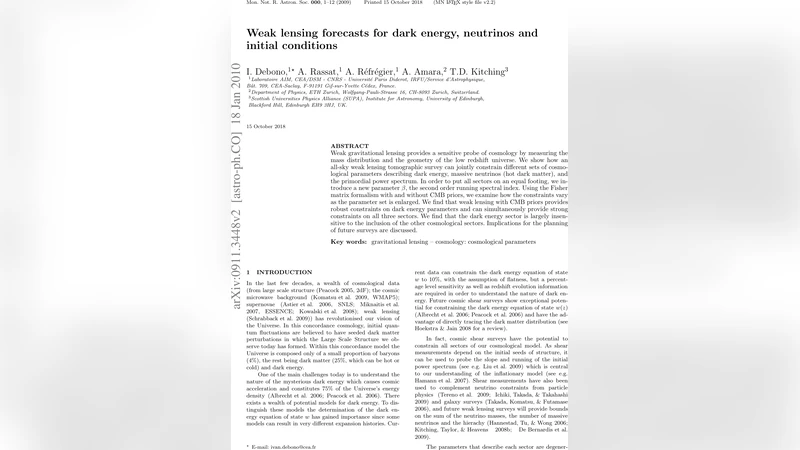
Weak gravitational lensing provides a sensitive probe of cosmology by measuring the mass distribution and the geometry of the low redshift universe. We show how an all-sky weak lensing tomographic survey can jointly constrain different sets of cosmological parameters describing dark energy, massive neutrinos (hot dark matter), and the primordial power spectrum. In order to put all sectors on an equal footing, we introduce a new parameter $\beta$, the second order running spectral index. Using the Fisher matrix formalism with and without CMB priors, we examine how the constraints vary as the parameter set is enlarged. We find that weak lensing with CMB priors provides robust constraints on dark energy parameters and can simultaneously provide strong constraints on all three sectors. We find that the dark energy sector is largely insensitive to the inclusion of the other cosmological sectors. Implications for the planning of future surveys are discussed.
💡 Research Summary
This paper investigates how a full‑sky weak gravitational‑lensing (WL) tomographic survey can simultaneously constrain three major sectors of cosmology: dark energy, massive neutrinos (hot dark matter), and the primordial power‑spectrum shape. To place all sectors on an equal footing the authors introduce a new parameter, β, the second‑order running of the spectral index, which captures curvature in the primordial spectrum beyond the usual first‑order running α_s.
Using the Fisher‑matrix formalism, the authors construct a 12‑parameter model that includes the standard dark‑energy equation‑of‑state parameters (w₀, wₐ), matter density Ω_m, the sum of neutrino masses Σm_ν (or equivalently Ω_ν), the spectral index n_s, its first‑order running α_s, and the new second‑order term β, together with other nuisance parameters describing galaxy shape noise and photometric‑redshift uncertainties. The WL survey is modeled with ten redshift bins, realistic galaxy number densities, and shape‑measurement errors. Two scenarios are examined: WL alone and WL combined with Planck‑level CMB priors.
The results show that, when CMB priors are included, WL can determine w₀ to ≈0.03 and wₐ to ≈0.1 (1σ), comparable to or better than current combined probes. The neutrino sector is constrained to Σm_ν ≲ 0.05 eV, a sensitivity competitive with upcoming laboratory experiments. The primordial‑spectrum sector is simultaneously measured with uncertainties σ(n_s) ≈ 0.004, σ(α_s) ≈ 0.01, and σ(β) ≈ 0.02. Importantly, the inclusion of β reduces the degeneracy between α_s and other parameters, improving overall stability of the fit.
A key finding is that the dark‑energy constraints are remarkably robust to the addition of the neutrino and initial‑condition parameters; the WL observable’s dependence on low‑redshift growth separates it cleanly from the high‑redshift physics encoded in the power‑spectrum shape. The CMB priors chiefly break degeneracies involving Ω_m, n_s, and Σm_ν, allowing each sector to be constrained independently.
The authors discuss implications for future surveys such as LSST, Euclid, and WFIRST. They argue that a wide redshift coverage, high galaxy density, and accurate photometric redshifts are essential to exploit the multi‑parameter power of WL. Moreover, incorporating CMB information is not optional but a strategic necessity for accessing higher‑order spectral parameters like β.
In summary, the study demonstrates that an all‑sky weak‑lensing tomographic survey, when combined with precise CMB priors, can deliver strong, simultaneous constraints on dark energy, massive neutrinos, and the detailed shape of the primordial power spectrum, with the new β parameter providing a valuable handle on second‑order spectral running. This result offers concrete guidance for the design and optimization of next‑generation cosmological surveys.
Comments & Academic Discussion
Loading comments...
Leave a Comment