Square-Root Finding Problem In Graphs, A Complete Dichotomy Theorem
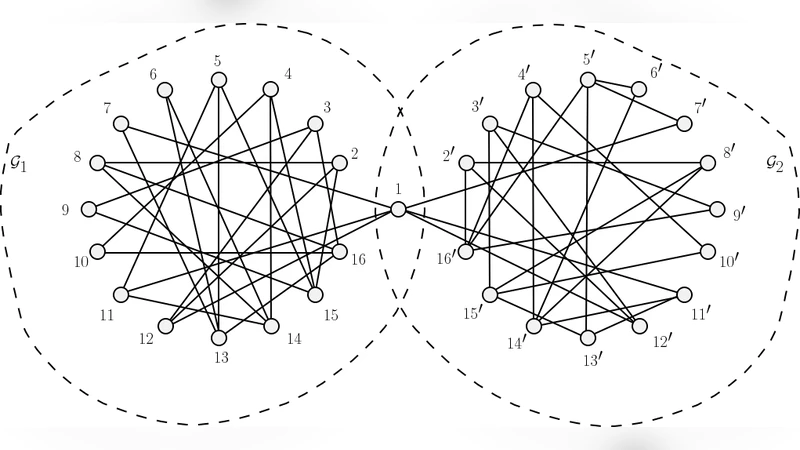
Graph G is the square of graph H if two vertices x,y have an edge in G if and only if x,y are of distance at most two in H. Given H it is easy to compute its square H^2. Determining if a given graph G is the square of some graph is not easy in general. Motwani and Sudan proved that it is NP-complete to determine if a given graph G is the square of some graph. The graph introduced in their reduction is a graph that contains many triangles and is relatively dense. Farzad et al. proved the NP-completeness for finding a square root for girth 4 while they gave a polynomial time algorithm for computing a square root of girth at least six. Adamaszek and Adamaszek proved that if a graph has a square root of girth six then this square root is unique up to isomorphism. In this paper we consider the characterization and recognition problem of graphs that are square of graphs of girth at least five. We introduce a family of graphs with exponentially many non-isomorphic square roots, and as the main result of this paper we prove that the square root finding problem is NP-complete for square roots of girth five. This proof is providing the complete dichotomy theorem for square root problem in terms of the girth of the square roots.
💡 Research Summary
The paper studies the inverse problem of graph squaring: given a graph G, decide whether there exists a graph H such that G = H², where two vertices are adjacent in G exactly when their distance in H is at most two. While computing H² from a known H is trivial, the reverse decision problem is computationally hard in general. Motwani and Sudan first proved NP‑completeness of this problem using a dense reduction that creates many triangles. Subsequent work refined the hardness landscape by restricting the girth (the length of the shortest cycle) of the sought square root. Farzad et al. showed that the problem remains NP‑complete when the square root is required to have girth 4, but they also gave a polynomial‑time algorithm for the case girth ≥ 6. Moreover, Adamaszek and Adamaszek proved that if a graph admits a square root of girth 6, that root is unique up to isomorphism.
The gap left open by these results is the status of girth 5. This paper fills that gap and, in doing so, establishes a complete dichotomy theorem for the square‑root problem parameterized by the girth of the root. The authors’ contributions can be summarised as follows.
-
Construction of a rich family of girth‑5 square‑root graphs.
The authors design a set of gadgets that consist of triangles and 5‑cycles arranged so that each gadget admits at least two distinct embeddings as a subgraph of a square root. By connecting these gadgets in a tree‑like fashion they obtain graphs G that have exponentially many non‑isomorphic square roots, all of girth 5. This shows that, unlike the girth ≥ 6 case, uniqueness is lost already at girth 5 and that the solution space can be extremely large. -
NP‑hardness reduction from 3‑SAT.
Using the gadgets, the paper builds a polynomial‑time many‑one reduction from an arbitrary 3‑SAT instance Φ to a graph GΦ. Variable gadgets encode a binary choice corresponding to a truth assignment; clause gadgets are constructed so that they can be satisfied in the square‑root representation only if at least one of their incident variable gadgets chooses the “true” embedding. Consequently, GΦ has a girth‑5 square root if and only if Φ is satisfiable. Since the reduction is parsimonious (preserving satisfiability), the decision problem for girth‑5 square roots is NP‑hard. Membership in NP is immediate (a candidate H can be guessed and verified in polynomial time), establishing NP‑completeness. -
Complete girth‑based dichotomy.
Combining the new NP‑completeness result for girth 5 with the known polynomial‑time algorithm for girth ≥ 6, the authors obtain a clean classification:- girth ≥ 6: The square‑root problem is solvable in polynomial time; any square root, if it exists, is unique up to isomorphism.
- girth ≤ 5: The problem is NP‑complete. In particular, girth 5 is the smallest girth for which the problem becomes hard, and it already admits exponentially many distinct roots.
-
Implications and future directions.
The dichotomy clarifies the exact boundary where the structural constraints on the root become strong enough to render the problem tractable. It also suggests several avenues for further research: approximation algorithms for girth ≤ 5, parameterised algorithms (e.g., by treewidth or feedback vertex set size), and cryptographic constructions that rely on the hardness of recovering a low‑girth square root from its square.
The paper is organized as follows. After an introductory section that surveys prior work and motivates the girth parameter, the authors formally define the square‑root problem, girth, and related notation. Section 2 presents the gadget construction, proves that each gadget admits multiple embeddings, and shows how to assemble them into a global graph with exponentially many square roots. Section 3 details the reduction from 3‑SAT, proving correctness in both directions and establishing NP‑completeness. Section 4 reviews the polynomial‑time algorithm for girth ≥ 6 and the uniqueness theorem, thereby completing the dichotomy. The final section discusses the broader impact of the result and outlines open problems.
In summary, the paper delivers the first complete classification of the computational complexity of finding graph square roots according to the girth of the root. It demonstrates that girth 5 is the critical threshold where the problem transitions from tractable (girth ≥ 6) to intractable (girth ≤ 5), and it enriches our understanding of the structural diversity of square roots in the hard regime. This contribution settles a long‑standing open question in graph theory and computational complexity, and it provides a solid foundation for subsequent algorithmic and theoretical investigations.
Comments & Academic Discussion
Loading comments...
Leave a Comment