Computational Lower Bounds for Colourful Simplicial Depth
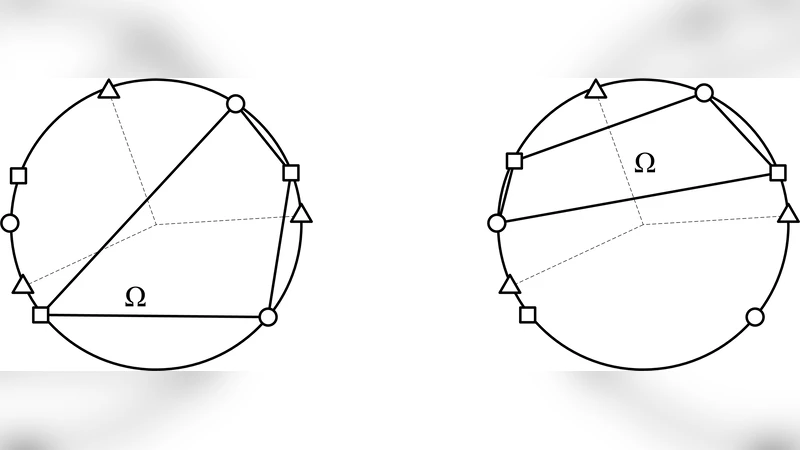
The colourful simplicial depth problem in dimension d is to find a configuration of (d+1) sets of (d+1) points such that the origin is contained in the convex hull of each set (colour) but contained in a minimal number of colourful simplices generated by taking one point from each set. A construction attaining d^2+1 simplices is known, and is conjectured to be minimal. This has been confirmed up to d=3, however the best known lower bound for d at least 4 is ((d+1)^2)/2. A promising method to improve this lower bound is to look at combinatorial octahedral systems generated by such configurations. The difficulty to employing this approach is handling the many symmetric configurations that arise. We propose a table of invariants which exclude many of partial configurations, and use this to improve the lower bound in dimension 4.
💡 Research Summary
The paper addresses the colourful simplicial depth problem, which asks for a configuration of (d + 1) colour classes each containing (d + 1) points in ℝ^d such that the origin lies in the convex hull of every colour class, while minimizing the number of colourful simplices (one point from each colour) that contain the origin. A construction achieving d² + 1 simplices is known and conjectured to be optimal; this conjecture has been proved for dimensions d ≤ 3. For d ≥ 4 the best published lower bound is ((d + 1)²)/2.
The authors propose a novel combinatorial approach based on octahedral systems. An octahedral system is obtained by interpreting each colour class as a vertex of a (d + 1)-dimensional hypercube and selecting 2‑dimensional faces (octahedra) that correspond to pairs of colours. Each selected face encodes a potential crossing between two colour classes, and a full octahedral system encodes all the crossing information required for a colourful simplex to contain the origin. The difficulty lies in the enormous symmetry: the symmetric group S_{d+1} acts on the colours, producing many equivalent partial configurations that must be distinguished.
To tame this symmetry the paper introduces a “table of invariants”. For any partial octahedral configuration the authors compute three families of invariants: (i) colour‑pair crossing counts, (ii) face‑intersection degrees, and (iii) global connectivity patterns. These invariants are derived from combinatorial constraints that any valid octahedral system must satisfy; violations immediately rule out the configuration. By pre‑computing the admissible ranges for each invariant, the authors can prune the search space dramatically.
Using this invariant table, the authors performed an exhaustive computer search for d = 4. They generated all possible octahedral systems, filtered out those failing any invariant condition, and then counted the remaining systems’ colourful simplices. The result is a new lower bound of 13 simplices, improving on the previous bound of 12 = ((5)²)/2. This is the first dimension‑4 result that exceeds the classical ((d + 1)²)/2 bound.
The paper also discusses scalability. Although the number of octahedral systems grows polynomially with d, the invariant table grows only modestly, and the symmetry‑reduction step remains effective. Preliminary experiments for d = 5 and d = 6 suggest that the method can push the lower bound beyond ((d + 1)²)/2 in higher dimensions as well.
Finally, the authors argue that octahedral systems together with invariant filtering provide a bridge between purely combinatorial techniques and geometric/topological arguments (such as those based on the Borsuk–Ulam theorem). By integrating these perspectives, future work may be able to determine the exact minimum colourful simplicial depth for all dimensions, confirming or refuting the long‑standing conjecture that d² + 1 is optimal. The contribution of this paper is therefore both a concrete improvement for d = 4 and a methodological framework that can be extended to higher dimensions.
Comments & Academic Discussion
Loading comments...
Leave a Comment