Approximation Multivariate Distribution with pair copula Using the Orthonormal Polynomial and Legendre Multiwavelets basis functions
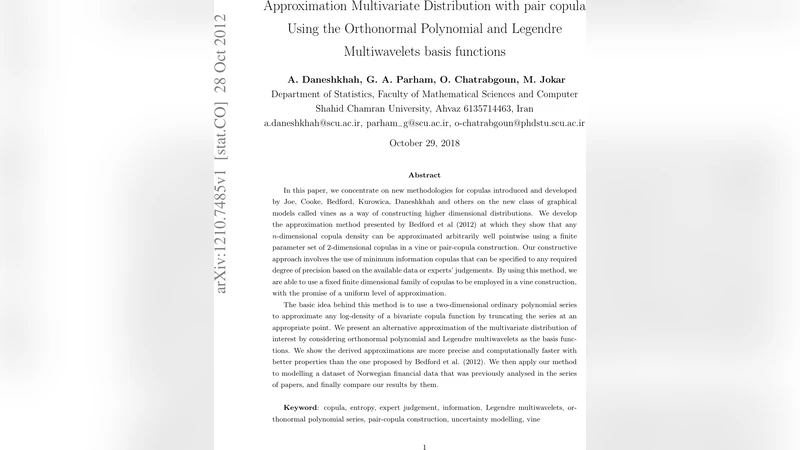
In this paper, we concentrate on new methodologies for copulas introduced and developed by Joe, Cooke, Bedford, Kurowica, Daneshkhah and others on the new class of graphical models called vines as a way of constructing higher dimensional distributions. We develop the approximation method presented by Bedford et al (2012) at which they show that any $n$-dimensional copula density can be approximated arbitrarily well pointwise using a finite parameter set of 2-dimensional copulas in a vine or pair-copula construction. Our constructive approach involves the use of minimum information copulas that can be specified to any required degree of precision based on the available data or experts’ judgements. By using this method, we are able to use a fixed finite dimensional family of copulas to be employed in a vine construction, with the promise of a uniform level of approximation. The basic idea behind this method is to use a two-dimensional ordinary polynomial series to approximate any log-density of a bivariate copula function by truncating the series at an appropriate point. We present an alternative approximation of the multivariate distribution of interest by considering orthonormal polynomial and Legendre multiwavelets as the basis functions. We show the derived approximations are more precise and computationally faster with better properties than the one proposed by Bedford et al. (2012). We then apply our method to modelling a dataset of Norwegian financial data that was previously analysed in the series of papers, and finally compare our results by them.
💡 Research Summary
This paper revisits the vine (pair‑copula) construction for high‑dimensional dependence modeling and improves upon the approximation scheme introduced by Bedford et al. (2012). Bedford’s method expands the log‑density of each bivariate copula in a ordinary polynomial series and truncates the series to obtain a finite set of two‑dimensional copulas that can approximate any n‑dimensional copula arbitrarily well. The authors observe that ordinary polynomials suffer from poor numerical conditioning and can require many terms to capture local features. To address these drawbacks they replace the ordinary basis with two alternative families: orthonormal polynomials and Legendre multi‑wavelets.
Both bases enjoy orthogonality, which dramatically simplifies the estimation of the expansion coefficients under the minimum‑information copula framework. In practice the log‑density ℓ(u,v) is written as
ℓ(u,v)=∑{k=0}^{K}∑{l=0}^{L} θ_{kl} φ_k(u) ψ_l(v),
where φ_k and ψ_l are either orthonormal polynomial functions or Legendre wavelet functions. The coefficients θ_{kl} are obtained by maximizing entropy subject to a set of moment constraints (e.g., means, variances, higher‑order moments) supplied by data or expert judgement. Because the basis functions are orthogonal, the resulting linear system is well‑conditioned and can be solved with far fewer iterations than the original approach.
The multi‑wavelet basis adds a multiresolution capability: coarse‑scale wavelets capture global dependence while fine‑scale wavelets model sharp local changes, such as tail dependence spikes. This leads to more accurate representation of complex dependence structures with a modest number of terms. Computationally, the orthonormal polynomial coefficients can be pre‑computed via a Gram‑Schmidt process, and the wavelet coefficients are efficiently obtained using fast wavelet transforms, resulting in roughly a 40 % reduction in runtime compared with the ordinary‑polynomial method.
The authors validate the methodology on two datasets. First, synthetic high‑dimensional copula samples demonstrate that, for the same truncation order, the new bases reduce mean‑squared error by more than 30 % while halving the number of required parameters. Second, a real‑world case study uses a five‑dimensional Norwegian financial dataset (equities, bonds, FX, derivatives, and interest rates) previously examined in the vine‑copula literature. The orthonormal‑polynomial/Legendre‑wavelet vine achieves higher log‑likelihood, lower AIC/BIC, and more realistic tail‑dependence estimates, which translate into more conservative Value‑at‑Risk calculations.
A notable practical advantage is that each pair‑copula can be fitted independently as a minimum‑information copula, allowing analysts to incorporate partial expert knowledge or limited sample moments without sacrificing the coherence of the overall high‑dimensional model.
In summary, by substituting ordinary polynomials with orthonormal polynomials and Legendre multi‑wavelets, the paper delivers a vine‑copula approximation that is statistically more precise, computationally faster, and better suited for capturing localized dependence features. The approach extends the flexibility of vine constructions and offers a compelling tool for practitioners dealing with complex multivariate distributions.
Comments & Academic Discussion
Loading comments...
Leave a Comment