Finite-time Blowup for the Inviscid Primitive Equations of Oceanic and Atmospheric Dynamics
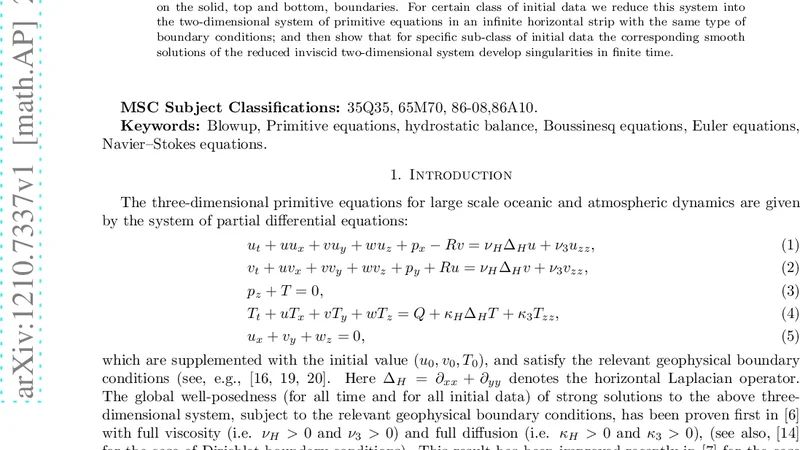
In an earlier work we have shown the global (for all initial data and all time) well-posedness of strong solutions to the three-dimensional viscous primitive equations of large scale oceanic and atmospheric dynamics. In this paper we show that for certain class of initial data the corresponding smooth solutions of the inviscid (non-viscous) primitive equations blow up in finite time. Specifically, we consider the three-dimensional inviscid primitive equations in a three-dimensional infinite horizontal channel, subject to periodic boundary conditions in the horizontal directions, and with no-normal flow boundary conditions on the solid, top and bottom, boundaries. For certain class of initial data we reduce this system into the two-dimensional system of primitive equations in an infinite horizontal strip with the same type of boundary conditions; and then show that for specific sub-class of initial data the corresponding smooth solutions of the reduced inviscid two-dimensional system develop singularities in finite time.
💡 Research Summary
The paper investigates the finite‑time blow‑up phenomenon for the inviscid (non‑viscous) primitive equations that model large‑scale oceanic and atmospheric dynamics. While the authors’ earlier work established global well‑posedness for the three‑dimensional viscous primitive equations for arbitrary initial data, the present study shows that removing the viscosity term fundamentally alters the analytical behavior: for a specific class of smooth initial data, the corresponding smooth solutions of the inviscid system develop singularities in finite time.
Problem setting and geometry
The authors consider the three‑dimensional inviscid primitive equations in an infinite horizontal channel. The horizontal directions are taken to be periodic, reflecting the large‑scale, quasi‑periodic nature of atmospheric and oceanic flows, while the vertical direction is bounded by solid top and bottom boundaries with no‑normal‑flow (impermeable) conditions. The governing equations consist of the incompressible momentum equations without viscous diffusion, the hydrostatic balance in the vertical, and the continuity equation. Temperature, salinity, or other scalar tracers are omitted for clarity, focusing solely on the velocity field and pressure.
Dimensional reduction
Exploiting the periodicity and the impermeable vertical boundaries, the authors perform a vertical averaging that eliminates the vertical velocity component and reduces the three‑dimensional system to a two‑dimensional primitive‑equation model defined on an infinite horizontal strip (ℝ ×
Comments & Academic Discussion
Loading comments...
Leave a Comment