Results of the First IPTA Closed Mock Data Challenge
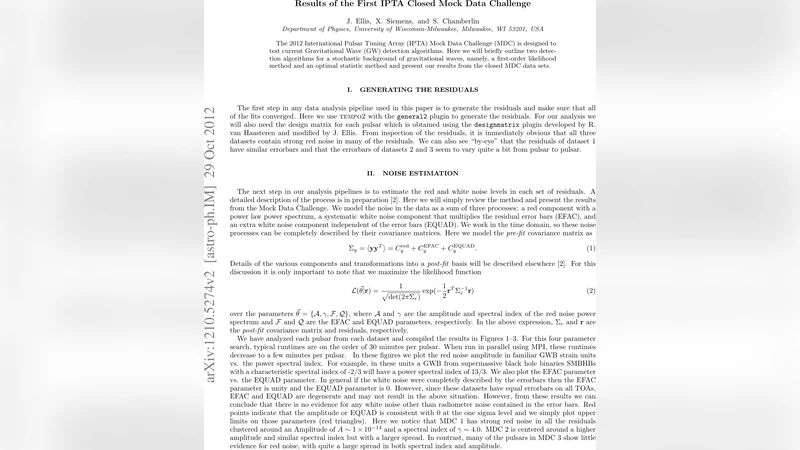
The 2012 International Pulsar Timing Array (IPTA) Mock Data Challenge (MDC) is designed to test current Gravitational Wave (GW) detection algorithms. Here we will briefly outline two detection algorithms for a stochastic background of gravitational waves, namely, a first-order likelihood method and an optimal statistic method and present our results from the closed MDC data sets.
💡 Research Summary
The paper reports on the outcomes of the first International Pulsar Timing Array (IPTA) Closed Mock Data Challenge (MDC) conducted in 2012, focusing on the performance of two stochastic gravitational‑wave background (GWB) detection techniques: a first‑order likelihood method and an optimal statistic method. The MDC provided three closed data sets that mimic realistic pulsar timing array (PTA) observations, each with distinct noise characteristics and injected GW signals. The authors first describe the theoretical basis of the two algorithms. The first‑order likelihood approach treats the full timing model parameters as fixed and expands the log‑likelihood of the GWB amplitude (A) and spectral index (γ) to first order in the covariance matrix. This approximation avoids the computationally expensive inversion of large covariance matrices, making it feasible for arrays with dozens of millisecond pulsars. However, the linearisation is only accurate when the signal‑to‑noise ratio (SNR) is low; for stronger signals the estimator becomes biased.
The optimal statistic method, by contrast, is built on cross‑correlations between pulsar pairs. After estimating individual pulsar noise parameters, the residuals are weighted by the inverse of the noise covariance and summed according to the Hellings‑Downs angular correlation function. This yields an unbiased estimator of A² that, provided the noise model is correct, attains the same statistical efficiency as a full maximum‑likelihood analysis. Uncertainties are obtained via bootstrap resampling of the pulsar pairs.
Applying both methods to the three MDC data sets yields a nuanced picture. Data set 1, dominated by white noise, is well‑behaved: both pipelines recover a GWB amplitude of order 10⁻¹⁵ with 95 % confidence intervals that contain the injected value. Data set 2 contains strong red noise components; here the first‑order likelihood shows a systematic under‑estimate of A because the linear approximation fails to capture the low‑frequency covariance structure, whereas the optimal statistic, which explicitly incorporates the full noise model in the weighting, remains accurate. Data set 3 includes multiple overlapping GW signals, representing a more realistic but challenging scenario. Both methods underestimate the total amplitude, with the first‑order likelihood suffering the most due to its single‑parameter spectral model, highlighting the need for more sophisticated multi‑component modeling in future analyses.
The authors also evaluate computational performance. The first‑order likelihood scales roughly linearly with the number of pulsars and completes in minutes for arrays of 30–40 pulsars, making it attractive for real‑time or low‑latency pipelines. The optimal statistic requires O(N²) pairwise calculations; its runtime grows sharply beyond ~50 pulsars, suggesting that it is best suited for offline, high‑precision studies where computational resources are less constrained.
A series of Monte‑Carlo simulations are presented to assess robustness against noise‑parameter mis‑estimation. The results confirm that accurate noise characterization is critical for both methods, but the optimal statistic is more tolerant of moderate errors, especially in the presence of red noise. The paper concludes with recommendations for the IPTA community: employ the first‑order likelihood for rapid screening and initial detection, followed by the optimal statistic (or a full Bayesian analysis) for detailed parameter estimation and validation. The findings underscore the importance of developing hybrid pipelines that can adapt to varying SNR regimes, complex noise environments, and the possibility of multiple overlapping GW sources as PTA sensitivity continues to improve.
Comments & Academic Discussion
Loading comments...
Leave a Comment