Biextensions of Picard stacks and their homological interpretation
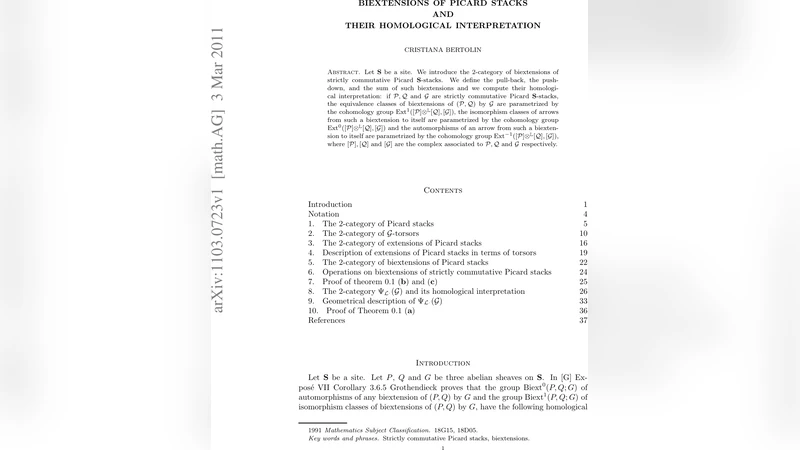
Let S be a site. We introduce the 2-category of biextensions of strictly commutative Picard S-stacks. We define the pull-back, the push-down, and the sum of such biextensions and we compute their homological interpretation: if P,Q and G are strictly commutative Picard S-stacks, the equivalence classes of biextensions of (P,Q) by G are parametrized by the cohomology group Ext^1([P] {\otimes} [Q] ,[G]), the isomorphism classes of arrows from such a biextension to itself are parametrized by the cohomology group Ext^0([P]{\otimes} [Q] ,[G]) and the automorphisms of an arrow from such a biextension to itself are parametrized by the cohomology group Ext^{-1}([P]{\otimes}[Q] ,[G]), where [P],[Q] and [G] are the complex associated to P,Q and G respectively.
💡 Research Summary
The paper develops a comprehensive theory of biextensions for strictly commutative Picard stacks over a site S and identifies their homological counterparts in the derived category of sheaves on S. After recalling the 2‑category structure of Picard stacks (objects are stacks, 1‑morphisms are additive functors, 2‑morphisms are natural transformations), the author introduces the notion of a G‑torsor and builds the 2‑category of G‑torsors. Using these tools, extensions of Picard stacks are described in terms of torsor data (a G‑P‑torsor together with a trivialization, a multiplication morphism, and coherence isomorphisms), generalising Grothendieck’s classical description for sheaves.
A biextension of a pair (P,Q) by a third Picard stack G is then defined as a G‑P×¹Q‑torsor B over the product P×Q equipped simultaneously with the structure of a Q‑P‑extension and a P‑Q‑extension, compatible in a precise sense. The collection of such biextensions, together with additive functors as 1‑arrows and morphisms of additive functors as 2‑arrows, forms a 2‑category Biext(P,Q;G). The paper defines natural operations on this 2‑category: a Baer‑type sum, pull‑back along a morphism of the base stacks, and push‑down (direct image) along a morphism of the coefficient stack. These operations endow the set of equivalence classes of biextensions with an abelian group structure.
The central result (Theorem 0.1) states that for strictly commutative Picard stacks P, Q, G, the following canonical isomorphisms hold:
- Biext¹(P,Q;G) ≅ Ext¹(
Comments & Academic Discussion
Loading comments...
Leave a Comment