Prediction of Ordered Random Effects in a Simple Small Area Model
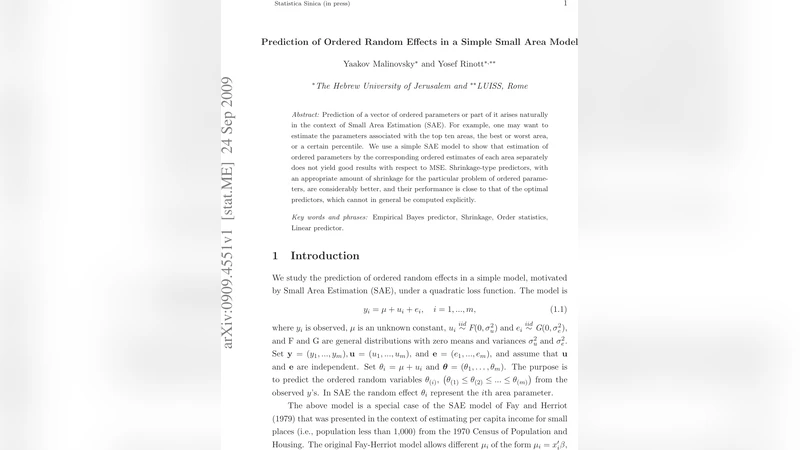
Prediction of a vector of ordered parameters or part of it arises naturally in the context of Small Area Estimation (SAE). For example, one may want to estimate the parameters associated with the top ten areas, the best or worst area, or a certain percentile. We use a simple SAE model to show that estimation of ordered parameters by the corresponding ordered estimates of each area separately does not yield good results with respect to MSE. Shrinkage-type predictors, with an appropriate amount of shrinkage for the particular problem of ordered parameters, are considerably better, and their performance is close to that of the optimal predictors, which cannot in general be computed explicitly.
💡 Research Summary
The paper addresses a problem that frequently arises in Small Area Estimation (SAE): the need to predict ordered random effects, such as the parameters of the top‑ranked areas, the worst‑performing area, or a specific percentile of the distribution of area‑specific effects. While the classical SAE framework focuses on estimating each area’s random effect (\theta_i) separately and then, if needed, sorting the point estimates, the authors demonstrate that this naïve approach is sub‑optimal in terms of mean‑squared error (MSE) for ordered quantities.
Model Setup
The authors work with the simplest linear mixed model often used in SAE, a special case of the Fay‑Herriot model:
( y_i = \mu + \theta_i + \epsilon_i,; i=1,\dots,m,)
where (\theta_i \sim N(0,\sigma^2_\theta)) are the area‑specific random effects, (\epsilon_i \sim N(0,\sigma^2_\epsilon)) are sampling errors, and all components are mutually independent. The target of inference is the ordered vector (\theta_{(1)}\le\cdots\le\theta_{(m)}) or a subset thereof.
Why Simple Sorting Fails
If one first computes an empirical Bayes (EB) estimate (\hat\theta_i) for each area and then orders these estimates, the resulting ordered estimator (\hat\theta_{(k)}) suffers from two sources of inefficiency. First, the distribution of an order statistic is inherently asymmetric, so the bias introduced by sorting does not cancel out as it does for the unordered case. Second, the optimal amount of shrinkage for a given area depends on its true rank; a single global shrinkage factor (\lambda) cannot simultaneously be optimal for the extremes and the middle of the distribution. The authors formalize this intuition by decomposing the MSE of (\hat\theta_{(k)}) into variance and squared bias components and showing that both components are inflated relative to the Bayes optimal predictor (\theta^*_{(k)} = \mathbb{E}
Comments & Academic Discussion
Loading comments...
Leave a Comment