Ram pressure stripping in elliptical galaxies: I. the impact of the interstellar medium turbulence
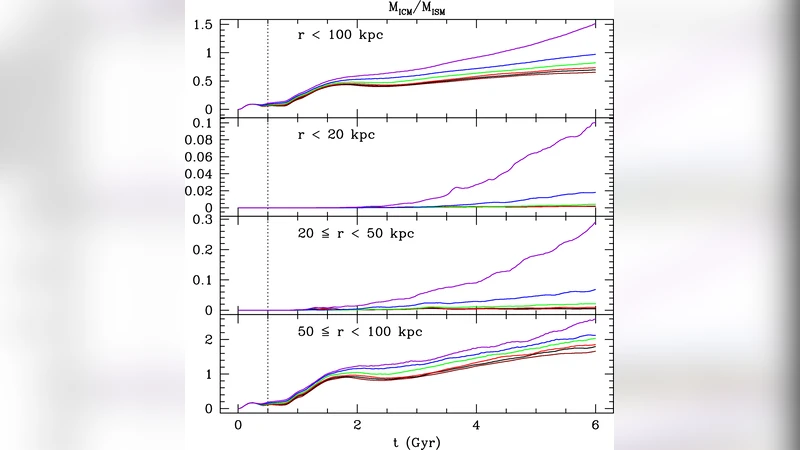
Elliptical galaxies contain X-ray emitting gas that is subject to continuous ram pressure stripping over timescales comparable to cluster ages. The gas in these galaxies is not in perfect hydrostatic equilibrium. Supernova feedback, stellar winds, or active galactic nuclei (AGN) feedback can significantly perturb the interstellar medium (ISM). Using hydrodynamical simulations, we investigate the effect of subsonic turbulence in the hot ISM on the ram pressure stripping process in early-type galaxies. We find that galaxies with more turbulent ISM produce longer, wider, and more smoothly distributed tails of the stripped ISM than those characterised by weaker ISM turbulence. Our main conclusion is that even very weak internal turbulence, at the level of <15% of the average ISM sound speed, can significantly accelerate the gas removal from galaxies via ram pressure stripping. The magnitude of this effect increases sharply with the strength of turbulence. As most of the gas stripping takes place near the boundary between the ISM and the intraclustermedium (ICM), the boost in the ISM stripping rate is due to the “random walk” of the ISM from the central regions of the galactic potential well to larger distances, where the ram pressure is able to permanently remove the gas from galaxies. The ICM can be temporarily trapped inside the galactic potential well due to the mixing of the turbulent ISM with the ICM. The galaxies with more turbulent ISM, yet still characterised by very weak turbulence, can hold larger amounts of the ICM. [Abridged]
💡 Research Summary
This paper investigates how sub‑sonic turbulence within the hot interstellar medium (ISM) of elliptical galaxies influences ram‑pressure stripping (RPS) when these galaxies move through the intracluster medium (ICM). Using three‑dimensional hydrodynamical simulations based on the FLASH code, the authors model a realistic elliptical galaxy potential and embed a hot, X‑ray‑emitting ISM that is initially perturbed with turbulent velocity fields of varying strength. The turbulence levels are expressed as a fraction of the average ISM sound speed, ranging from 0 % (no turbulence) to 15 %, which corresponds to sub‑sonic motions typical of feedback from supernovae, stellar winds, or low‑level AGN activity.
The simulations place the galaxy in a uniform ICM flow with a relative velocity of roughly 1000 km s⁻¹ and an ICM density appropriate for the core of a massive galaxy cluster. Each run is evolved for about 2 Gyr, allowing the stripping process to reach a quasi‑steady state. The main diagnostics include the total mass of ISM removed, the morphology of the stripped tail, the mixing fraction of ICM gas that becomes temporarily bound to the galaxy, and the redistribution of temperature and metallicity.
Key findings are:
-
Turbulence‑driven acceleration of stripping – Even weak turbulence (≈5 % of the sound speed) increases the ISM removal rate modestly, but the effect grows sharply with turbulence strength. At 10 % of the sound speed the stripping rate is roughly doubled, and at 15 % it can be three to four times higher than in the laminar case. The underlying mechanism is a “random walk” of ISM parcels: turbulent eddies transport gas from the deep potential well to larger radii where the external ram pressure exceeds the local gravitational restoring force, making the gas permanently unbound.
-
Tail morphology – Stronger turbulence produces longer, wider, and smoother tails. In low‑turbulence runs the tail consists of fragmented clumps and shows a jagged, irregular outline. With higher turbulence the tail becomes a continuous sheath that extends many tens of kiloparsecs downstream, reflecting enhanced mixing and reduced shear‑driven instabilities at the ISM–ICM interface.
-
ICM trapping and mixing – Turbulent motions at the boundary layer generate vortical structures that can temporarily capture ICM gas inside the galaxy’s potential well. This trapped ICM contributes to an increase in the total gas mass bound to the galaxy despite ongoing stripping. The mixing layer also facilitates the exchange of heat and metals, leading to a broader temperature distribution and a dilution of ISM metallicity in the downstream tail.
-
Observational implications – The results provide a natural explanation for several X‑ray observations of cluster ellipticals that show extended, low‑surface‑brightness tails and central temperature/metallicity enhancements. The presence of even modest internal turbulence can reconcile the discrepancy between the long stripping timescales predicted by static models and the relatively rapid gas depletion inferred from observations. Moreover, the morphology and surface‑brightness profile of the stripped tail become potential diagnostics of the underlying ISM turbulence level.
-
Broader significance – The study demonstrates that internal turbulence, often overlooked in analytic RPS models, is a critical factor governing gas loss in cluster galaxies. It suggests that feedback processes that sustain sub‑sonic turbulence (e.g., low‑luminosity AGN, stellar mass loss) can indirectly accelerate environmental quenching. Future work should explore a wider range of turbulence spectra, include magnetic fields, and couple the turbulence to realistic AGN jet feedback to assess the combined impact on galaxy evolution in dense environments.
In summary, the paper provides compelling numerical evidence that sub‑sonic turbulence, even at amplitudes below 15 % of the sound speed, markedly enhances ram‑pressure stripping of hot gas from elliptical galaxies. This effect operates by transporting gas outward within the galaxy, widening and smoothing the stripped tail, and allowing temporary ICM capture, all of which have observable consequences for the X‑ray appearance of cluster galaxies.