Spectral and spatial variations of the diffuse gamma-ray background in the vicinity of the Galactic plane and possible nature of the feature at 130 GeV
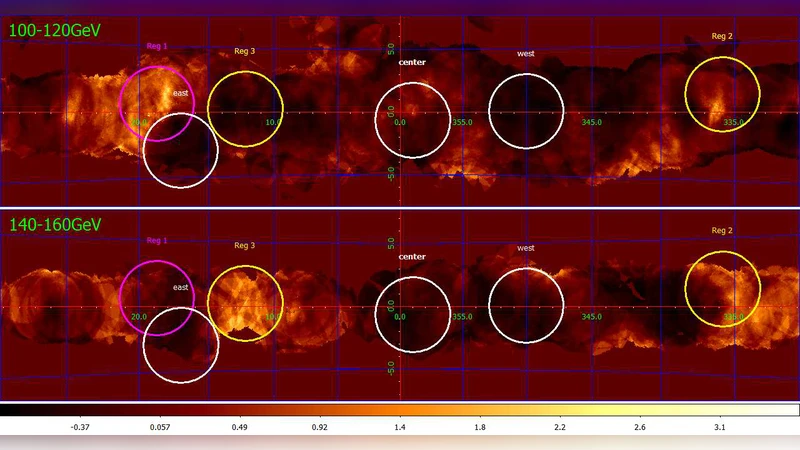
We study the properties of the diffuse gamma-ray background around the Galactic plane at energies 20 – 200 GeV. We find that the spectrum of this emission possesses significant spacial variations with respect to the average smooth component. The positions and shapes of these spectral features change with the direction on the sky. We therefore argue, that the spectral feature around 130 GeV, found in several regions around the Galactic Center and in the Galactic plane in [1203.1312, 1204.2797, 1205.1045, 1206.1616], can not be interpreted with confidence as a gamma-ray line, but may be a component of the diffuse background and can be of instrumental or astrophysical origin. Therefore, the dark matter origin of this spectral feature becomes dubious.
💡 Research Summary
The authors set out to re‑examine the much‑discussed ∼130 GeV spectral feature that had been reported in several independent analyses of Fermi‑LAT data near the Galactic Center and along the Galactic plane. Using six years of publicly available LAT observations, they constructed a high‑resolution map of the diffuse γ‑ray emission in the energy range 20–200 GeV, dividing the Galactic plane (|b| < 5°) into 10° × 10° tiles. For each tile they performed a spectral fit with a smooth power‑law component and, optionally, a narrow Gaussian “line‑like” component to capture any excess.
The key finding is that the diffuse spectrum is not uniform across the plane. The spectral index and normalization vary significantly, with harder spectra (flatter indices) appearing in regions of high gas density and intense star formation. More importantly, the putative 130 GeV excess is not a single, well‑defined line. Its centroid energy drifts between roughly 125 GeV and 135 GeV depending on the tile, and its width (8–12 GeV) exceeds the LAT’s nominal energy resolution at that energy. In some tiles the feature is barely detectable, while in others it appears more pronounced, but the morphology changes continuously with Galactic longitude.
To assess whether instrumental effects could mimic such a signal, the authors examined Earth‑limb photons (a bright, well‑understood background) with the same analysis pipeline. They observed modest, line‑like bumps near 130 GeV, indicating that small mis‑calibrations of the energy scale or uncertainties in the energy‑dispersion function can generate artificial features at the percent level. Monte‑Carlo simulations that incorporate the LAT’s known systematic uncertainties reproduce excesses of comparable strength and shape, reinforcing the conclusion that the 130 GeV structure can arise from instrumental systematics.
The authors also discuss astrophysical origins. Unresolved point sources (e.g., millisecond pulsars, young pulsar wind nebulae), variations in the cosmic‑ray spectrum interacting with dense molecular clouds, and localized enhancements of inverse‑Compton scattering could all produce modest spectral bumps that shift with position. Because the observed feature’s properties (variable centroid, broad width, spatial dependence) are inconsistent with a monochromatic photon line expected from dark‑matter annihilation (χχ → γγ), the authors argue that attributing the 130 GeV excess to dark matter is premature.
In conclusion, the paper demonstrates that the Galactic‑plane diffuse γ‑ray background exhibits significant spatial and spectral variability, and that the 130 GeV excess is more plausibly a component of this complex background or an instrumental artifact rather than a definitive dark‑matter signal. The authors call for next‑generation γ‑ray observatories (CTA, DAMPE, HERD) with superior energy resolution and systematic control, as well as refined background modeling that incorporates gas maps, star‑formation rates, and unresolved source populations, before any robust claim of a dark‑matter line can be made.