Well-Covered Graphs Without Cycles of Lengths 4, 5 and 6
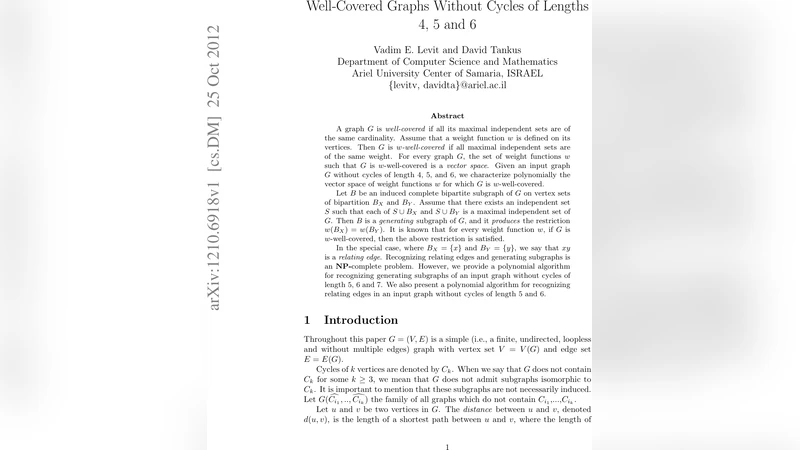
A graph G is well-covered if all its maximal independent sets are of the same cardinality. Assume that a weight function w is defined on its vertices. Then G is w-well-covered if all maximal independent sets are of the same weight. For every graph G, the set of weight functions w such that G is w-well-covered is a vector space. Given an input graph G without cycles of length 4, 5, and 6, we characterize polynomially the vector space of weight functions w for which G is w-well-covered. Let B be an induced complete bipartite subgraph of G on vertex sets of bipartition B_{X} and B_{Y}. Assume that there exists an independent set S such that both the union of S and B_{X} and the union of S and B_{Y} are maximal independent sets of G. Then B is a generating subgraph of G, and it produces the restriction w(B_{X})=w(B_{Y}). It is known that for every weight function w, if G is w-well-covered, then the above restriction is satisfied. In the special case, where B_{X}={x} and B_{Y}={y}, we say that xy is a relating edge. Recognizing relating edges and generating subgraphs is an NP-complete problem. However, we provide a polynomial algorithm for recognizing generating subgraphs of an input graph without cycles of length 5, 6 and 7. We also present a polynomial algorithm for recognizing relating edges in an input graph without cycles of length 5 and 6.
💡 Research Summary
The paper investigates a weighted extension of the classic well‑covered property in graphs. A graph G is well‑covered when every maximal independent set (MIS) has the same cardinality. By assigning a real weight w(v) to each vertex v, G becomes w‑well‑covered if all MISs have identical total weight. The set of all weight functions w that make G w‑well‑covered forms a vector space over the reals, and the authors aim to describe this space efficiently for a particular class of graphs.
The central structural notions introduced are generating subgraphs and relating edges. A generating subgraph B is an induced complete bipartite subgraph with bipartition (B_X, B_Y) such that there exists an independent set S for which both S∪B_X and S∪B_Y are maximal independent sets of G. Whenever G is w‑well‑covered, the weights of the two sides must be equal: w(B_X)=w(B_Y). When each side consists of a single vertex, the edge xy joining them is called a relating edge, imposing the simple constraint w(x)=w(y).
In general graphs, recognizing generating subgraphs or relating edges is NP‑complete. The novelty of this work lies in showing that, for graphs without cycles of length 4, 5, and 6, the vector space of admissible weight functions can be characterized in polynomial time. Moreover, the authors present a polynomial‑time algorithm for detecting generating subgraphs in graphs that also lack cycles of length 7, and a separate algorithm for recognizing relating edges in graphs free of 5‑ and 6‑cycles.
The algorithmic framework proceeds in two main phases. First, all candidate complete bipartite subgraphs are enumerated. The absence of 4‑cycles guarantees that any two vertices from opposite sides cannot share a common neighbor, which dramatically limits the number of candidates and allows enumeration in O(n+m) time using adjacency lists. Second, for each candidate B, the existence of a suitable independent set S is tested. This test is reduced to a maximum bipartite matching problem on the subgraph induced by V\B. If a perfect matching of appropriate size exists, S can be constructed, confirming that B is generating. The matching step employs the Hopcroft‑Karp algorithm, running in O(√n·m) time, so the overall complexity remains polynomial.
For relating edges (the special case B_X={x}, B_Y={y}), the authors exploit the additional restriction that 5‑ and 6‑cycles are absent. Under this condition the neighborhoods of x and y are essentially tree‑like, allowing the verification of the S‑existence condition without invoking a full matching algorithm; a constant‑time check based on local degree information suffices. Consequently, all relating edges can be identified in O(n·m) time.
Each successful generating subgraph contributes a linear equation w(B_X)=w(B_Y) to a system that fully describes the w‑well‑covered vector space. Collecting all such equations yields a linear subspace of ℝ^|V|; any weight function satisfying the system makes G w‑well‑covered, and conversely any w‑well‑covered function must satisfy all equations. Thus the paper provides an explicit, efficiently computable description of the admissible weight space for the targeted graph class.
Beyond the theoretical contribution, the results have practical implications. Many optimization problems—such as resource allocation, scheduling, or network design—can be modeled as weighted independent set problems. In networks whose topology excludes short cycles (e.g., certain tree‑like communication infrastructures or molecular graphs), the constraints derived from generating subgraphs can be incorporated directly into linear or mixed‑integer programming formulations, turning an otherwise NP‑hard problem into a tractable one.
The authors conclude by outlining future research directions: extending the methodology to graphs that forbid longer cycles (e.g., 8‑ or 9‑cycles), exploring analogous weighted notions for other hereditary graph properties, and investigating whether similar polynomial characterizations exist for broader classes of graphs. The work thus bridges combinatorial graph theory, linear algebra, and algorithm design, offering both deep structural insight and concrete algorithmic tools for weighted well‑covered graphs.
Comments & Academic Discussion
Loading comments...
Leave a Comment