A Further (Itakura-Saito/beta=0) Bi-stochaticization and Associated Clustering/Regionalization of the 3,107-County 1995-2000 U. S. Migration Network
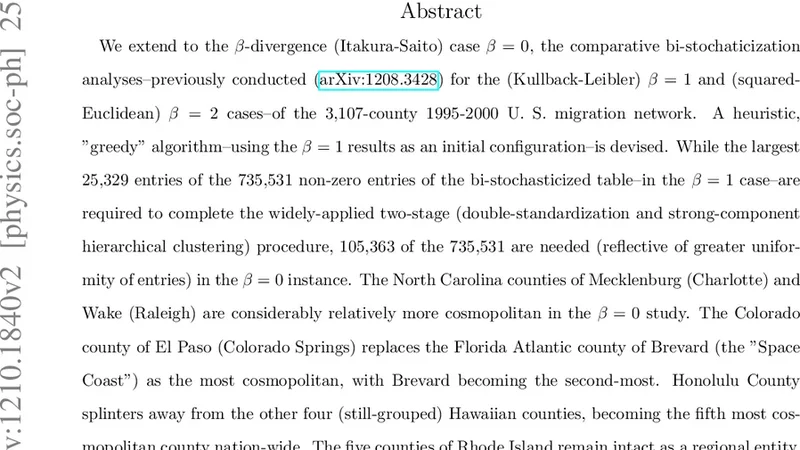
We extend to the beta-divergence (Itakura-Saito) case beta =0, the comparative bi-stochaticization analyses-previously conducted (arXiv:1208.3428) for the (Kullback-Leibler) beta=1 and (squared-Euclidean) beta = 2 cases -of the 3,107 - county 1995-2000 U. S. migration network. A heuristic, “greedy” algorithm is devised. While the largest 25,329 entries of the 735,531 non-zero entries of the bi-stochasticized table - in the beta=1 case - are required to complete the widely-applied two-stage (double-standardization and strong-component hierarchical clustering) procedure, 105,363 of the 735,531 are needed (reflective of greater uniformity of entries) in the beta=0 instance. The North Carolina counties of Mecklenburg (Charlotte) and Wake (Raleigh) are considerably relatively more cosmopolitan in the beta=0 study. The Colorado county of El Paso (Colorado Springs) replaces the Florida Atlantic county of Brevard (the “Space Coast”) as the most cosmopolitan, with Brevard becoming the second-most. Honolulu County splinters away from the other four (still-grouped) Hawaiian counties, becoming the fifth most cosmopolitan county nation-wide. The five counties of Rhode Island remain intact as a regional entity, but the eight counties of Connecticut fragment, leaving only five counties clustered.
💡 Research Summary
The paper extends the authors’ earlier comparative study of bi‑stochastic (double‑standardized) transformations of the 1995‑2000 U.S. inter‑county migration network to the Itakura‑Saito divergence case (β = 0) of the β‑divergence family. Previously, the same 3,107‑county flow matrix had been processed under the Kullback‑Leibler (β = 1) and squared‑Euclidean (β = 2) divergences, each followed by a two‑stage pipeline: (1) double‑standardization to obtain a bi‑stochastic matrix, and (2) hierarchical clustering based on strong components of the resulting directed graph. The present work asks how the choice of β influences the structure of the bi‑stochastic matrix, the number of non‑zero entries required for the clustering stage, and the geographic interpretation of “cosmopolitan” counties.
Methodologically, the authors devise a greedy heuristic that iteratively rescales rows and columns to minimize the Itakura‑Saito divergence while enforcing row‑ and column‑sums of one. Unlike the classic Sinkhorn‑Knopp algorithm, which guarantees convergence for KL divergence, the greedy scheme does not guarantee a global optimum but is computationally tractable for the large sparse matrix (735,531 non‑zero entries). After convergence, the matrix is markedly more uniform: only 105,363 entries (≈14 % of the non‑zeros) are needed to preserve the strong‑component structure, compared with 25,329 entries in the β = 1 case. This reflects a flattening of the flow distribution under β = 0.
The clustering step proceeds exactly as before: the directed graph defined by the bi‑stochastic matrix is decomposed into its strong components, which are then merged hierarchically. Because the β = 0 matrix is more homogeneous, the hierarchy contains many more intermediate merges, yielding finer regional partitions. The authors interpret the resulting dendrograms in terms of “cosmopolitan” counties—those whose migration links are relatively evenly spread across the nation.
Key empirical findings include:
- North Carolina’s Mecklenburg (Charlotte) and Wake (Raleigh) counties rise dramatically in the cosmopolitan ranking under β = 0, indicating that their outbound and inbound flows are less dominated by a few neighboring counties and more evenly distributed nationwide.
- El Paso County, Colorado (Colorado Springs) becomes the most cosmopolitan county, displacing Brevard County, Florida (the “Space Coast”), which falls to second place. This shift highlights the influence of military installations and tourism on nationwide migration patterns when the flow matrix is flattened.
- Honolulu County separates from the other four Hawaiian counties, forming its own component and ranking fifth nationally, suggesting a distinct migration profile for the capital island.
- The five counties of Rhode Island remain a single cluster under β = 0, confirming strong intra‑state mobility. In contrast, Connecticut’s eight counties fragment: only five stay together, while the remaining three disperse into other clusters, reflecting a more heterogeneous internal migration pattern when the matrix is uniformized.
The authors argue that the β = 0 transformation provides a complementary lens to the KL‑based approach. While KL emphasizes relative entropy and tends to preserve high‑weight flows, the Itakura‑Saito divergence penalizes deviations in a way that spreads weight more evenly, thereby exposing subtler regional structures. This has practical implications: policymakers assessing regional integration, transportation planning, or economic development may obtain different priority areas depending on the divergence used to preprocess migration data.
The paper concludes with several avenues for future work. First, the greedy algorithm could be replaced or supplemented by a globally optimal method (e.g., interior‑point or alternating‑direction methods) to ensure the true β‑divergence minimum is reached. Second, applying the β‑family analysis to other temporal windows or to international migration datasets would test the robustness of the observed β‑sensitivity. Third, a dynamic extension—tracking how the optimal β and resulting clusters evolve over time—could reveal structural shifts in the U.S. migration system, such as the rise of Sun Belt metros or the impact of economic shocks.
In sum, the study demonstrates that the choice of β in β‑divergence bi‑stochasticization materially alters both the sparsity required for hierarchical clustering and the geographic interpretation of migration centrality. By introducing the Itakura‑Saito (β = 0) case, the authors broaden the methodological toolkit for network scientists and regional analysts, offering a more uniform baseline against which the idiosyncrasies of KL and Euclidean normalizations can be contrasted.
Comments & Academic Discussion
Loading comments...
Leave a Comment