The price of re-establishing perfect, almost perfect or public monitoring in games with arbitrary monitoring
This paper establishes a connection between the notion of observation (or monitoring) structure in game theory and the one of communication channels in Shannon theory. One of the objectives is to know under which conditions an arbitrary monitoring structure can be transformed into a more pertinent monitoring structure. To this end, a mediator is added to the game. The objective of the mediator is to choose a signalling scheme that allows the players to have perfect, almost perfect or public monitoring and all of this, at a minimum cost in terms of signalling. Graph coloring, source coding, and channel coding are exploited to deal with these issues. A wireless power control game is used to illustrate these notions but the applicability of the provided results and, more importantly, the framework of transforming monitoring structures go much beyond this example.
💡 Research Summary
The paper establishes a novel bridge between observation (monitoring) structures in dynamic games and communication channels in Shannon’s information theory. The authors consider a setting where a game is played repeatedly, each stage generating a strategic information source (typically the action profile). Players receive private signals through individual monitoring functions, which may be arbitrarily noisy or incomplete, and consequently the game may lack desirable equilibrium properties.
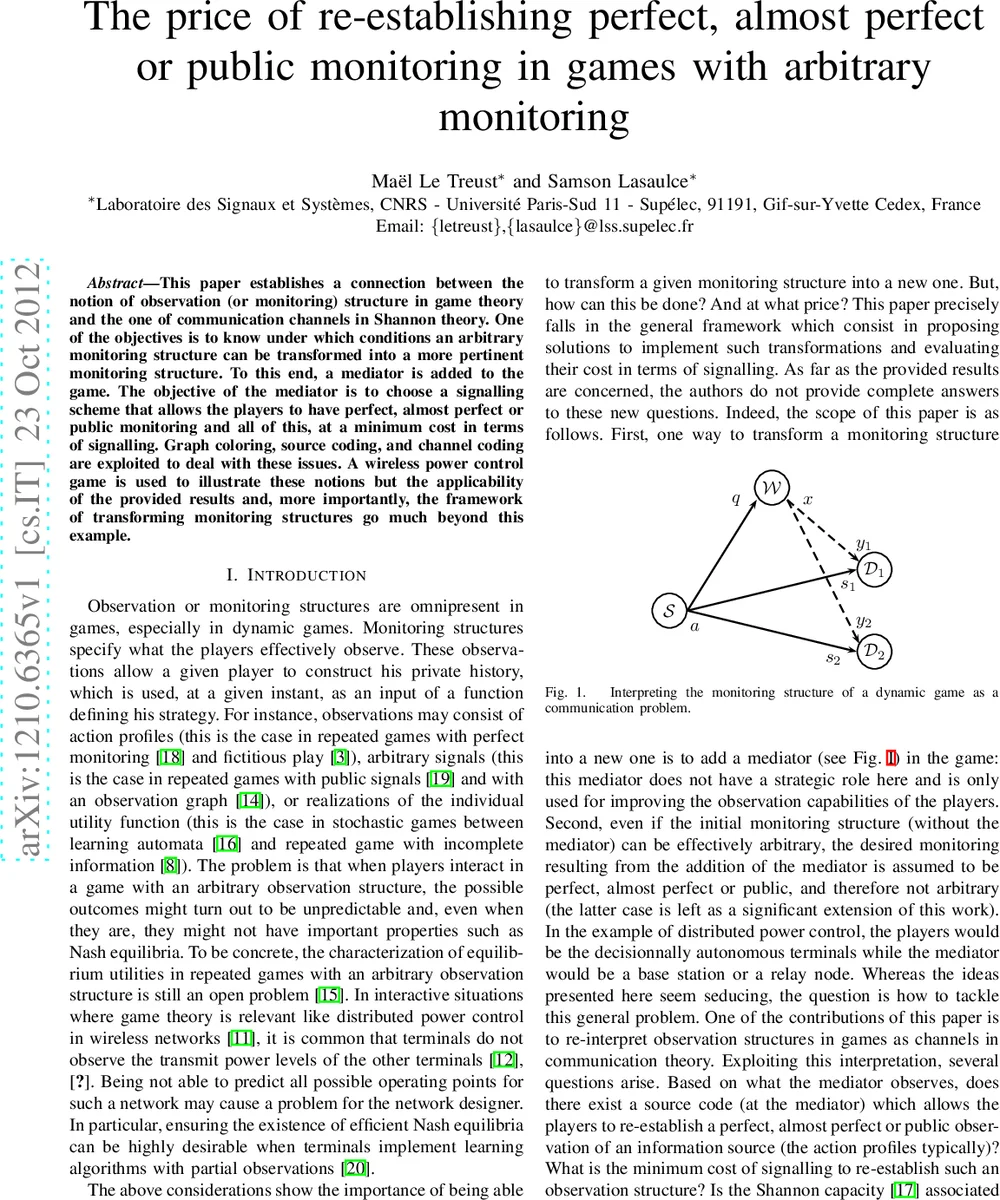
To overcome this limitation, the authors introduce a non‑strategic mediator that observes a noisy version of the source through an observation channel m and broadcasts an additional public signal to all players via a communication channel f. The central question is: under what conditions can the mediator’s signaling enable the players to reconstruct the source with perfect, almost‑perfect (ε‑perfect), or public monitoring, and what is the minimal signaling cost required?
The paper proceeds in several steps. First, it formalizes ε‑perfect monitoring as the existence of partitions of the signal space such that the probability of a signal belonging to the correct partition exceeds 1 − ε for every action. A max‑min expression is derived to compute ε exactly.
Second, the authors propose two sufficient conditions for achieving ε‑perfect monitoring. The (x, y)‑coloring condition links the private monitoring functions gᵢ and the mediator’s observation m through auxiliary graphs. For each player i, a graph Gᵢ is built whose vertices are actions and edges connect actions that are indistinguishable under gᵢ with high probability. If the partition induced by m acts as a proper coloring of Gᵢ and the auxiliary monitorings ˜gᵢ and ˜m are respectively x‑perfect and y‑perfect, then the mediator’s information is orthogonal to the private signals, guaranteeing that every action can be uniquely identified when the two sources of information are combined.
Third, the notion of “essential information rate” is introduced to capture how much of the mediator’s observation is actually needed by the players. By constructing a bi‑auxiliary graph eG that connects mediator signals q that are redundant with respect to the private signals, the authors extract a minimal information sequence r. The required transmission rate is the entropy of r, and the condition C(f) > H(r) (where C(f) is the Shannon capacity of the mediator‑to‑players channel) ensures that the public signal can be conveyed reliably.
With these two conditions satisfied, the paper demonstrates the existence of a coding scheme (n, h, φ, {ψᵢ}) consisting of:
- an encoder h that maps the raw observation q to the essential information r,
- a source‑channel encoder φ that maps blocks of r into channel inputs xⁿ, and
- decoders ψᵢ that combine each player’s private signal block sᵢⁿ with the received public block yᵢⁿ to reconstruct the original action sequence aⁿ.
Using standard Shannon source‑channel coding arguments, the authors show that for sufficiently large block length n the reconstruction error can be made arbitrarily small, thereby achieving ε‑perfect monitoring at a cost that approaches the theoretical minimum.
To illustrate the theory, the authors apply the framework to a wireless power control game. In this scenario, terminals (players) choose transmit powers, but they cannot directly observe each other’s powers, leading to inefficient or non‑existent Nash equilibria. A base station or relay acts as the mediator, observing noisy power measurements and broadcasting a compressed public signal. By satisfying the (x, y)‑coloring and essential‑information conditions, the system effectively recreates a perfect monitoring environment, enabling the existence of efficient Nash equilibria and improving overall network performance.
The paper concludes with a discussion of limitations and future directions. The current analysis assumes i.i.d. stationary sources and memoryless channels; extending the results to Markovian or non‑stationary sources, time‑varying channel capacities, multiple mediators, and privacy constraints are identified as promising research avenues. Moreover, the combination of graph‑coloring techniques with information‑theoretic coding opens new possibilities for designing observation structures in distributed learning, security‑enhanced games, and complex networked systems.
Overall, the work provides a rigorous, quantitative framework for transforming arbitrary monitoring structures into more informative ones, quantifying the signaling cost via channel capacity, and offering concrete coding constructions that bridge game theory and communication theory.
Comments & Academic Discussion
Loading comments...
Leave a Comment