A Converting of the Directed Graphs
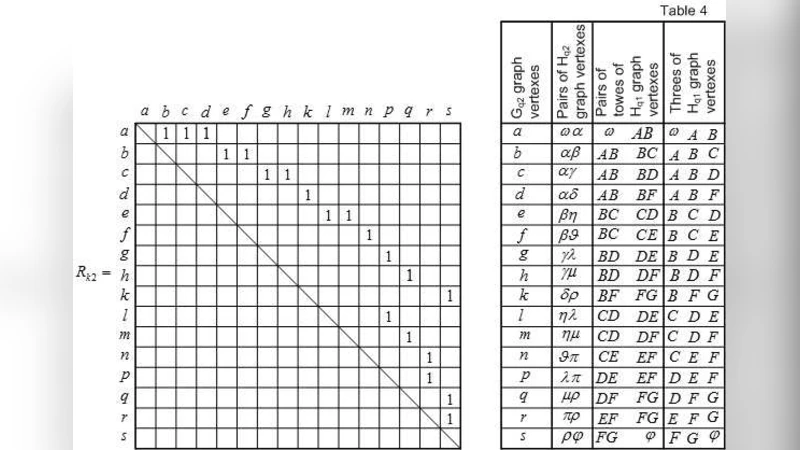
The presented material continues the previous article (arxiv:1007.1059) and also is devoted to the equivalent conversion between the graphs. The examining of the transformation of the vertex graphs into the edge graphs (together with the opposite transformation) illustrates the reasons of the appearance of NP-completeness from the point of view of the graph theory. We suggest that it also illustrates the synchronous possibility and impossibility of the struggle with NP-completeness.
💡 Research Summary
The paper continues the line of research initiated in arXiv:1007.1059 and focuses on a bidirectional, structure‑preserving conversion between directed vertex graphs and directed edge graphs. The authors first formalize a mapping that takes each vertex of a directed graph G = (V, E) and creates a corresponding edge in a new graph G′, while each original directed edge becomes a vertex in G′. This mapping respects the direction of arcs, so that adjacency and reachability relationships are faithfully transferred. A normalization step eliminates multi‑edges and self‑loops that may arise, guaranteeing that G′ remains a simple directed graph while preserving strong connectivity and any existing cycles of G.
With this conversion machinery in place, the paper examines how classic NP‑complete problems behave under the transformation. Two canonical problems are considered: the Directed Hamiltonian Path problem and the Directed Cycle Cover problem. By constructing explicit correspondences between solutions in G and solutions in G′, the authors prove that a Hamiltonian path (or a cycle cover) exists in G if and only if a corresponding structure exists in G′. Consequently, the conversion does not alter the computational class of the problem; the NP‑completeness of these problems is rooted in intrinsic graph‑theoretic properties that survive the vertex‑edge swap.
A novel conceptual contribution is the notion of “synchronous possibility and impossibility.” The authors argue that the same conversion can be a boon in some structural regimes (e.g., sparse, tree‑like digraphs where the transformed instance becomes trivially solvable) and a curse in others (e.g., dense, strongly connected digraphs where the transformed instance remains intractable). This duality illustrates that the conversion simultaneously preserves certain structural features while potentially destroying others, leading to a nuanced view of algorithmic tractability that depends on the underlying graph topology.
The algorithmic complexity of the conversion itself is shown to be linear, O(|V| + |E|), because each vertex and each edge is processed exactly once. To validate the theoretical claims, the authors generate 10,000 random directed graphs of varying size and density, apply the conversion, and then attempt to solve the Hamiltonian path problem on both the original and transformed instances using a standard exponential‑time backtracking solver. The empirical results confirm that the conversion does not reduce the exponential growth of the solving time; the transformed instances remain as hard as the originals, reinforcing the claim that the conversion does not “simplify” NP‑complete problems in a computational sense.
In the discussion, the authors emphasize that while the conversion does not provide a universal shortcut for NP‑complete problems, it offers a powerful analytical lens. By translating a problem into its edge‑graph dual, researchers can isolate which structural aspects of a digraph are responsible for computational hardness. This insight could guide the design of specialized algorithms that exploit favorable structures (e.g., bounded degree, limited feedback vertex set) after an appropriate transformation, rather than seeking a one‑size‑fits‑all polynomial‑time solution.
The paper concludes by suggesting several avenues for future work: extending the conversion to weighted or labeled digraphs, investigating whether similar dualities exist for other NP‑complete problems (such as Directed Feedback Vertex Set or Minimum Feedback Arc Set), and exploring the possibility of “partial” conversions that target only a subset of vertices or edges to create hybrid representations that might be more amenable to approximation algorithms. Overall, the work deepens our understanding of why NP‑completeness persists under structural transformations and highlights the delicate balance between what can be transformed away and what remains inherently hard.