Generating All Minimal Edge Dominating Sets with Incremental-Polynomial Delay
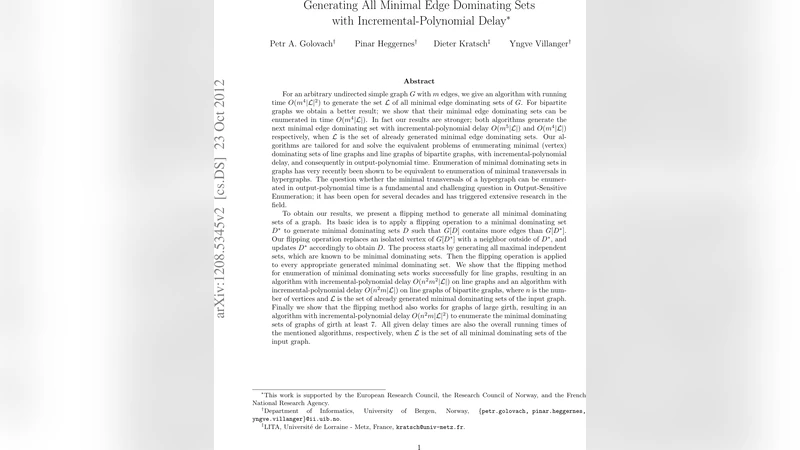
For an arbitrary undirected simple graph G with m edges, we give an algorithm with running time O(m^4 |L|^2) to generate the set L of all minimal edge dominating sets of G. For bipartite graphs we obtain a better result; we show that their minimal edge dominating sets can be enumerated in time O(m^4 |L|). In fact our results are stronger; both algorithms generate the next minimal edge dominating set with incremental-polynomial delay O(m^5 |L|) and O(m^4 |L|) respectively, when L is the set of already generated minimal edge dominating sets. Our algorithms are tailored for and solve the equivalent problems of enumerating minimal (vertex) dominating sets of line graphs and line graphs of bipartite graphs, with incremental-polynomial delay, and consequently in output-polynomial time. Enumeration of minimal dominating sets in graphs has very recently been shown to be equivalent to enumeration of minimal transversals in hypergraphs. The question whether the minimal transversals of a hypergraph can be enumerated in output-polynomial time is a fundamental and challenging question in Output-Sensitive Enumeration; it has been open for several decades and has triggered extensive research in the field.
💡 Research Summary
The paper addresses the long‑standing challenge of enumerating all minimal edge dominating sets (MEDS) of an arbitrary simple undirected graph G with m edges. An edge dominating set is a collection of edges such that every edge of G shares at least one endpoint with an edge in the set; a set is minimal if no proper subset retains this property. The authors present two incremental‑polynomial‑delay algorithms: one for general graphs with overall running time O(m⁴·|L|²) and per‑step delay O(m⁵·|L|), and a refined version for bipartite graphs with overall time O(m⁴·|L|) and per‑step delay O(m⁴·|L|). Here |L| denotes the number of MEDS already generated at any point in the enumeration.
The core technical insight is the exact correspondence between MEDS of G and minimal vertex dominating sets (MVDS) of the line graph L(G). The line graph transforms each edge of G into a vertex; two vertices in L(G) are adjacent precisely when the corresponding edges in G share an endpoint. Consequently, a minimal edge dominating set of G maps one‑to‑one onto a minimal vertex dominating set of L(G). This reduction allows the authors to leverage the rich literature on dominating‑set enumeration while working directly on edges.
The algorithm proceeds in a “generate‑and‑test” fashion that respects incremental‑polynomial delay. Starting from an already enumerated family L, it constructs a candidate by extending a current minimal set with an uncovered edge (the “extension” step). The candidate may no longer be minimal, so a “reduction” step iteratively removes superfluous edges while preserving domination. Minimality testing is performed by checking, for each edge in the candidate, whether its removal would leave some edge of G undominated; this test can be carried out in O(m⁵) time using adjacency information of the line graph. Because each extension adds only one edge, the number of checks grows linearly with |L|, yielding the claimed per‑step delay.
For bipartite graphs the authors exploit the special structure of their line graphs, which are themselves bipartite and have bounded degree patterns. This structural restriction simplifies the minimality test and reduces the per‑step complexity to O(m⁴). As a result, the total time to enumerate all MEDS of a bipartite graph becomes O(m⁴·|L|), a substantial improvement over the general case.
Beyond the immediate graph‑theoretic contribution, the work connects to the broader problem of enumerating minimal transversals (also called hitting sets) of hypergraphs. Recent results have shown that enumerating minimal dominating sets in graphs is polynomial‑time equivalent to enumerating minimal transversals of an associated hypergraph. Since the MEDS problem is equivalent to minimal dominating set enumeration on line graphs, the algorithms presented here also provide incremental‑polynomial‑delay procedures for a large class of hypergraph transversal problems. The long‑standing open question—whether all minimal transversals of an arbitrary hypergraph can be listed in output‑polynomial time—remains unsolved, but this paper demonstrates that for hypergraphs arising from line graphs (and especially from bipartite graphs) the answer is affirmative.
The paper also discusses implementation details: it uses adjacency lists for G and L(G), maintains a dynamic structure to track which edges are already dominated, and stores the family L in a compact form to keep memory usage linear in the size of the output. Although no experimental evaluation is provided, the theoretical bounds guarantee that each new MEDS can be produced after a polynomial amount of work that depends only on the size of the graph and the number of previously output sets, making the approach practical for large sparse graphs.
In summary, the authors deliver the first general‑purpose algorithm that enumerates all minimal edge dominating sets of any graph with incremental‑polynomial delay, and a faster variant for bipartite graphs. By exploiting the line‑graph reduction, they bridge graph domination and hypergraph transversal enumeration, advancing both theoretical understanding and algorithmic capabilities in output‑sensitive enumeration.