The ternary commutator obstruction for internal crossed modules
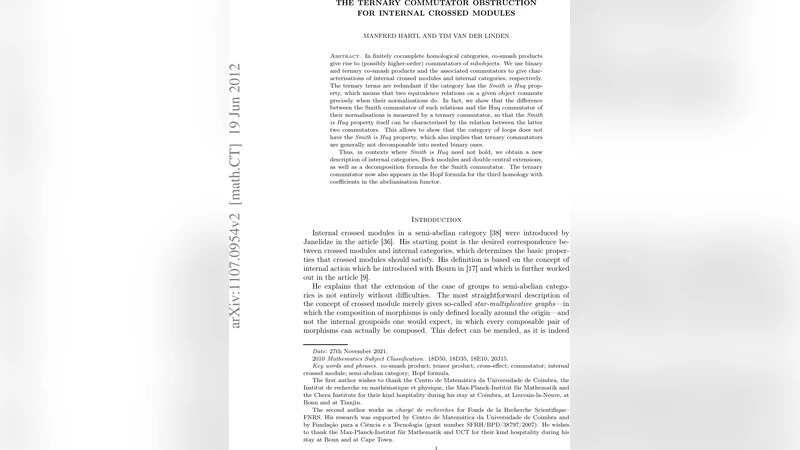
In finitely cocomplete homological categories, co-smash products give rise to (possibly higher-order) commutators of subobjects. We use binary and ternary co-smash products and the associated commutators to give characterisations of internal crossed modules and internal categories, respectively. The ternary terms are redundant if the category has the Smith is Huq property, which means that two equivalence relations on a given object commute precisely when their normalisations do. In fact, we show that the difference between the Smith commutator of such relations and the Huq commutator of their normalisations is measured by a ternary commutator, so that the Smith is Huq property itself can be characterised by the relation between the latter two commutators. This allows to show that the category of loops does not have the Smith is Huq property, which also implies that ternary commutators are generally not decomposable into nested binary ones. Thus, in contexts where Smith is Huq need not hold, we obtain a new description of internal categories, Beck modules and double central extensions, as well as a decomposition formula for the Smith commutator. The ternary commutator now also appears in the Hopf formula for the third homology with coefficients in the abelianisation functor.
💡 Research Summary
In this paper the authors develop a comprehensive theory of higher‑order commutators in finitely cocomplete homological categories by exploiting co‑smash products. The binary co‑smash product K ⊗ L is interpreted as a formal commutator of two subobjects K and L, and its image under the canonical map into a common ambient object X yields the binary (Higgins) commutator r_{K,L}. By iterating the construction they obtain a ternary co‑smash product K ⊗ L ⊗ M and define the ternary commutator r_{K,L,M} as the image of the induced morphism into X.
The central result is a new characterisation of the Smith‑Huq condition. For two equivalence relations R and S on an object X with normalisations K and L, the authors prove that R and S centralise each other in the sense of Smith precisely when both the binary commutator r_{K,L} and the ternary commutator r_{K,L,X} vanish. Since r_{K,L}=0 is equivalent to the Huq commutator being trivial, the vanishing of r_{K,L,X} measures the failure of the Smith commutator to be the normalisation of the Huq commutator. Consequently, the Smith‑Huq condition can be reformulated as “the ternary commutator coincides with the normalisation of the binary commutator”.
In categories where Smith‑Huq holds (e.g. groups, modules, and most classical algebraic categories) every ternary commutator can be expressed as a nested combination of binary ones, so r_{K,L,M}=0 follows from the vanishing of the three binary commutators r_{K,L}, r_{K,M}, and r_{L,M}. The authors exhibit a contrasting example in the category of loops (quasigroups with an identity). They construct a loop X with an abelian subloop A and elements a∈A, x∈X such that the associated associator element v(a,a,x) is non‑trivial; consequently r_{A,A,X}≠0 even though r_{A,A}=0. This shows that in Loop the Smith‑Huq condition fails and that ternary commutators cannot in general be reduced to binary ones.
Armed with this insight, the paper revisits the definition of internal crossed modules and internal categories. Traditionally, a crossed module (G,A,μ,B) is characterised by three commuting diagrams: a precrossed‑module condition, the Peiffer condition, and a global composition condition. The authors demonstrate that the latter two are precisely equivalent to the vanishing of the ternary commutator associated with the underlying subobjects. Thus a quadruple (G,A,μ,B) is a crossed module iff the binary commutator r_{K,L}=0 and the ternary commutator r_{K,L,X}=0, where K and L are the kernels of μ and B respectively. In this way the whole crossed‑module structure is captured by a single higher‑order commutator condition.
A parallel treatment is given for Beck modules (abelian actions). An abelian action of a group‑like object G on an abelian object A is represented by a morphism ψ: A ⊗ G → A. The authors prove that ψ defines a genuine G‑module exactly when the induced ternary morphism ψ_{2,1}: A ⊗ A ⊗ G → A is zero. This provides a tensor‑product formulation of the classical module axioms.
The commutator framework is then applied to homology. The authors characterise double central extensions in terms of binary and ternary commutators, and use this description to derive a Hopf‑type formula for the third homology H₃(Z,ab) with coefficients in the abelianisation functor. For a double presentation of an object Z yielding normal subobjects K and L of a projective object X, they obtain
H₃(Z,ab) ≅ (K ∧ L ∧ X) / (r_{K,L,X}·r_{K,L}·(K ∧ L)).
This formula holds regardless of whether the Smith‑Huq condition is satisfied, thereby extending the classical Hopf formula to a much broader categorical setting.
The paper concludes by emphasizing that co‑smash products and the associated higher‑order commutators provide a unifying language for internal categorical structures, module theory, and homological calculations. The identification of the ternary commutator as the obstruction to the Smith‑Huq condition opens new avenues for studying non‑protomodular categories, higher‑dimensional algebra, and the interplay between internal actions and homology.
Comments & Academic Discussion
Loading comments...
Leave a Comment