Astro2010 Decadal Survey Whitepaper: Coordinated Science in the Gravitational and Electromagnetic Skies
It is widely expected that the coming decade will witness the first direct detection of gravitational waves (GWs). The ground-based LIGO and Virgo GW observatories are being upgraded to advanced sensitivity, and are expected to observe a significant binary merger rate. The launch of The Laser Interferometer Space Antenna (LISA) would extend the GW window to low frequencies, opening new vistas on dynamical processes involving massive (M >~ 10^5 M_Sun) black holes. GW events are likely to be accompanied by electromagnetic (EM) counterparts and, since information carried electromagnetically is complementary to that carried gravitationally, a great deal can be learned about an event and its environment if it becomes possible to measure both forms of radiation in concert. Measurements of this kind will mark the dawn of trans-spectral astrophysics, bridging two distinct spectral bands of information. The aim of this whitepaper is to articulate future directions in both theory and observation that are likely to impact broad astrophysical inquiries of general interest. What will EM observations reflect on the nature and diversity of GW sources? Can GW sources be exploited as complementary probes of cosmology? What cross-facility coordination will expand the science returns of gravitational and electromagnetic observations?
💡 Research Summary
The white paper outlines a roadmap for the emerging field of multi‑messenger astronomy that combines gravitational‑wave (GW) observations with electromagnetic (EM) follow‑up across the entire sky. It begins by reviewing the status of the ground‑based interferometers LIGO and Virgo, which are entering an advanced‑sensitivity era expected to yield dozens to hundreds of binary black‑hole and neutron‑star mergers per year. The authors emphasize that these events provide precise measurements of masses, spins, and orbital dynamics directly from the GW waveform, opening a new window on strong‑field gravity, nuclear physics, and tests of general relativity.
A central thesis is that many GW sources will have EM counterparts—short gamma‑ray bursts, kilonovae, afterglow emission in X‑ray, optical, radio, and even high‑energy gamma‑rays. Detecting these counterparts supplies sky localization, redshift, and environmental diagnostics that are inaccessible to GW data alone. The combination enables the use of GW events as “standard sirens” for cosmology: by pairing the luminosity distance from the GW signal with the redshift from EM spectroscopy, one can construct an independent distance–redshift relation. This method promises to tighten constraints on the Hubble constant and the equation of state of dark energy, complementing traditional standard‑candle techniques.
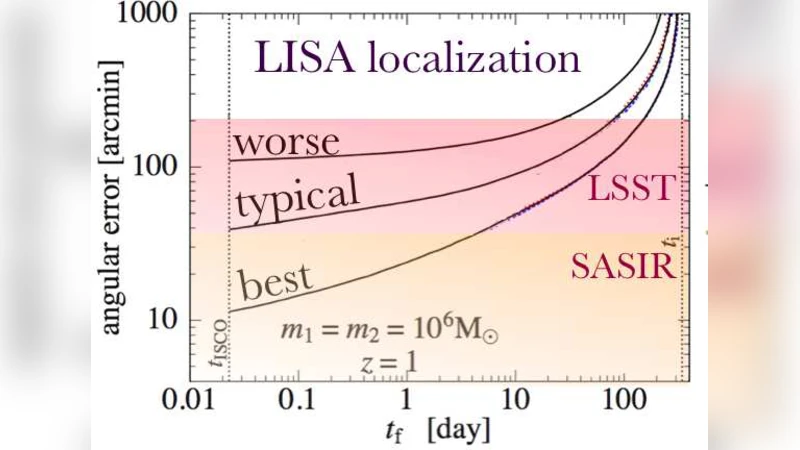
The paper then turns to the space‑based Laser Interferometer Space Antenna (LISA), which will probe low‑frequency GWs from massive black‑hole binaries (M ≳ 10⁵ M⊙), extreme‑mass‑ratio inspirals, and stochastic backgrounds. LISA’s sky‑localization accuracy, however, will be limited to tens of square degrees, making rapid, wide‑field EM surveys essential for identifying host galaxies and characterizing the surrounding gas, dust, and stellar populations. The authors argue that coordinated observations with facilities such as the Vera C. Rubin Observatory (optical), the Square Kilometre Array (radio), eROSITA (X‑ray), and Fermi (γ‑ray) are crucial to capture the full phenomenology of these massive‑black‑hole mergers and to test models of galaxy evolution and black‑hole growth.
To realize this vision, the white paper proposes a set of concrete actions:
- Real‑time alert infrastructure – GW detectors must broadcast low‑latency alerts (seconds to minutes) with probability sky maps that are automatically ingested by EM observatories.
- All‑sky, high‑cadence EM monitoring – Wide‑field surveys should operate continuously, providing rapid imaging and spectroscopy of candidate regions.
- Standardized data formats and shared repositories – A community‑wide protocol for metadata, localization maps, and follow‑up results will enable seamless cross‑facility analysis.
- Joint theory‑observation workshops – Regular meetings that bring together waveform modelers, EM emission theorists, and instrument teams will refine prediction pipelines and observation strategies.
- Machine‑learning pipelines for transient identification – Automated image‑difference and classification algorithms are needed to sift through millions of transient alerts and isolate true GW counterparts.
The authors stress that the scientific payoff extends beyond individual events. By building a statistically robust sample of GW–EM coincidences, researchers can map the demographics of compact‑object mergers, probe the physics of relativistic jets, measure the rate of r‑process nucleosynthesis, and test alternative theories of gravity. Moreover, the synergy between GW distances and EM redshifts will transform cosmology into a truly multi‑messenger discipline, reducing systematic uncertainties that currently limit precision measurements of the expansion history.
In summary, the paper argues that coordinated, cross‑facility science in the gravitational and electromagnetic skies will usher in “trans‑spectral astrophysics,” a new era where two fundamentally different carriers of information are combined to answer some of the most pressing questions in astrophysics and cosmology. Achieving this requires sustained investment in detector upgrades, rapid‑response networks, data‑sharing standards, and interdisciplinary training, but the potential rewards—ranging from a deeper understanding of black‑hole physics to a more accurate measurement of the universe’s expansion—are profound.